
Best Piano Hammer Voicing Tools for Precise Tone Adjustment
When selecting a piano hammer voicing tool, the goal is precise, controllable adjustments that improve tonal quality without risking the instrument. This guide highlights five reliable options and explains who each tool is best for, including practical considerations to help buyers compare features, handle comfort, and portability.
Summary of chosen products:
| Product | Key Benefit | Best For |
|---|---|---|
| TUOREN Piano Hammer Voicing Tool (Three Needles) | Three fixed needle positions with a stable screw design | Technicians needing quick, repeatable adjustments |
| Adjustable Piano Hammer Voicing Tool — Made in USA | Adjusts to three positions with set screws and holds up to 4 needles | Pro users requiring versatile needle options |
| Piano Voicing Tool, Rotatable Tuning Hammer with 3 Needles | Wooden handle and three needles for versatility | Instrument technicians focusing on comfort and precision |
| Piano Single Needle Voicing Tool — AMS Piano Tools | Single needle design for focused tonal tweaks | Detailed adjustments on specific hammer felts |
| TUOREN Piano Regulating Gauge Tool | Measures distance from string to hammer head for proper alignment | Regulation check and setup before voicing |
TUOREN Piano Hammer Voicing Tool with Three Position Needles
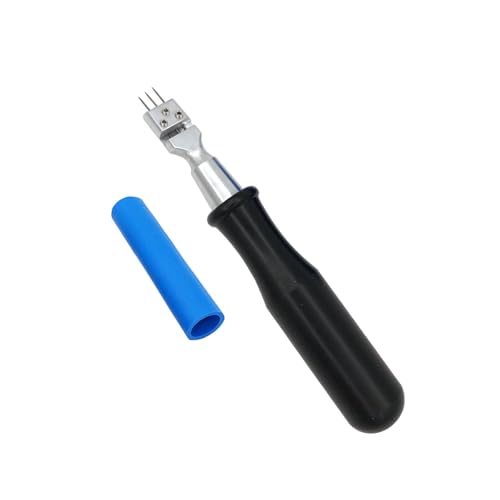
The TUOREN tool uses a fixing screw design to provide stability and allows adjustment in three different positions. This structure helps technicians set precise needle depth, improving control during tonal shaping. A plastic handle offers a safe, comfortable grip, and a rubber protective cover enhances portability and storage safety. Best for: professionals who need a reliable, multi-position voicing option for quick changes. Limitation: the fixed needle positions may limit highly custom tonal tweaks for certain pianos.
Adjustable Piano Hammer Voicing Tool — Made in USA

This tool is adjustable to three positions and can hold up to four needles with set screws securing them in place. The design emphasizes durability and precise needle alignment, which supports controlled adjustments for nuanced tonal changes. Best for: technicians who require flexible needle configurations and secure needle positioning. Caution: ensure screws are tightened adequately to prevent needle movement during voicing.
Piano Voicing Tool with Rotatable 3 Needles — Girftong

Girftong’s tool combines a wooden handle with three needles, delivering a comfortable grip for precise voicing. The three-needle setup offers versatility for adjusting different hammer felts or touch points. Best for: practitioners who value a smooth wooden handle and multiple needle options. Limitation: needle quality and length may influence the depth of adjustment in deeper hammer felts.
Piano Single Needle Voicing Tool — AMS Piano Tools

AMS Piano Tools offers a focused single-needle instrument, enabling precise, targeted adjustments on specific hammer felts. This simplicity supports technicians who want direct control over localized tonal changes without adjusting multiple needles. Best for: detailed repairs and fine-tuning where pinpoint accuracy is essential. Caution: single-needle use may require more time for broader tonal adjustments across multiple hammers.
TUOREN Regulating Gauge Tool for Grand Piano

This gauge measures the distance from the underside of the string to the top of the hammer head felt, helping to ensure correct alignment before voicing. The brass construction provides durability, and the tool remains lightweight for easy transport. Best for: technicians performing pre-voicing regulation and setup to prevent improper hammer strike. Limitation: it measures distance but does not perform the voicing itself; use in conjunction with a voicing tool for complete tuning.
Buying Guide: Key Purchase Considerations
- Needle configuration: Decide between single-needle precision versus multi-needle versatility. Three-needle tools offer broader coverage, while single-needle tools provide pinpoint accuracy.
- Handle comfort: Wooden handles tend to provide a steady grip and reduced fatigue, while plastic handles can be lighter and safer for long sessions.
- Stability and adjustment: Tools with fixed positions or set screws help maintain consistent needle depth, which is essential for repeatable results.
- Portability and storage: Rubber covers and compact dimensions help protect the instrument and ease transport between pianos.
- Measurement aids: Some tools include regulating gauges to assess hammer-to-string distance before voicing, which improves overall results when combined with voicing needles.
- Material quality: Brass or aluminum components offer durability; wooden handles improve grip comfort during extended sessions.
Frequently Asked Questions
- What is a piano hammer voicing tool used for? – It adjusts hammer felt density and tamping to shape tone and dynamics without replacing parts.
- How many needles should I choose? – Three-needle tools offer broader adjustment options; single-needle tools are best for precise, localized tweaks.
- Is a regulating gauge necessary? – A gauge helps ensure proper hammer alignment before voicing, improving results and consistency.
- Can I use a voicing tool on any piano? – Most are designed for standard upright and grand pianos, but verify compatibility with your specific instrument and scale length.
- What maintenance is required after use? – Clean needles to prevent rust, store with protective covers, and tighten set screws to maintain stability.
- Should I buy a kit or individual tools? – A kit with multiple needles and a gauge offers versatility for varying piano needs and future adjustments.