
A car plug inverter is useful when a modest electronic device needs an AC outlet and a suitable direct USB or vehicle adapter is unavailable. Choosing one starts with the vehicle’s outlet limit and the device’s actual input requirements. The large watt number on an inverter’s title is not the amount of AC power that every car socket can supply.
The existing five selections below are compact 12V plug inverters. Their different port arrangements can be useful, but none should be treated as permission to run a heater, kettle, or other demanding appliance from an ordinary accessory socket. These recommendations use documented model information and purchase checks; they do not claim measured efficiency, long term durability, or hands on testing.
Work out the usable power before choosing ports
Read the vehicle manual first
Find the limit for the exact socket you intend to use. A cabin outlet and a cargo area outlet may have different ratings or share a circuit. The manual may also restrict use with the engine off or identify which outlets remain energized. Do not infer the limit from the socket’s shape, from the inverter’s plug, or from another vehicle of the same brand.
For example, one Ford owner’s manual power point section specifies a 12V DC 180W limit. That is an example of an OEM restriction, not a universal figure for all cars. An inverter consumes some power in conversion, so a 180W DC allowance would not establish that 180W of AC output is available continuously.
The weakest applicable limit governs the setup. Consider the vehicle circuit, socket, inverter plug and cable, inverter’s continuous rating, and the connected loads together. A fuse is protection against certain faults or excessive current, not an operating target. Never replace a vehicle fuse with a higher rating to accommodate a load that its socket or wiring was not designed to supply.
Distinguish continuous output from a short peak
Continuous power is the relevant starting point for equipment that runs for an extended period. A peak or surge figure describes a different condition and may have a very short duration. Unless the manufacturer specifies a compatible surge and duration, do not assume a motor or compressor will start simply because its running watts are below an advertised peak number. A laptop charger also needs checking against its AC input label.
Add the intended simultaneous loads, including USB charging, before buying. The two AC receptacles on a compact inverter share its available output; they do not each provide the headline wattage. USB ports likewise draw from the vehicle’s same DC source even when their output specification is shown separately. An inverter with six sockets is still constrained by the supply circuit and the unit’s total limits.
Use a conservative example, rather than a promise
Suppose your equipment needs 60W of AC power. At an illustrative 85% conversion efficiency, providing that output would require about 71W at the DC side before any additional consumption. Dividing by an illustrative 12V gives approximately 5.9A. This arithmetic explains why input demand exceeds output demand; 85% is an example assumption, not a measured efficiency for these products. Real demand varies with load, voltage, and the unit.
Now add USB devices or another AC charger, and the DC requirement rises. Compare the result with the vehicle’s documented restrictions while leaving sensible margin. If the setup is close to a limit or depends on an undocumented surge, choose a different powering arrangement approved for the equipment. A simple plug adapter is attractive precisely when the load is modest and the compatibility checks are clear.
The five linked inverters, with their practical limits
PiSFAU 200W: useful port variety, subject to the shared input limit

The linked PiSFAU 200W model combines two AC outlets with four USB ports, including USB-A and USB-C connections in its current product description. Its appeal is convenience when several small devices need different connectors. That should be evaluated as a port layout advantage, rather than evidence that the vehicle can deliver 200W or that every USB-C port supports a laptop’s required charging protocol.
Check the current unit’s continuous AC rating, input range, combined port limits, and supported USB output profiles. Connector type alone does not establish USB Power Delivery, a particular fast charging standard, or the wattage available when other ports are occupied. Bring the exact device charger specification to that comparison. A phone cable fitting a socket does not answer whether the phone receives its preferred charging mode.
This is a reasonable candidate for mixed modest charging tasks when the vehicle socket and actual loads are verified. Do not base purchase on generalized claims that built in protection makes overload harmless. Keep the unit’s vents unobstructed, and avoid a placement where multiple connected leads will strain its plug or interfere with driving.
PiSFAU 150W: one AC outlet for a simpler charging plan

This PiSFAU variant is the 150W model with one AC receptacle and two USB ports. Its listing distinguishes 150W continuous output from a 300W peak. The single AC outlet can be a more straightforward choice if one suitable charger is the main reason you need an inverter. There is less temptation to mistake several receptacles for several independent power allowances.
Treat the 300W number as a peak claim, not continuous capacity and not an assurance of motor starting. The vehicle outlet may impose a lower usable limit than the unit’s own rating. Confirm the USB total allocation and the AC charger’s input requirements before assuming that all ports can be used together at their maximum advertised outputs.
Choose it for a defined small load, after comparing the total cost with a suitable direct DC or USB adapter. If your devices can already charge effectively from the vehicle’s approved USB supply, adding AC conversion may bring unnecessary bulk and losses. The compact format is useful only if its actual mounting and cable route remain secure during travel.
FOVAL 150W Classic Red: dual USB alongside a single AC outlet
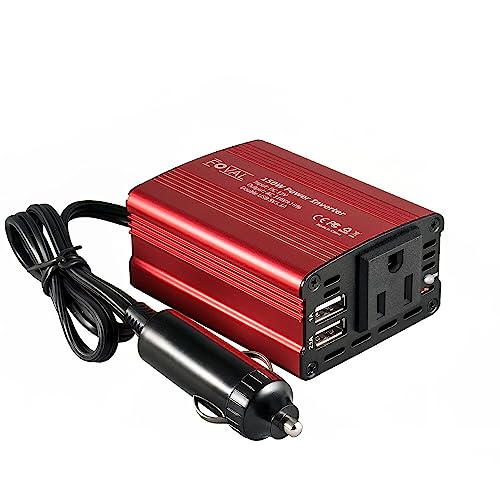
The Classic Red FOVAL is another 12V to 110V AC plug model with a stated 150W continuous output, one AC receptacle, and two USB connections. Its USB specification is up to 3.1A combined, rather than 3.1A guaranteed from each port simultaneously. That distinction matters if two passengers expect both devices to charge at the same rate as their individual wall chargers.
Its fit is a reader who needs one modest AC charger plus basic USB charging, with a vehicle supply that can support the total load. Compare the actual plug position and cable length with where the device will sit. A unit that fits in a bag or cupholder may still need ventilation and a stable location; dimensions do not establish that enclosing it is appropriate.
The advertised fuse and protection features do not raise the car socket’s limit or remove the need to stop using a hot or damaged connection. Check current operating instructions, intended AC waveform compatibility, and device manufacturer requirements. This recommendation is about an identified port arrangement and continuous rating, not a claim that it is the quietest or most reliable inverter available.
BESTEK 300W MRI3011BU: higher unit capacity does not upgrade a socket
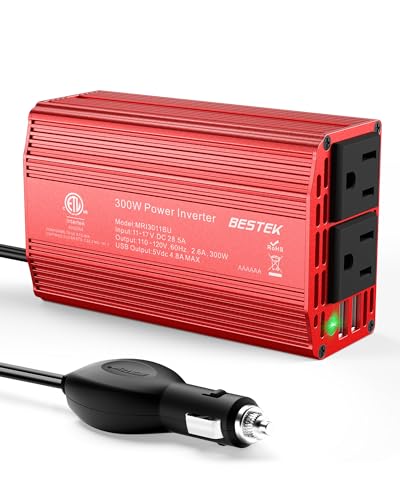
The BESTEK model offers two AC receptacles and two USB ports, with a stated 300W continuous AC rating. It is relevant when comparing a recognizable model with published manufacturer documentation, but the rating cannot be fully used through a vehicle socket whose DC allowance is lower. Never interpret its own internal fuse rating as the correct fuse for the car’s circuit.
There is also a revision issue to resolve before purchase. The BESTEK MRI3011BU manual describes an 11–15V input range and USB output totaling 4.8A, with up to 2.4A per port. The current linked listing advertises an upgraded 11–17V version. Confirm the delivered unit’s label and matching instructions; do not combine an older manual’s specifications with a newer unit or assume compatibility with every Tesla accessory outlet.
This is a shortlist option when its documented version and your vehicle supply match the planned load. A higher rated inverter can still be used for a modest task, but it does not justify adding a power strip full of chargers or choosing a demanding appliance. Verify the exact revision, total USB limits, and current warranty support instead of relying on a familiar brand name alone.
FOVAL 200W Gray: verify the contradictory output wording
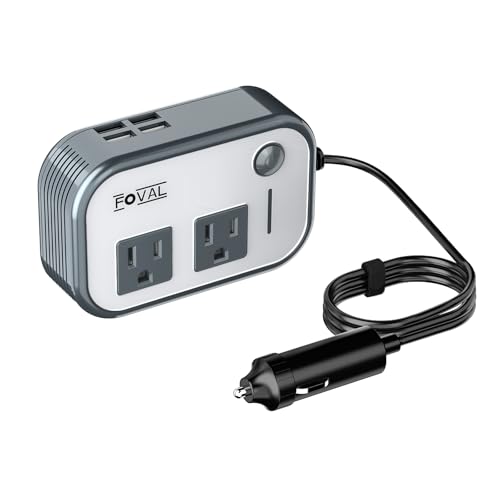
The Gray FOVAL SGR-NX2011SK-2 is the original linked model with two AC outlets and four USB ports. Its title says 200W, while the current description says that it provides power up to 180W. That discrepancy is material when selecting a continuous load. This guide therefore does not treat the title as proof of a 200W continuous rating.
Its port arrangement may suit several modest charging devices, but ask for the actual unit’s continuous specification and current manual before committing to a load near either number. If the seller cannot clarify the rating, do not buy it for a task that depends on that uncertainty. The listing specifies 12V use rather than 24V use, so it should not be carried into a truck system based only on the plug fitting.
Consider this variant for its verified identity and layout, with the unresolved wattage treated explicitly. Four USB ports do not guarantee four independent fast charging supplies. Confirm combined output, supported protocols, and the vehicle’s input capacity. This is a conditional recommendation, rather than hiding conflicting product information behind a favorable comparison table.
Match the appliance, not just its watt label
AC waveform and charger requirements
An appliance’s power requirement and its tolerance of the inverter’s AC waveform are separate questions. Some product listings use “modified sine” terminology; that should not be silently upgraded to pure sine output. If a device manufacturer requires pure sine power or gives restrictions on inverter operation, follow those instructions. A device appearing to turn on is not proof of suitable operation over an entire journey.
Check the AC charger’s input voltage and frequency range, its maximum draw, and any warning about vehicle inverters. The wattage printed for its output is not necessarily the total power it draws from the inverter. If you are comparing two charging methods, use the appropriate input specification for each. Avoid assuming that a 65W laptop output rating creates an identical 65W AC load in every operating condition.
Medical and other critical equipment require their own approved power arrangements. This guide does not establish suitability for such equipment, unattended overnight operation, or a guaranteed backup supply. Obtain the equipment manufacturer’s specific requirements and an appropriate verified solution. A general consumer inverter recommendation cannot substitute for that approval or assure continuity if a vehicle battery or outlet disconnects.
Prefer direct charging when it solves the actual problem
If the device supports a suitable direct vehicle or USB charger, compare that option before adding AC conversion. The relevant questions are connector compatibility, supported voltage profiles, available output, and device approval. An existing USB-C port in the car may be a low power port, while a compatible direct adapter may have different capabilities. Check both rather than assuming that all USB-C charging arrangements are equivalent.
An inverter remains helpful for an existing wall charger that has no convenient approved alternative. It also provides flexibility when a passenger brings different small electronics. That flexibility should remain within a documented load plan. If your needs regularly change toward appliances with motors, heating elements, or high current demand, reassess the supply system rather than continually stretching a plug inverter’s role.
Set up for a journey without creating a distraction
Choose a secure, ventilated position where the inverter will not be covered by clothing, luggage, or upholstery. Keep it away from liquids and hot surfaces, and route cables so they cannot enter pedal space, snag seat movement, or obstruct controls. Arrange and test the setup while parked. A passenger can monitor a charging device; the driver should not troubleshoot plugs or alarms while moving.
Check that the socket is clean and the plug seats correctly without forcing it. Do not use a damaged adapter, loose extension, or splitter to multiply a circuit’s apparent capacity. If the plug or socket becomes unusually hot, smells, sparks, or repeatedly loses contact, stop using the setup and have the fault addressed. Merely reducing the device’s screen brightness is not a reliable answer to an electrical connection problem.
Understand when the vehicle supplies the socket. Leaving a charger connected after shutdown can drain the starting battery on some vehicles, while others disconnect the outlet. An inverter’s low voltage cutoff is not a guarantee that enough battery capacity remains to start the engine. Avoid leaving the system unattended, and follow the vehicle’s instructions. Never run an engine in an enclosed space to maintain charging power.
Before a long trip, test the intended device and cables in the intended parked setup for normal operation, within the documented limits. Keep the original device adapter and inverter instructions accessible. If the system shuts down, disconnect the load and review the reason rather than repeatedly forcing restarts. Protection may be responding to overload, voltage, temperature, or another condition requiring correction.
Treat noise and temperature as installation questions
If a charger produces interference in the vehicle’s audio system, note whether the symptom appears only while the inverter is connected or under a particular load. Compare the setup with the inverter disconnected while parked, and consult the relevant equipment support. Do not present a buzzing charger, radio noise, or a stopped fan as something to cure by removing a ground connection or altering the inverter. Fault diagnosis should preserve the designed electrical protection.
Fan noise can also influence placement for passengers, especially during a quiet journey. The product descriptions do not provide comparable measured noise results, so this guide does not rank the models as silent. Check the current operating instructions and return policy if that matters to you. A warmer location, a heavier load, or restricted airflow can change operating conditions; hiding the unit under a seat cover to quiet it is not a sensible remedy. Keep monitoring and access practical without creating a driving distraction.
A purchase checklist that prevents most mismatches
- Identify the exact 12V outlet, its vehicle manual rating, and any shared circuit restrictions.
- Record the actual AC input requirements and USB charging needs of all simultaneous devices.
- Confirm continuous output separately from peak power, and resolve contradictory listing numbers.
- Match the delivered inverter revision, input range, waveform, and manual to the advertised model.
- Check combined USB allocation and supported charging protocols, not just port shapes.
- Plan a secure location, clear ventilation, cable access, and a sensible engine off usage policy.
For one modest AC charger, the PiSFAU 150W or FOVAL Classic Red offers a simpler port arrangement. For mixed charging connectors, examine the PiSFAU 200W’s actual USB profiles. The BESTEK deserves a revision check, and the Gray FOVAL needs its continuous rating clarified. The useful inverter is the one whose verified limits fit your vehicle and devices; buying the largest headline number does not answer that question.