
Best Pre Amp for Speakers: Clear Guide to Choose the Right Phono Preamp
Looking for the right pre amp for speakers? This guide compares five well-suited phono preamps and small audio preamps to help you choose the best match for your setup. It targets vinyl enthusiasts, home theater refinements, and budget-conscious listeners who want quieter operation and better sound from turntables, receivers, and active speakers. The following summary table highlights each option’s strengths and ideal user.
| Product | Best For | Why It Stands Out | Caution |
|---|---|---|---|
| Pyle Phono Turntable Preamp PP999 | Vinyl collectors with legacy receivers | Low-noise operation and simple phono-to-line conversion | Requires 12V DC power; place near source to minimize noise |
| Fosi Audio P4 Mini Preamp | Multi-device setups with easy source switching | Three RCA inputs, gain control, remote, and bass/treble controls | Remote control may add complexity for minimalists |
| Fosi Audio Box X2 Phono Preamp | MM turntables and tweak-friendly listening | Three gain modes and built-in grounding post for stability | May require compatible phono cartridge and receiver |
| cotsoco Phono Turntable Preamp | Compact vinyl setups needing clean conversion | Low-noise operation with RCA inputs/outputs and DC adapter | Nearby placement still recommended to minimize noise |
| Pyle Phono Turntable Preamp PP999 (second listing) | Budget-friendly option with straightforward use | Direct phono-to-line conversion and compatibility with speakers | Performance depends on proper grounding and cable quality |
Pyle Phono Turntable Preamp PP999
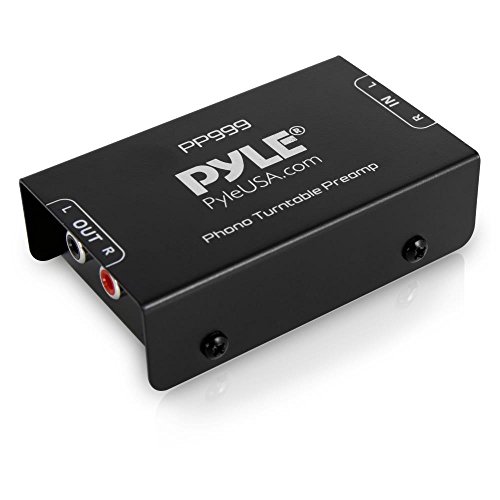
The PP999 converts phono signals into line-level output for standard speakers and receivers. It supports magnetic pickups with 3 mV input sensitivity at 50K ohms and delivers up to 2V peak-to-peak at 10K ohms. Best for turntable users who need a compact, low-noise preamp close to the source. Best for budget-conscious vinyl listeners and small-space setups. Caution: position near the source to minimize noise and interference from cables.
Fosi Audio P4 Mini Preamp

The P4 provides up to three RCA inputs, a motorized volume control, and bass/treble adjustments with a bypass option. It’s ideal for setups with multiple audio sources like CD players, DACs, and turntables with built-in phono preamps, plus a remote for easy operation. Best for users who want flexible source switching and convenient tonal control. Limitation: motorized control adds a minor mechanical complexity and potential drift over time.
Fosi Box X2 Phono Preamp

The Box X2 is a tube-friendly MM phono preamp with three gain modes (39, 42, 45 dB) and a grounding post to reduce hum. Its tube-inspired character aims for warm, smooth sound. Best for listeners seeking a gentler, vintage-like warmth in vinyl playback and flexible gain. Choose this if you value tonal coloration and can manage a small, stable setup. Caution: tube-style warmth may not suit very bright or analytical systems.
cotsoco Phono Turntable Preamp

The cotsoco preamp converts phono signals to line level with RCA inputs and outputs, and it includes a 12V DC adapter. It emphasizes low-noise operation and improved record playback fidelity. Best for vinyl enthusiasts who want a compact, quiet interface between turntables and modern receivers or speakers. Limitation: ensure your turntable does not include a built-in preamp, or the noise floor may rise.
Pyle Phono Turntable Preamp (Another Model)

This Pyle unit offers phono-to-line conversion with 3 mV sensitivity at 50K ohms and up to 2V peak-to-peak output. It’s positioned for budget-minded buyers who need reliable improvement over a turntable’s direct output. Best for basic vinyl listening and simple speaker setups. Caution: ensure proper grounding and shielding will minimize hum.
Buying Guide
What to consider when choosing a pre amp for speakers:
- Source compatibility: MM vs. MC cartridges require different gain and loading; many preamps support MM (moving magnet) formats.
- Gain settings: Look for multiple gain options to match your turntable and receiver input sensitivity.
- Noise floor: Low-noise op-amps and careful grounding reduce hum and hiss in vinyl playback.
- Inputs and outputs: Ensure the preamp has enough RCA inputs for your devices and proper outputs for your speakers or amplifiers.
- Physical size and placement: Compact units fit tight shelves; place preamp near the source to minimize interference.
- Controls: Analog vs. motorized controls, tone controls, and remote operation affect usability and setup time.
- Power requirements: Some models include a 12V DC adapter; verify compatibility with your power supply.
Comparison Snapshot
- Best for simplicity: Pyle PP999 and Pyle’s second model provide straightforward phono-to-line conversion with minimal setup.
- Best for multi-source needs: Fosi P4 offers multiple inputs, gain steps, and remote control for diverse systems.
- Best for warmth and tone: Fosi Box X2 introduces tube-like warmth with adjustable Gain modes.
- Best for space-conscious vinyl fans: cotsoco emphasizes compact design and solid noise performance.
FAQ
- Do I need a preamp if my receiver has a phono input?
No. If your receiver already includes a phono stage, you can connect the turntable directly to it. A separate preamp is useful when the receiver lacks a phono input or you want to improve signal quality. - What is MM vs MC in phono preamps?
MM stands for moving magnet and is common in consumer equipment; MC stands for moving coil and typically requires higher gain and proper loading. - Can a preamp be powered by a standard USB adapter?
Most dedicated preamps use a 9–12V DC or similar supply; check the product’s specified power requirements before using an alternate supply. - Is a remote control necessary for everyday use?
Not essential, but it can improve convenience when switching sources or adjusting volume from a seating area. - Will a preamp improve digital music playback?
No. Phono preamps are designed to optimize vinyl playback; digital sources do not require phono EQ processing. - How do I minimize hum from a turntable?
Ensure proper grounding, shielded cables, secure turntable placement, and keep signal cables away from power lines.