
Best Preamps for Condenser Mics: Clear, Low-Noise Boost for Home Studios
The top picks below are designed to power condenser mics with clean gain, low noise, and reliable phantom power. This guide helps vocalists, podcasters, home-studio producers, and sound engineers choose a preamp that matches their gear and workflow. Each product highlights who it’s best for and why, with practical caveats where applicable.
Quick reference: selected products and who they’re best for.
- Rodyweil RO03: Best for budget-conscious setups needing ultra-low noise and instrument DI support.
- FOSA Microphone Preamp: Best for versatile, low-noise recording with 48V phantom power.
- StudioMan CL-100: Best for compact, robust desktop use with emphasis on dynamic mics.
- JCANOL MIC-1: Best for multi-mic setups needing clean gain and flexible outputs.
- Yunir Microphone Preamp: Best for rechargeable, portable setups with dual-input capability.
Product Spotlight: Rodyweil RO03 Mic Preamp

Best for budget-conscious home studios needing ultra-low noise gains. The 2026 RO03 focuses on noise reduction with an EIN of -120 dB, delivering a clean signal when paired with the right cable to an interface. The gain range is 19–66 dB, a practical span for real-world use. It includes a high-impedance instrument input (1 MΩ) for better performance with musical instruments. Note that the two input ports cannot operate simultaneously.
Who it’s for: solo vocalists or instrument-focused projects where you want clear gain without noticeable hiss, and you’re comfortable managing one input at a time. Why selected: its noise-first design and achievable gain make it a strong value in low-budget studios. Limitation: simultaneous two-channel operation is not supported.
Product Spotlight: FOSA Microphone Preamp

Best for home studios needing clean, modest gain with 48V phantom power. This preamp provides 20 dB gain with a fully balanced circuit for ultra-low noise, and it supports 48V phantom power for condenser mics. The design emphasizes transparent gain without coloration, which is helpful for accurate voice and instrument recordings.
Who it’s for: podcasters and singers who require a compact, quiet boost in a semi-professional setup. Why selected: the combination of 48V support and low-noise performance suits many condenser mic applications. Limitation: only 20 dB gain, which may be low for particularly quiet sources.
Product Spotlight: StudioMan CL-100

Best for compact, desk-friendly dynamic mic work and small studios. The StudioMan CL-100 offers +25 dB gain, a low-noise design, and USB/phantom power compatibility for versatile use with dynamic mics and passive ribbons. Its compact metal chassis provides durability and EMI/RFI shielding, suited for desktop setups, broadcasts, and home studios.
Who it’s for: users prioritizing a sturdy desktop unit to boost dynamic mics or ribbons without a large rack. Why selected: a focused dynamic-mic-friendly preamp with a simple, plug-and-play workflow. Limitation: designed primarily around dynamic and passive ribbon mics; phantom power compatibility is mentioned but not elaborated, so verify your chain if phantom power use is critical.
Product Spotlight: JCANOL MIC-1

Best for multi-mic setups needing clean, high-gain two-channel prep. The MIC-1 provides up to +75 dB gain, 48V phantom power, and two input channels. It supports a range of microphones, including dynamics and condensers, with multi-channel output through XLR and 6.35 mm jacks for flexible routing in studios, livestreams, and performances.
Who it’s for: producers or creators who need to run two mics simultaneously with clean preamplification. Why selected: the dual-channel capability and high gain offer significant versatility. Limitation: the combination of high gain and phantom power requires careful gain staging to avoid noise or clipping in some environments.
Product Spotlight: Yunir Microphone Preamp

Best for portable, rechargeable setups with 2-channel input. The Yunir preamp combines 48V phantom power with a rechargeable format and dual-input capability. It emphasizes low noise and clean gain to support a range of dynamic and condenser mics in mobile or desktop contexts.
Who it’s for: on-the-go recording, podcasts, or field setups where battery or USB power is preferred. Why selected: portability and dual-input flexibility suit mobile workflows. Limitation: rechargeable operation implies reliance on battery/power management; confirm compatibility with your main power source in travel scenarios.
Product Spotlight: VBESTLIFE Microphone Preamp
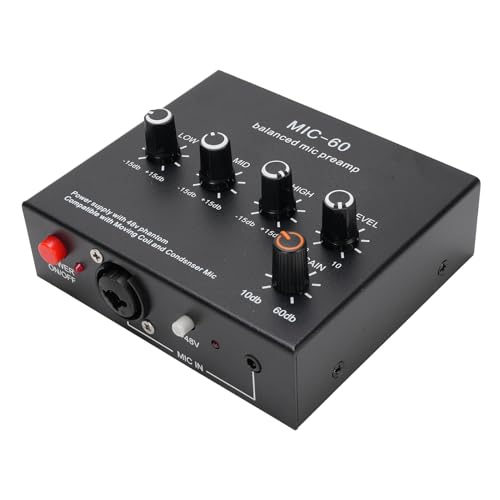
Best for multi-input studio rigs needing flexible outputs. The VBESTLIFE preamp offers 3-channel input with 48V phantom power and XLR and 3.5 mm/6.35 mm outputs. It’s designed to boost a mix of dynamic and condenser microphones while providing multiple destination options for your signal chain.
Who it’s for: users building a multi-mic setup for podcasts, voiceovers, or small-band sessions. Why selected: multi-input capability and varied output options support more complex routing. Limitation: three inputs may require careful gain staging to avoid interference among channels.
Product Spotlight: Vizni Mic Preamp

Best for compact, lightweight setups with 48V support. The Vizni mic preamp provides 48V phantom power and XLR output, with a compact design suitable for home studios, podcasts, and small-scale recording environments. It emphasizes low noise and clean gain to preserve vocal clarity and instrument detail.
Who it’s for: creators needing an affordable, portable solution for condenser and dynamic mics. Why selected: compact form factor and solid phantom power support make it a versatile choice. Limitation: feature set is modest; larger studios may require additional input channels for bigger sessions.
Product Spotlight: Micfuns Microphone Preamp

Best for two-mic setups needing clean, balanced outputs. The Micfuns preamp offers two-channel inputs, XLR balanced output, and 6.35 mm outputs with 48V phantom power. It is designed for dynamic and condenser mics, ensuring low noise and clean signal reproduction.
Who it’s for: home studios and small broadcasts that require reliable two-mic gain with flexible outputs. Why selected: balanced connectivity and dual-input design support practical auditioning and recording workflows. Limitation: like others, gain staging and impedance matching should be considered in complex signal chains.
Buying Guide: How To Choose A Preamp For Condenser Mics
What is the gain range you need? For condenser mics, you may require more than standard microphones, so consider units offering 20–75 dB of gain, and verify that the gain is achievable without introducing noise at higher settings.
Phantom power compatibility matters. Condenser mics require 48V phantom power in most cases. Ensure the preamp provides stable phantom power without affecting other connected devices.
Input/output flexibility helps future-proof your setup. Multi-input, multi-output preamps enable more complex workflows, such as multi-mic vocals, instrument miking, or live streaming with separate feeds to mixers or interfaces.
Noise performance and impedance handling. Look for ultra-low-noise designs and high impedance instrument inputs when you plan to DI guitars or keyboard pickups to preserve tone and detail.
Portability vs. desktop use. If you travel or record on location, portable, rechargeable, or USB-powered options can be advantageous. For fixed studios, a compact desktop model with good shielding may suffice.
Build quality and durability. Metal housings with shielding reduce interference and stand up to daily use in busy studios or classrooms.
FAQ
Do I need a high-gain preamp for a condenser mic?
Not always, but condenser mics are often quiet and benefit from clean gain. Look for preamps offering 40–60 dB of gain or more, with stable phantom power.
Can I use a preamp with dynamic mics as well as condensers?
Yes. Many preamps support both dynamic and condenser mics, typically with phantom power and a suitable gain range.
Is phantom power required for all condenser mics?
Most condenser mics require 48V phantom power. Some small condensers may work with lower voltages, but 48V is common.
What is EIN, and why does it matter?
Equivalent Input Noise (EIN) measures the preamp’s own noise. A lower EIN (in dB) means less audible hiss in recordings, especially at higher gain.
Are two-channel preamps always better for home studios?
Not necessarily. If you only record one mic at a time, a single-channel good-quality preamp may be sufficient. Multi-channel units offer flexibility for multi-mic sessions.
What should I consider when pairing a preamp with an interface?
Ensure impedance compatibility, appropriate gain staging, and a clear signal path. Use appropriate cables (XLR, TRS) to maintain signal integrity.