
Best Professional Audio Distribution Amplifier: Top Multi-Room Options for 2026
Answering your search for a reliable professional audio distribution amplifier, these selections cover multi-zone control, robust power, and flexible input options for both home and small-stage setups. Ideal buyers include installers seeking scalable multi-room systems, venues needing zoned audio, and studios requiring precise monitoring across multiple outputs. This guide highlights five capable models and explains who benefits most from each choice, plus practical considerations to help you compare quickly.
Dayton Audio DAX88 8-Source Matrix Amplifier

The Dayton DAX88 is a bridgeable, 8-zone distributed audio matrix with integrated Wi-Fi and mobile app control. It delivers 75 W per channel across 8. It can bridge channels for up to 260 W, enabling immersive multi-room playback. It supports analog and digital inputs and outputs, making it flexible for various device setups. Best for installers seeking a scalable, centrally managed multi-room system that can handle eight independent zones in one enclosure.
Who it’s best for: professionals building a wired-home or small commercial system that requires independent zone distribution and centralized control. Why selected: strong power handling, eight zones, and built-in Wi‑Fi for simple app-based configuration. Caution: higher power option may require careful heat management in compact rack spaces.
Dayton Audio MA1260 Multi-Zone 12 Channel Amplifier

The MA1260 consolidates 12 channels across 6 stereo zones in one enclosure, with independent and bus inputs and bridgeable outputs for extra power. It’s a strong choice for installations requiring more zones in a single chassis, with flexible routing options for complex layouts. Best for venues or large homes where multiple, independently controlled listening areas are needed.
Who it’s best for: installers needing a dense channel count and flexible input topology. Why selected: more zones than typical 8-channel models, plus bridgeable outputs for additional power when required. Caution: larger footprint and more complex setup may demand more planning than smaller systems.
Soundavo WS66i 6 Zone Amplifier

The Soundavo WS66i provides six zones with six sources, combining app control with a whole-home audio approach. It supports independent zone control and multi-source routing, enabling different music in each room or synchronized playback. Best for homeowners and small businesses seeking straightforward, app-driven multi-room audio management.
Who it’s best for: customers who want modern, app-based control across six zones. Why selected: clear, centralized interface and flexible source-to-zone mapping. Caution: limited to six zones; consider expansion needs if planning future growth.
Pyle 4 Multi-Zone Stereo Amplifier

The Pyle PT8000CH is a rack-mountable 4-channel, multi-zone amplifier with built-in bridgeable switches and 8-ohm capable outputs. It’s positioned for smaller installations requiring multiple rooms or zones with a straightforward control layout. Best for budget-conscious projects needing reliable multi-room amplification without extra features.
Who it’s best for: budget-conscious installers and small offices or apartments. Why selected: compact 4-channel design with practical zone control. Caution: fewer zones and power headroom than larger 8- or 12-channel models.
FlyroadUp 3.5mm Aux RCA L/R Audio Splitter
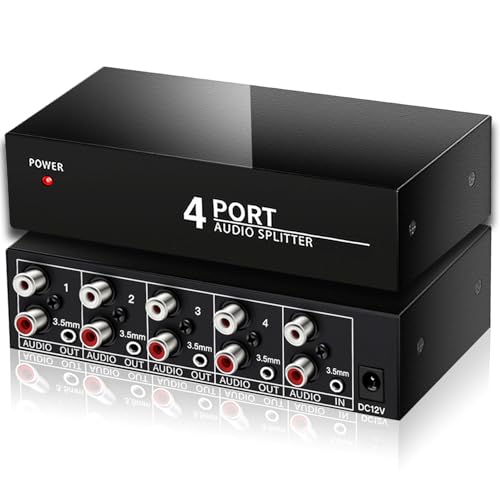
The FlyroadUp 3.5mm/Aux and RCA splitter provides one source distributed to four outputs, with flexible 3.5 mm and RCA connections. While not a full-fledged distribution amplifier, it serves in certain line-level applications where the goal is to route a single source to multiple devices. Best for simple, small-scale setups or as a supplemental distribution tool in larger systems.
Who it’s best for: quick, low-cost distribution of a single source to multiple destinations. Why selected: compatibility with both 3.5 mm and RCA outputs. Caution: not a multi-channel amplifier; limited amplification; use as a supplementary piece rather than primary distribution solution.
Buying Guide
What to consider when selecting a professional distribution amplifier
- Channel count and zone independence: Determine how many dedicated listening areas you need and whether you require independent routing or simple grouped zones.
- Power and headroom: Assess wattage per channel and whether bridged configurations are necessary for higher-power zones or outdoor deployments.
- Inputs and outputs: Match the device’s analog/digital inputs and outputs to your existing sources (DACs, players, PCs, streaming devices).
- Network features: If you want app control and remote management, prioritize products with built-in Wi-Fi or Ethernet and a stable control app.
- Form factor and installation: Rack-mountable units save space; verify cooling and ventilation for continuous operation in racks.
- Compatibility and expandability: Consider future growth—do you need a system that scales from 4 to 12 zones?
- Budget vs. value: Higher channel counts and denser feature sets deliver more flexibility but at a higher cost. Choose based on current needs and anticipated expansion.
- Compare per-zone power ratings and ensure the amplifier can drive your chosen speaker load.
- Check whether the unit supports independent zone control versus shared source routing.
- Evaluate control options: mobile app, web UI, or local front-panel controls.
- Plan speaker wiring and impedance to prevent overloading outputs, especially on bridged channels.
- Label each zone clearly to simplify configuration and future maintenance.
- Consider backup control methods (physical front panel or a secondary control device) in case the app is unavailable.
- What is a distribution amplifier used for?
A distribution amplifier takes a single audio source and distributes it to multiple outputs, maintaining signal integrity across all connected devices.
- How many zones should my system have?
Choose the number of zones based on the number of rooms or areas you want to control independently; plan for potential future expansion.
- Do I need built-in Wi-Fi for multi-room audio?
Wi-Fi or app control is convenient for centralized management, but not strictly required if your system uses a wired control approach.
- What’s the difference between a matrix amplifier and a conventional amp?
A matrix amplifier provides independent amplification and routing to multiple zones, whereas a conventional amp typically powers a single zone or a few shared outputs.
- Can I bridge outputs on all models?
Bridging capabilities vary by model; if you need higher power in a given zone, choose a unit that explicitly supports bridged operation.
- Which brand is best for professional installations?
All listed brands offer solid options; Dayton Audio is notable for flexible multi-zone configurations, while Soundavo focuses on app-driven whole-home systems.
How to compare models quickly
Practical setup considerations
Frequently asked questions
Summary of selected products
| Product | Best For | Key Advantage | Limitation |
|---|---|---|---|
| Dayton Audio DAX88 | Eight-zone, app-controlled systems | 8 zones, bridgeable, built-in Wi-Fi | Higher complexity in setup |
| Dayton Audio MA1260 | Large multi-zone installations | 12 channels, flexible inputs | Wider footprint |
| Soundavo WS66i | Six-zone app-controlled homes | Six zones, six sources | Limited to six zones |
| Pyle PT8000CH | Budget multi-room setups | Rack-mountable, four channels | Less power headroom than bigger models |
| Rolls DA134 | Small studios or DIY setups | Four-channel distribution, front-panel controls | Lower channel count |
These selections reflect a balance between channel count, control options, and practicality for professional or semi-professional multi-room audio deployments. When evaluating options, prioritize models that align with your room count, desired control method, and future expansion plans. This approach helps ensure robust performance while maintaining straightforward management for clients and technicians.