Best Rackmount USB Audio Interfaces for Studio-Quality Recording
Answering the question: which rackmount USB audio interface fits your setup and budget? This guide highlights five rackmount options that balance professional sound with practical features for home studios, project studios, and small rehearsal spaces. Each product is evaluated for its intended user and best-use scenario, from multi-mop recording rigs to compact, easy-to-integrate interfaces. Below, a quick summary table helps you compare key points at a glance.
| Product | Best For | Key Benefit |
|---|---|---|
| Behringer UMC1820 | Larger sessions with many inputs | 18×20 I/O with ADAT |
| Tascam US-16×08 | Live tracking or drums | 16 inputs and 8 outputs |
| Universal Audio Volt 876 | Analog warmth and pro mastering vibe | Vintage preamps and 32-bit/192 kHz |
| Behringer U-PHORIA UMC1820 | Budget multi-input workhorse | Midas preamps, 18×20 |
| Behringer ADA8200 | ADAT expansion or large sessions | 8-in/8-out with ADAT |
Behringer UMC1820 Audiophile Rack Interface

The Behringer UMC1820 provides a high I/O count in a rack-mountable chassis. It features 18 inputs and 20 outputs, plus ADAT I/O for expanding the setup. The interface uses Midas-proven preamps and supports 24-bit/96 kHz audio. It suits projects that require multiple mics and line inputs, such as drum rooms, small ensembles, or production studios that need flexible routing and expandability. This option is best for multi-instrument recording where space on the rack is at a premium and future expansion is anticipated.
Best for: Larger tracking sessions with many mics or instruments. Why selected: the ADAT I/O allows adding more channels, and Midas preamps deliver clean, low-noise gain. Caution: setup can be more complex due to the number of I/O, and driver stability may vary with older DAW configurations.
Tascam US-16×08 Rackmount USB Audio Interface

This Tascam model offers 16 inputs and 8 outputs in a rack-friendly unit, designed for big sessions such as drum tracking or multi-mic setups. Eight Ultra-HDDA microphone preamps provide clean gain up to substantial levels, with two additional line inputs and the option to switch two inputs to instrument level. It is well-suited for studios that need a robust hardware interface with flexible routing and direct control software integration.
Best for: Drums or large-band setups that require many mic inputs. Why selected: high headroom on preamps and a straightforward rack-manageable interface. Caution: the interface is relatively feature-dense—consider if you need simpler workflows or smaller-session use.
Universal Audio Volt 876 Rack-Mount Interface
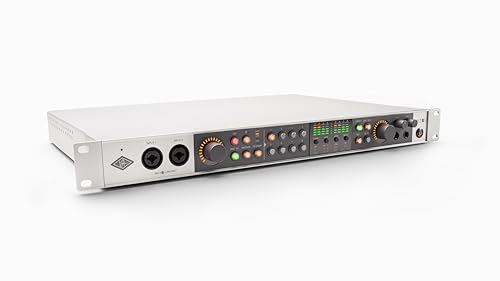
The Volt 876 emphasizes analog character with eight onboard Vintage preamps and classic compressors inspired by iconic UA gear. It supports up to 32-bit/192 kHz conversion and works with the UA Console app for easy control, including auto-gain assistance and session recall. This is a strong choice for users seeking studio-grade signal quality and a workflow that mirrors professional centers for tracking and mixing.
Best for: Producers and engineers chasing UA-like analog vibe in a Rack-mount form factor. Why selected: renowned signal path fidelity and integrated software support. Caution: premium price and UA-specific ecosystem may be more than needed for casual or entry-level users.
Behringer U-PHORIA UMC1820 Audio Interface

Similar in lineage to the UMC1820, the UMC1820 focuses on 18 inputs and 20 outputs with Midas mic preamps. It is described as compatible with major recording software and offers reliable performance for multi-song sessions. This model is a good pick for those who value familiar Behringer preamps and a broad I/O set in a rack-friendly format.
Best for: Budget-conscious multi-input studios. Why selected: strongPreamp options across many channels at a reasonable cost. Caution: marketing descriptions repeat software compatibility hints; verify driver support for your DAW and OS version before purchase.
Behringer ADA8200 ADAT Audio Interface

The ADA8200 is an 8-in/8-out ADAT-enabled interface with Midas preamps, designed for expanding an existing setup or adding more channels to a main interface. It operates at 24-bit, 44.1/48 kHz, and provides ADAT optical output for expansion. This unit is ideal for users who need to grow an established system without sacrificing analog performance.
Best for: Expanding an existing rack, or adding capacity to a primary audio interface. Why selected: straightforward ADAT expansion with reliable Behringer mic preamps. Caution: this is an expansion tool, not a full standalone workstation; you’ll need another main interface to route audio.
Behringer UMC404HD 4×4 USB Interface
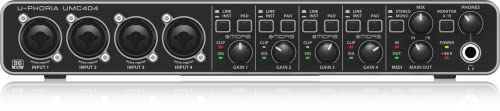
The UMC404HD delivers a compact yet capable 4-in/4-out USB audio/MIDI interface with Midas preamps and 24-bit/192 kHz resolution. It targets small teams or solo producers who need high-quality sound with straightforward routing. This is a best-for choice when you want clean vocal and instrument tracks without overwhelming hardware.
Best for: Small home studios or solo projects needing clean, transparent preamps. Why selected: reliable performance in a compact rack-mountable package. Caution: fewer inputs than larger models; consider future expansion if your workflow grows.
Focusrite Scarlett Solo 3rd Gen

The Focusrite Scarlett Solo 3rd Gen is a compact, user-friendly interface designed for guitarists, vocalists, podcasters, or producers who want studio-quality sound without complexity. It features two high-headroom inputs, Gain Halos for precise gain staging, and 24-bit/192 kHz conversion for clear recordings. It is well-suited for solo projects and streaming work that require quick, reliable performance.
Best for: Solo artists needing high-quality preamps and simple workflow. Why selected: ease of use with strong performance in a small, rack-mountable footprint. Caution: limited I/O compared to other rack units; not ideal for multi-mic drum setups without expansion.
Buying Guide
What to consider when choosing a rackmount USB audio interface:
- Input/Output needs: How many mics or line sources do you plan to record at once? If you need many inputs, models with 16+ inputs or ADAT expansion are advantageous.
- Preamplifier quality: Look for interfaces with reputable preamps (e.g., Midas or UA-grade). This affects signal cleanliness and headroom.
- Sample rate and bit depth: 24-bit/192 kHz provides higher resolution; 16- or 24-bit at 44.1/48 kHz suffices for many projects.
- Expansion options: ADAT I/O can future-proof by adding more channels via an external converter or expansion unit.
- Software compatibility: Ensure drivers and bundled software align with your DAW (Pro Tools, Ableton, Cubase, etc.).
- Latency and monitoring: Look for direct monitoring and low-latency performance to avoid monitoring delays during recording.
- Rack footprint and power: Confirm the unit fits your rack size and power requirements in your workspace.
FAQ
- What is rackmount USB audio interface best for? – It suits studios needing multiple inputs in a fixed rack space, offering organized routing, expandability, and easy integration with existing rack gear.
- Why choose ADAT expansion? – ADAT adds channels without stacking separate USB units, ideal for growing multi-mic setups or drum rooms.
- Are vintage-sounding preamps worth it? – If you want character and warmth, models inspired by classic analog gear can be desirable, but assess whether you prioritize clean, neutral tone.
- Is a higher sample rate always better? – Higher rates improve fidelity but require more storage and CPU power; for most home studios, 24-bit/96 kHz is a solid standard, with 192 kHz offering marginal gains for certain sources.
- What should I pair with a rackmount interface? – A compatible multitrack DAW, adequate monitoring, and a stable PCIe/Thunderbolt audio chain if needed for your workflow.
- How do I decide between a 4×4 vs 16×8 interface? – If you primarily record a couple of instruments, a 4×4 might be enough. For tracking bands or project studios with many mics, a larger I/O or expansion is more practical.