
Best RCA Line Level Booster Picks for Clean, Stronger Audio
Looking for an RCA line level booster to elevate low-volume sources to amplifier-ready levels? This guide highlights five practical options that suit different setups, from compact preamps to DIY-friendly boosters. Each pick targets common buyer needs: simple plug-and-play use, DIY customization, or better compatibility with older gear. The list helps identify who benefits most from each model, such as vinyl enthusiasts, home theater fans, or general-purpose audio hobbyists.
Summary of chosen products:
- Douk Audio L1-MiINI Stereo Line Level Booster Amplifier
- Douk Audio L1 Mini Stereo Line Level Booster
- AtNeDcVh Mini Small Stereo Preamplifier
- multicomp PRO Stereo Line Level Amplifier
- TCC TC-780LC Black Stereo Line Level Preamp
Douk Audio L1-MiINI Stereo Line Level Booster

Best for: Audiophiles who want upgradeability and precise control. This model offers a built-in amplification and a voltage boost circuit with adjustable gain up to 20 dB, matching a variety of low-output sources to speaker or amplifier inputs. Its NE5532P op amp and high-quality potentiometer support a smooth, natural sound with low distortion. The design emphasizes a stable, wider frequency response for better dynamic range.
Why selected: It combines easy input/output options (AUX, RCA) with a pluggable op-amp design for DIY sound shaping. This makes it suitable for users who value both performance and upgrade flexibility. The 26V high-output capability helps drive modestly powered amplifiers more cleanly.
Caution: The integrated voltage boost relies on a specific supply arrangement; ensure your power setup matches the unit’s needs to avoid insufficient headroom.
AtNeDcVh Mini Stereo Preamplifier
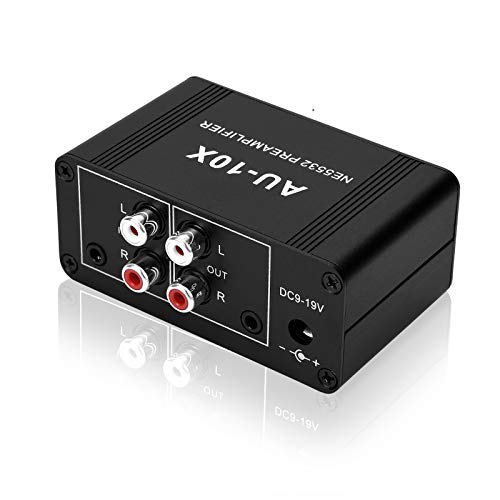
Best for: Budget-conscious listeners who want a compact, straightforward gain boost for turntables or small speakers. The unit provides up to 20 dB gain, using a Dual NE5532OP amp setup for cleaner signal amplification and reduced noise. It supports RCA and 3.5 mm inputs, with output options including RCA, 3.5 mm, and headphones for personal listening.
Why selected: The dedicated gain knob and simple architecture make it an easy upgrade from a raw phono connection or weak line-level signal, especially when space is limited. The compact build suits desktop setups or small AV racks.
Caution: The product notes indicate a standalone headphone drive capability; using multiple outputs simultaneously may introduce crosstalk or impedance issues.
Douk Audio L1 Mini Stereo Line Level Booster
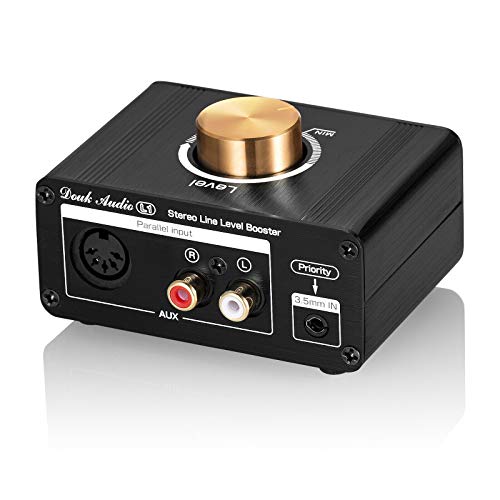
Best for: Enthusiasts who want versatility without clutter. The L1 Mini offers multiple input/output interfaces (3.5 mm, RCA, 5-DIN) and a voltage-boost circuit with adjustable gain up to 20 dB. It supports a wide input voltage range and can share a power supply with amplifiers, simplifying wiring in larger setups.
Why selected: Its dual-op-amp socket design enables future tonal tweaks or upgrades. A sealed potentiometer supports stable, wide-frequency performance with minimal distortion, making it a practical choice for diverse gear like TVs, PCs, and portable players.
Caution: The device can be sensitive to power supply quality; poor or noisy DC inputs may impact noise floor and sound clarity.
multicomp PRO Stereo Line Level Amplifier

Best for: Users seeking a straightforward, dedicated line-level boost with defined gain control. The unit provides 0–15 dB adjustable gain and RCA stereo inputs/outputs with a clean frequency response of 20 Hz to 20 kHz.
Why selected: Its compact size and simple interface make it ideal for hobbyists upgrading older home theater or stereo setups. The clear gain range helps dial in the exact level from a variety of legacy sources without introducing significant noise.
Caution: The product references a compact package; ensure adequate headroom for very low-output sources to avoid under-driving amplifiers in large rooms.
TCC TC-780LC Black Stereo Line Level Preamp

Best for: Those who need a compact, black-finished option with flexible inputs including MP3 players and iPods. It supports RCA and a front-panel stereo mini-jack for easy connection to portable devices.
Why selected: The black finish and dual-input capability suit modern and older gear in mixed setups. The front-panel jack adds quick access for portable players without needing to unplug other sources.
Caution: The device emphasizes iPod-style inputs; verify compatibility with your specific portable gear and the required cabling in your rack space.
Buying Guide
What should you consider when choosing an RCA line level booster?
- Gain range: Look for models offering up to 20 dB of boost for older or weaker sources. If your devices already run near line level, a smaller gain may suffice to avoid distortion.
- Input/output options: Ensure the unit supports the connections you own (RCA, 3.5 mm, DIN, and even 5-DIN if you have legacy gear). More options improve compatibility with a wider range of sources.
- Power supply and headroom: Some boosters require specific DC input ranges. Verify compatibility with your amplifier’s power supply to prevent noise or clipping.
- Op-amp design and upgradeability: Dual op-amps and socketed designs offer sound-tuning opportunities for audiophiles who want to tailor tonality or reduce distortion.
- Size and placement: If space is limited, consider compact units designed for desktop setups or slim racks. For DIY enthusiasts, look for models with accessible components.
- Noise floor and distortion: Prioritize models with stable, low-noise design and wide frequency response to preserve dynamic range and clarity across audio sources.
Practical questions to guide your choice
- Do I need a dedicated preamp with a strong, adjustable gain for vinyl or taped sources?
- Can I share a power supply with my existing amplifier to reduce clutter?
- Will I connect multiple devices at once, or just one primary source?
- Is upgradeability important for future sound tuning or component swaps?
Quick comparison at a glance
- Best overall flexibility: Douk Audio L1-MiINI — high headroom, upgradeable op-amps, broad input options.
- Best compact design: AtNeDcVh Mini — small footprint with solid 20 dB gain; straightforward use.
- Best for DIY enthusiasts: Douk Audio L1 Mini — multiple interfaces and swap-friendly op-amps.
- Best value option: multicomp PRO — simple 0–15 dB gain with RCA I/O.
- Best for portable devices: TCC TC-780LC Black — front-panel mini-jack for iPod-style players.
FAQ
- What is line level boosting used for?
It raises weak audio signals to a level suitable for amplification, improving drive to speakers and improving overall loudness and clarity. - Do these boosters introduce noise?
Some noise can occur if power quality is poor or if the device is driven beyond its design headroom; choose units with good shielding and stable op-amps. - Can I use a booster with a turntable?
Yes, if the turntable output is low, a booster helps raise the signal before the main amplifier or receiver. - Is higher gain always better?
No. Excess gain can cause clipping and distortion if the source already approaches line level; match gain to the source’s output. - Do boosters require special power supplies?
Many use standard DC inputs; verify voltage ranges (e.g., 5–24V) and ensure compatibility with your system’s power supply. - Should I choose a socketed op-amp design?
Socketed designs offer customization opportunities, allowing audiophiles to try different op-amps for tonal changes and performance tweaks.