
Best RCA Splitter for 4 Channel Amp: Top Picks for Clear Car Audio Expansion
Looking to power a four-channel amp from a two-channel RCA source? This guide presents five reliable RCA splitter options that convert 2-channel to 4-channel outputs with minimal signal loss. Best for car audio setups, home theater, and DIY projects, these picks balance signal integrity, build quality, and value. Suitable buyers include car audio enthusiasts upgrading a factory system, professionals wiring multi-speaker setups, and hobbyists building custom audio rigs in vehicles or studios.
Below is a quick buying guide table with the five selected products and who they are best for. Use this table to compare core features at a glance before diving into detailed sections.
| Product | Best For | Key Benefit | Notable Limitation |
|---|---|---|---|
| MEIRIYFA RCA Car Audio Cable Y Splitter Adapter Cord | Car enthusiasts needing shielded, low-noise conversion | Fully shielded, low-noise copper conductor | 5m length may be longer than needed for small installs |
| YQMRCZRF RCA Car Audio Cable Y Splitter | Multi-device setups with stable, long runs | Twisted pair design for stable signal | Length specified as 5m; consider room for routing |
| Cubilux AS-R1 4 Way RCA Splitter Box | Multi-sink projects needing low loss | Zero degradation of audio signal | Aluminum housing is sturdy but may be bulkier |
MEIRIYFA RCA Car Audio Cable Y Splitter Adapter Cord

Best for: Car audio fans who want a robust, shielded 2-to-4 RCA expansion. This 2RCA to 4RCA interconnect uses 100% copper conductors with full shielding to reduce noise in automotive environments. It suits installations that require separating two audio sources to four destinations, such as driving two sets of speakers or expanding to an additional amp channel.
Why selected: The MEIRIYFA cable emphasizes shielding and low-noise performance with a clip-design 2RCA to 4RCA arrangement. It supports full 2-channel to 4-channel expansion and uses oxygen-free copper conductors to maintain signal clarity.
Best for: Users prioritizing noise reduction in loud, rattly vehicle cabins and those needing easy, reliable 2-to-4 channel expansion. Limitations: The 5-meter length may be longer than necessary for compact interiors; ensure routing fits your installation layout.
YQMRCZRF RCA Car Audio Cable Y Splitter Adapter Cord

Best for: Systems requiring dependable two-to-four channel conversion with a focus on signal stability over longer runs. This model highlights a twisted pair design to aid noise resistance and supports conversion to two separate audio outputs from a single 2-channel input.
Why selected: It’s designed to maintain clear stereo signals across car, home, and racing setups, with emphasis on stability for longer cable runs. Limitations: Like others, it’s still an RCA cable solution—not a powered splitter, so noise performance depends on source quality and installation cleanliness.
Cubilux AS-R1 4 Way RCA Audio Splitter Box

Best for: Projects needing a compact, dedicated 1-in-4-out splitter with strong isolation. The Cubilux AS-R1 uses an aluminum alloy chassis to help shield against EMI/RFI and protect signal integrity when feeding multiple sinks from one source.
Why selected: It delivers lossless sound distribution with a sturdy enclosure and dedicated 4-way outputs. Limitations: It is a passive splitter; performance relies on source capability and proper cable routing to avoid interference.
InstallGear 2 Pack RCA Y Adapter Splitter
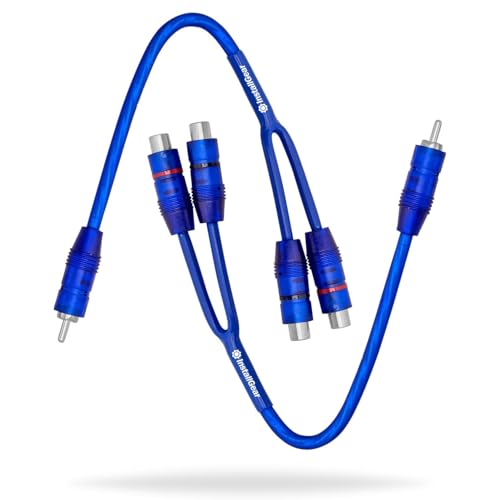
Best for: Budget-conscious setups that still require reliable 2-to-2 RCA expansion. This two-pack offers shielded, 100% OFC conductors to help preserve signal integrity across basic car or home theater installations.
Why selected: The product emphasizes simplified installation and stable signal transmission with a secure male-to-two-female arrangement. Limitations: It’s a basic splitter without extra gain or per-output level controls; consider separate balance controls if needed for multiple outputs.
CNHIDEE RCA Splitter 1 Female To 2 Male
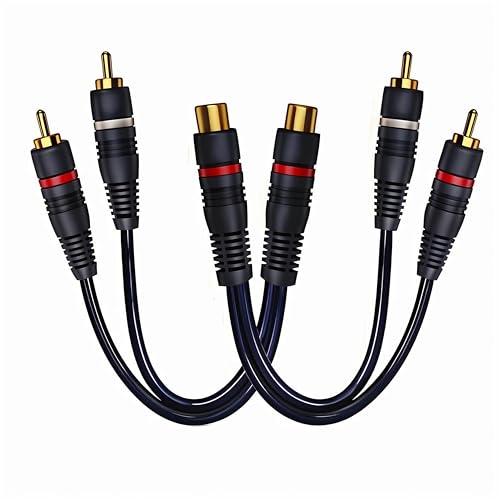
Best for: Those who need a compact, two-output split from one female input, with emphasis on crystal audio transmission. The CNHIDEE model uses gold-plated connectors and dual-layer EMI shielding to reduce interference in typical home theater and gaming setups.
Why selected: It provides robust corrosion resistance and shielding benefits, aiding in clear stereo transmission. Limitations: It offers only a 1-in-2-out configuration; for four outputs you’ll need two splitters or a different 2-to-4 design.
Buying Guide
What should you look for in a 2-to-4 RCA splitter?
Signal integrity: Look for full shielding, copper conductors, and low-noise designs to minimize hiss and static in noisy environments like vehicles or basements.
Construction: Aluminum or robust plastics with solid jacks reduce wear and EMI/RFI interference. A compact enclosure helps fit behind dashboards or AV racks.
Length and routing: Choose a length that matches your installation layout to avoid excess cable slack that can cause interference or tangling.
Configuration: Ensure the product truly converts 2RCA to 4RCA, and verify if it’s passive (no power required) or needs amplification/separate gain controls for optimal balance.
Best-use scenarios: For car audio or marine setups, prioritize shielding and moisture resistance. For home theaters, consider higher channel counts if expanding beyond four outputs in the future.
How to choose between active vs passive splitters?
Passive splitters are simple, cost-effective, and rely on the source to drive multiple endpoints. Active splitters (or splitters with built-in amplification) can help when the source is underpowered or when long cable runs risk signal loss. For most stereo 2-to-4 expansions at typical room or vehicle distances, a high-quality passive splitter is sufficient.
What common pitfalls should buyers avoid?
Avoid very cheap unshielded cables that introduce noise in loud environments. Double-check connector compatibility with your devices and ensure that the splitter’s impedance and conductor quality won’t degrade the signal when feeding multiple speakers or amps.
What installation tips improve results?
- Keep power lines away from RCA cables to reduce EMI.
- Label outputs when routing to multiple amps or speakers to simplify future maintenance.
- Secure cables and avoid sharp bends to preserve conductor integrity.
- Test each output individually before final routing to identify any signal loss or crosstalk.
FAQ
- Q: Is a 2-to-4 RCA splitter suitable for automotive use? A: Yes, with shielded cables and proper routing, it can expand vehicle audio to multiple amplifiers or speakers.
- Q: Do I need power for a 2-to-4 RCA splitter? A: Most are passive and do not require power, though some high-gain designs or active splitters may.
- Q: Will a splitter reduce audio quality? A: A quality shielded splitter with good conductors minimizes degradation; poor shielding or long runs can introduce noise.
- Q: Can I use any RCA splitter with any source? A: Most RCA splitters are source-agnostic, but confirm compatibility with your equipment and impedance needs.
- Q: How do I know if I need a 1-in-4-out or 2-in-4-out splitter? A: If you have two stereo outputs to distribute, choose a 2-in-4-out design; for a single stereo source, a 1-in-4-out is sufficient.
- Q: What is the benefit of twisted-pair RCA cables? A: Twisted-pair construction can improve signal stability and reduce interference over longer runs.