
Best Receivers for Stereo System: Top Picks for Clear, Powerful Music and Home Theater
Answering the common buyer question “what is the best receiver for a stereo system?” this guide highlights five reliable amplifiers that balance power, features, and value. These models suit different needs—from simple Bluetooth-enabled listening to multi-room and 8K-capable home theater. Use this guide to compare how each can fit your setup, whether you’re a casual listener, a home theater hobbyist, or a karaoke host.
| Product | Best For | Key Feature |
|---|---|---|
| Sony STR-DH190 | Budget stereo pairs with vinyl | Phono input and Bluetooth |
| Yamaha R-S202BL | Two-zone listening with Bluetooth | Speaker selector for 2 systems |
| Donner MAMP6 | Small gatherings and karaoke | 6-channel amp with Bluetooth 5.3 |
| Denon AVR-S570BT | 8K-ready home theater and music | 4x HDMI 2.1 8K inputs, multi-room |
| Yamaha RX300A | Dolby Atmos and high-fidelity home theater | Dolby Atmos, Bluetooth Multipoint |
Sony STR-DH190 2-Ch Stereo Receiver

Best for entry-level stereo setups. This model delivers 100 watts per channel (8 ohms) and includes a phono input for turntables, along with Bluetooth connectivity. Its simple layout makes it ideal for vinyl enthusiasts who want a straightforward, reliable amplifier without frills.
Who it’s best for: listeners upgrading a basic system or beginners building a vinyl-first setup. Why selected: reliable power, built-in phono stage, and easy Bluetooth streaming for a single-room listening experience.
Caution: l imited to two-channel stereo output; not designed for immersive surround sound setups.
YAMAHA R-S202BL Stereo Receiver
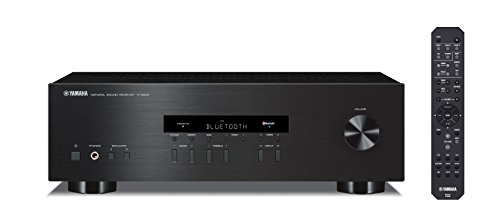
Best for dual-zone listening and easy streaming. This receiver supports Bluetooth and includes a speaker selector for two systems, making it practical for bridging two listening areas or rooms. It emphasizes clean, well-balanced sound with simple setup.
Who it’s best for: homes needing two separate audio zones or a user who values straightforward controls. Why selected: reliable Yamaha sound with multi-room flexibility and a user-friendly interface.
Caution: fewer modern digital inputs beyond Bluetooth and line-in options; may require additional adapters for more sources.
Pyle Home Stereo Receiver with Bluetooth – PDA77BU

Best for karaoke and party setups in compact spaces. This 4-channel amplifier caters to mixed-use listening with Bluetooth, USB, SD card, FM, and karaoke-oriented features like echo and mic inputs. It’s a versatile choice for home gatherings.
Who it’s best for: hosts who want a straightforward karaoke-friendly receiver with multiple input options. Why selected: robust feature mix at a compact size, ideal for casual entertaining.
Caution: power specs emphasize peak values; real-world output depends on speaker matching and room acoustics.
Donner MAMP6 Stereo Receiver

Best for multi-source hobbyists and home theater on a mid-budget. Donner’s 1000W peak power across six channels accommodates multiple speaker configurations. It includes Bluetooth 5.3, USB, RCA, mic inputs, and optical/coaxial options for smart TVs.
Who it’s best for: users who want flexible inputs and independent channel control for a more complex audio setup. Why selected: high peak power with broad input compatibility for diverse media sources.
Caution: data notes multi-channel performance; real-world room performance depends on speaker compatibility and room acoustics.
Denon AVR-S570BT 5.2 Channel AV Receiver

Best for immersive home theater and music with 8K readiness. The Denon AVR-S570BT offers 70W x 5 channels, four HDMI 2.1 8K inputs, and eARC. It also supports Dolby TrueHD and DTS HD Master Audio for cinematic sound, plus built-in Bluetooth for wireless streaming.
Who it’s best for: households seeking an all-in-one AV receiver for movies, gaming, and music across multiple rooms. Why selected: strong future-proof HDMI capabilities and robust audio processing.
Caution: higher power and feature set mean a steeper setup curve for non-AV enthusiasts; ensure speaker wiring matches 8K/HDMI expectations.
Yamaha RX300A 5.2-Channel AV Receiver

Best for Dolby Atmos and enhanced video compatibility. This model supports 4K/120 and 8K/60 HDMI, Bluetooth Multipoint, and a 5.2 channel configuration with Dolby Atmos and DTS Virtual:X for multi-dimensional sound.
Who it’s best for: home theater fans who want cutting-edge video support and immersive audio. Why selected: strong Atmos capabilities and high-quality streaming options.
Caution: more features mean greater complexity; ensure your speaker layout aligns with Atmos processing for optimal results.
Buying Guide: How To Choose The Right Receiver For Your Stereo System
- Power and speaker compatibility: Match amplifier wattage to your speakers (typically 50–100W per channel for most hi-fi speakers). Ensure impedance (6–16 ohms) suits the receiver’s output.
- Inputs and outputs: List your required sources (Bluetooth, USB, CD/Phono, HDMI). For home theater, HDMI 2.1 and eARC support are important.
- Multi-room and zones: If you want two listening areas, look for dual-zone functionality or Bluetooth streaming options across rooms.
- Dolby Atmos and surround processing: For immersive surround, choose AV receivers with Atmos/DTS:X and appropriate speaker arrangements.
- Phono and streaming: Vinyl lovers should prioritize a phono input. For casual streaming, Bluetooth or Wi-Fi multi-room can simplify setup.
- Ease of use and setup: Consider receivers with clear on-screen guides, simple remote control, and robust auto-calibration options.
- Future-proofing: HDMI 2.1, 8K support, and Bluetooth versions influence long-term compatibility with new devices and TVs.
FAQ
- What is a stereo receiver best used for?
It powers speakers and processes audio from various sources, delivering improved sound quality for music and simple home theater setups. - Do I need a Dolby Atmos receiver for a stereo system?
No. Atmos is for multi-channel surround sound; a stereo/2-channel or 5.1 receiver is sufficient for basic music listening and two-channel playback. - Is Bluetooth enough for streaming music?
Bluetooth is convenient, but for higher fidelity, consider receivers with Wi-Fi, AirPlay, or Spotify/Tidal integration. - Can I use a vintage turntable with a modern receiver?
Yes, if the receiver has a phono input or a separate phono preamp is used. - What should I check before buying?
Speaker compatibility (impedance and power), available inputs, room size, and whether you need multi-room capability. - How important is HDMI on a stereo receiver?
HDMI is essential if you plan to connect a TV or game console for enhanced video and audio pass-through.