Best Record Player for Sampling: Top Picks for Beating Accurate Grooves and Easy Integration
Choosing a record player for sampling means prioritizing stable speed options, decent preamps, and flexible connectivity. The top picks below are aimed at producers, beatmakers, DJs, and hobbyists who want reliable playback, easy transfer to digital formats, and compatibility with external gear. Each option highlights who it’s best for and why it stands out for sampling work, including portability, built-in speakers vs. external systems, and feature sets that aid precise capture of audio grooves.
Summary of chosen products:
| Product | Best For | Key Benefit |
|---|---|---|
| Cotsoco Vinyl Record Player With Bluetooth | Home studio setups; casual sampling | Built-in speakers and Bluetooth for quick listening |
| Numark PT01 Scratch | On-the-go sampling; scratch-friendly | Battery or AC powered; built-in speaker; portable |
| Seasonlife Vintage Turntable | Vintage vibe with modern inputs | Three speeds; wireless input options |
| Retrolife 3-Speed Suitcase | Travel-friendly sampling | Built-in speakers; multiple connection options |
| Audio-Technica AT-LP60X-BK | Reliable studio use; simple workflow | Fully automatic belt-drive; two speeds |
Cotsoco Vinyl Record Player With Built-In Bluetooth

Best for compact home studios that need quick listening and sampling checks. This belt-drive unit supports three speeds (33, 45, 78 RPM) and allows listening via built-in speakers or Bluetooth from a phone or laptop. It also offers AUX-in and RCA line-out for direct integration into a mixing or audio interface. The dual 2-speaker setup makes it suitable for immediate listening before digitizing sections for sampling. A potential limitation is the built-in speakers if you require raw, high-fidelity monitoring; external speakers deliver better detail.
Numark PT01 Scratch

Best for prototyping beats on the move. The PT01 Scratch is ultra-portable with three speeds and a built-in speaker, letting you sample vocal and instrumental grooves anywhere. Its Scratch Slide Switch supports left- and right-handed use, which is helpful for quick loop sampling and cueing. Battery-powered operation (with optional D cells) adds portability. The built-in speaker is convenient, but for precise sampling and mastering, connect external speakers via RCA outputs to get clearer, louder reference tracks.
Seasonlife Vinyl Record Player With Speakers

Best for a vintage aesthetic with modern connectivity. This three-speed turntable supports 7″, 10″, and 12″ records and offers wireless input pairing, letting you sample from digital playlists or streaming services. The integrated speakers provide immediate feedback for rough edits, while the AUX input and RCA outputs enable clean recording to an audio interface. The main caveat is that the built-in speakers may color the sound; use the RCA outputs for accurate sampling before digitizing.
Retrolife 3-Speed Bluetooth Suitcase
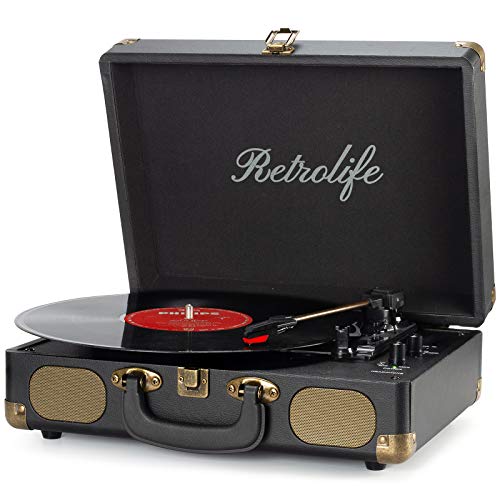
Best for portable sampling workflows that require a stylish yet durable package. The suitcase design makes it easy to carry to a remote studio or location scout. It features three speeds and three record sizes, with built-in Bluetooth speakers plus RCA and AUX-in options. This is a practical pick for field sampling or quick demos, but for studio-grade sampling, couple it with external monitors or a dedicated audio interface to achieve clearer capture and reduced coloration.
Audio-Technica AT-LP60X-BK

Best for a reliable, studio-friendly workflow. The AT-LP60X-BK is fully automatic and belt-driven with two speeds, offering consistent playback ideal for sampling setups that require predictable groove tracking. The die-cast aluminum platter reduces resonance, contributing to cleaner grabs when sampling. It’s a straightforward choice for those who prioritize reliability and ease of use over feature-packed but noisier models. A downside is the lack of built-in preamp in some configurations, so ensure you have a suitable input stage if your setup needs it.
Buying Guide: Key Considerations For Sampling-Ready Turntables
Are you connecting to a mixer or an audio interface? If you plan to sample digitally, you’ll want a turntable with a solid line-out, proper grounding, and options to connect to an external preamp or audio interface. Built-in speakers can help with quick checks, but for precise sampling, connect to external monitors or headphones to hear the true groove and dynamics.
Speed Stability And Cartridge Quality
Three speeds (33/45/78 RPM) expand your vinyl options. Look for a stable belt-drive system and a high-quality stylus cartridge (e.g., magnetic or ceramic). A poor cartridge can introduce flutter, rumble, or tracking errors that complicate sampling.
Connectivity Options
Bluetooth is convenient for listening but may add latency, complicating precise sampling. Prefer units with RCA line-out or a dedicated preamp input. AUX-in is helpful for direct sampling from non-vinyl sources. If you plan to digitize, ensure your turntable can connect to an audio interface or mixer without adapters.
Portability Versus Fidelity
Portable suitcase models are great for field sampling and quick demos but may compromise sound quality. In-studio units generally offer better isolation and sound, though they lack the convenience of travel-friendly designs. Balance portability with the fidelity you need for your projects.
Durability And Build Quality
Look for anti-resonance plinths and sturdy tonearms to minimize vibration. A heavier chassis reduces feedback during monitoring, which matters when you need clean captures for sampling.
Headphones And Monitoring
Consider the availability of a headphone jack or dedicated audio outputs. For sampling, close-back headphones or studio monitors will help you hear subtle groove details, hiss, and surface noise that influence how you sample.
Practical Tips For Sampling With Turntables
- Record in a quiet environment; reduce surface noise with clean records and a dust-free stylus.
- Use a ground wire to minimize hum; ensure proper alignment of the tonearm.
- Sample at the original groove pitch and avoid speed anomalies by stabilizing the platter before playback.
- Digitize at a safe sample rate and bit depth to preserve dynamics; apply non-destructive processing later.
Frequently Asked Questions
- What is the best turntable for sampling on a budget?
Look for models with solid line-out, stable speeds, and reliable tonearms. Portable options with external output are often budget-friendly while still offering clean sampling paths.
- Should I use a turntable with built-in speakers for sampling?
Built-in speakers are convenient for quick checks but not ideal for final sampling due to coloration and limited dynamics. Use them for initial listening and connect to external gear for accurate sampling.
- Is Bluetooth okay for sampling?
Bluetooth can introduce latency and compression that hinders precise sampling. Prefer wired connections when capturing audio to digital formats.
- What speeds are essential for sampling different record sizes?
At least 33 and 45 RPM; 78 RPM is useful for shellac or older vinyl. Three-speed turntables broaden your sampling options across record types.
- Do belt-drive turntables affect sampling quality?
Belt-drive turntables can deliver better isolation from motor noise, which is beneficial for sampling. Look for anti-resonance features to minimize feedback during capture.