
Best Remote Volume Control for Speakers: Easy, Safe, and Flexible Options
If you need precise, hands-on control of speaker volume across rooms or zones, a wall-mounted or remote-style volume control makes sense. This guide highlights five reliable options suitable for home theaters, outdoor setups, and multi-room systems. Each product is described with who it’s best for, why it’s a good pick, and a practical caveat to consider before you buy.
Summary Of Chosen Products
- STUDIOFINIX ST-VC100: Best for large, multi-room installations with up to 8 speaker pairs
- OSD Audio SVC100: Best for centralized systems needing precise impedance protection
- Pyle PVCD15: Best for simple two-channel setups with ease of use
- Rockville VOL850: Best for precise, step-by-step volume control in small to medium spaces
- RECOIL VC-R100: Best for robust multi-room control with flexible jumper options
STUDIOFINIX 100W In Wall Volume Control

Best for large home theaters or outdoor speaker arrays that demand robust passive power handling. The ST-VC100 supports up to 8 pairs of speakers, offering extensive connectivity and a compact, passive design that requires no extra power sources. This makes it a solid choice for installers who want centralized control without clutter. A potential limitation is that installation may require wall remodeling to fit the unit and wire routing for all connected speakers.
OSD Audio SVC100 100W In Wall Volume Control
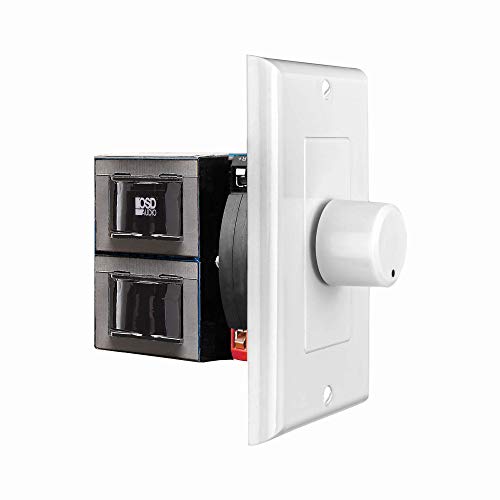
Best for systems needing solid impedance protection and independent zone control. The SVC100 provides 100 watts per channel and front-mounted jumpers for up to eight pairs of 8-ohm speakers. It’s particularly suitable for homes with multiple listening zones where protecting the amp from impedance shifts is important. A caveat is that the unit’s features are optimized for standard 8-ohm loads; nonstandard wiring may require careful verification.
Pyle PVCD15 In Wall Speaker Volume Control

Best for small to medium interior spaces needing a simple 2-channel controller. It allows control of right and left speakers and handles a 120W load, which is ample for many living rooms or compact studios. This model is ideal for users who want straightforward, dependable input from a single control point. Its limitation is that it may lack advanced impedance protection features found in higher-end models.
Rockville VOL850 8 Ohm Stereo Volume Controller
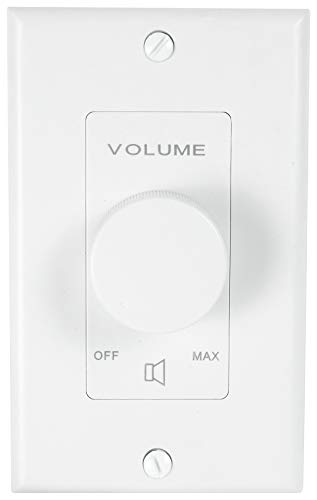
Best for precise, step-by-step balance in home or small commercial spaces. With an 11-step rotary knob and 50W per channel (100W total) at 8 ohms, it offers clear attenuation and reliable performance. It’s suitable where fine control over listening levels is essential, such as media rooms or small venues. A limitation is the 8-ohm compatibility may restrict use with certain high-impedance speaker configurations.
RECOIL VC-R100 100W In-Wall Volume Controller

Best for multi-room homes that require scalable control with robust jumper options. The VC-R100 handles up to 8 pairs of 8-ohm speakers and features a 12-step rotary knob for independent zone control. This makes it a strong candidate for expanding audio layouts without sacrificing fidelity. The potential drawback is that it may require careful wiring to ensure consistent performance across all connected zones.
Buying Guide: How To Choose The Right Remote Volume Controller For Speakers
- Power rating and impedance: Match the controller’s wattage and impedance support to your speaker load to prevent distortion or damage.
- Number of zones: If you have multiple rooms or zones, choose a model that supports 4–8 pairs of speakers or more, depending on your layout.
- Passive vs. active design: Passive controllers don’t need external power, simplifying setup but may have fewer features than active models.
- Independent channel control: For stereo setups, ensure the unit can independently manage left/right channels or zones as needed.
- Installation considerations: In-wall units require wall work and proper wiring; surface-mount options offer easier retrofits.
- Impedance protection: Look for devices that help stabilize load to protect amplifiers against mismatched speakers or parallel connections.
What to Ask Before You Buy
- How many speaker pairs will the system consistently support in your home?
- Do you need per-room or per-zone volume control, or both?
- Is impedance protection important for your existing amplifier and speaker setup?
- Will you install the unit in-wall, or prefer a surface-mount option?
- Are you wiring for outdoor or indoor environments, and does the unit support that exposure?
Tips For Installation And Use
- Plan your wiring path to minimize run length and maintain signal integrity.
- Test each zone after wiring to verify independent control and consistent attenuation.
- Label speaker runs clearly at the controller and amplifier to avoid setup mistakes.
FAQ
- What is a wall-mount volume control used for? It provides centralized, easy access to adjust speaker levels across rooms or zones without touching the main amplifier.
- Do these devices affect sound quality? A well-matched, properly installed controller preserves frequency response and minimizes distortion, assuming compatible speaker loads.
- Can I use any volume control with any amplifier? Not always; check wattage ratings, impedance compatibility, and the number of zones supported.
- Is impedance protection necessary? It helps prevent amplifier overheating and protects connected speakers in multi-speaker configurations.
- Are in-wall controls easy to install for a DIYer? Some are straightforward with standard wall boxes; others may require professional wiring and wall modification.
- Can I mix brands? Mixing brands is possible if the controller specifications align with your speakers and amp, but consistency improves reliability.