Best RFID Card and Reader Solutions for Quick Access and Security
Looking for an RFID card reader that matches your security needs and device setup? This guide highlights five versatile options suitable for access control, attendance, and quick data capture across Windows, Linux, Android, and macOS. Each pick targets specific buyers—from tech hobbyists and DIY security projects to small-business owners needing portable, plug‑and‑play solutions. The table below summarizes core details to compare quickly before diving into individual product specifics.
| Product | Best For | Frequencies | Notes |
|---|---|---|---|
| RFID Reader 125KHz Reader Reads Both 1326 Family Proximity Cards | All-in-one proximity card users | 125KHz; 1326 family; ISO Prox | USB, no driver required |
| Tqsbeyah RFID Copier RFID Reader Writer | Card cloning and multi-frequency experiments | 125KHz to 13.56MHz | Free software included |
| Tqsbeyah RFID Reader Writer Handheld 125KHz | On-site copying and portable use | 125KHz | Battery powered, portable |
| 13.56Mhz USB RFID Reader As Keyboard | Desktop data capture via keyboard emulation | 13.56MHz | HID USB, no driver |
| Ajfwm Dual-Band RFID Card Reader | Dual-band versatility for various cards | 125KHz & 13.56MHz | Plug-and-play, cross-platform |
RFID Reader 125KHz Reader Reads Both 1326 Family Proximity Cards

This USB RFID reader supports 125KHz proximity cards and 1326 family ISO Prox cards, along with a range of 4100 IDs. It presents as a USB device with no driver requirement, simplifying setup on multiple operating systems. Best for tech users who want a broad card compatibility in a single device and straightforward integration with Linux, Android, Windows, or iOS environments.
Best for: small offices or individuals who need a universal reader for various card families without complex configuration. The device can output multiple ID formats and offers up to 40-bit UID configuration via a user-configurable card.
Caution: While broad, it may lack some vendor-specific advanced features found in dedicated access control systems. Ensure your card family is supported before purchase.
Tqsbeyah RFID Copier and Reader Multi-Frequency
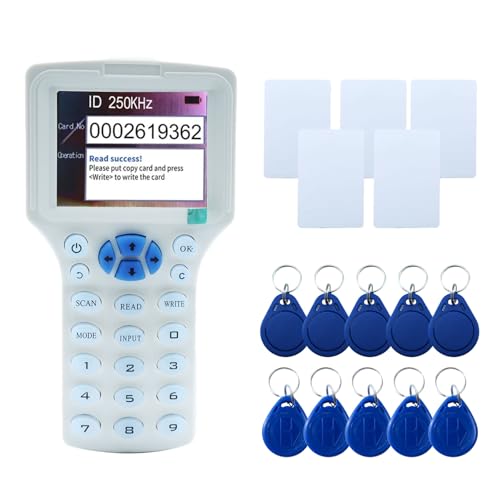
This RFID copier supports a wide range of frequencies from 125KHz up to 13.56MHz, including HID cards. It is designed for seamless read/write operations and includes software for enabling access control and data transfer workflows. Best for users who need to clone or copy various card types and test different card formats.
Best for: users experimenting with access control cards or performing legitimate card provisioning. The device’s broad frequency support makes it suitable for comparing card compatibility across multiple systems.
Caution: Some users may require troubleshooting when a write operation fails; multiple attempts may be needed and the device should be used within legal guidelines for card copying.
Tqsbeyah RFID Reader Writer Handheld 125KHz

This handheld 125KHz RFID writer is compact and designed for portable use. It ships with writable keyfobs and cards, making it suitable for on-site data copying and quick card provisioning. Requires two AAA batteries for operation. Best for fieldwork or temporary access setups where a computer connection is not available.
Best for: on-site copying and rapid deployment of access credentials. Its portability supports quick action in facilities or events. Limitation: batteries are sold separately and may affect immediate on-site usability if not prepared.
13.56Mhz USB RFID Reader As Keyboard Input

This USB reader works as a HID keyboard input device and supports ISO 14443A protocol cards. It emulates keystrokes for card UID data, making it ideal for quick data capture into text fields or spreadsheets. Best for developers or administrators who need a simple data entry workflow without drivers.
Best for: environments needing plug-and-play keyboard emulation for card data. Limitation: may require manual formatting of UID data in downstream software.
Ajfwm Dual-Band RFID Card Reader

The Ajfwm reader supports both 125KHz and 13.56MHz frequencies, compatible with ISO14443-A/B protocols and IC ID card formats. It emphasizes easy setup across Windows, Linux, and Android, without driver installation. Best for users who need a versatile, cross-system reader in a single device.
Best for: users who require flexible frequency support and broad compatibility. Limitation: ensure your specific card type is supported by the device’s features before purchase.
Buying Guide: Key Considerations For RFID Card Readers
What should you check before buying? Identify the primary users (DIY tinkerers, small businesses, or security teams) and your target card formats (125KHz vs 13.56MHz). Consider the following:
- Compatibility: Are your cards ISO Prox, HID, EM, or other formats? Choose a device with multi-format support if needed.
- Frequency range: Single-band readers work for focused use; dual-band options provide future-proofing.
- Interface and setup: USB HID devices are driver-free; some devices require software for cloning or configuration.
- Portability: On-site deployments benefit from handheld units with battery power.
- Security and legality: Use readers for legitimate access control and card provisioning only; cloning or copying should follow local laws and organizational policies.
How to decide between options? If you need broad card support with easy USB use, consider the 125KHz/dual-band readers. If you want on-site copying or testing, a handheld writer may be best. For desktop data capture via keyboard emulation, a 13.56MHz HID reader is ideal.
Frequently Asked Questions
- What is the difference between 125KHz and 13.56MHz readers?
125KHz handles low-frequency proximity cards; 13.56MHz covers more modern proximity technologies and many IC cards. Some devices support both for versatility. - Do HID USB readers need drivers?
Most HID USB readers act as keyboard input and do not require drivers, enabling plug-and-play use across systems. - Can these readers clone or copy cards?
Some devices advertise cloning capabilities; use only for legitimate, authorized purposes and follow legal guidelines and device instructions. - Are dual-band readers backward compatible with older cards?
Yes, dual-band readers typically support both older and newer card formats, depending on the model and configuration. - Which reader is best for field use?
Handheld or portable readers are best for on-site copying and quick credential provisioning without a computer. - Do these readers work with Linux or macOS?
Many listed devices support Linux and macOS in addition to Windows, but check each product’s compatibility notes before purchasing.