
Finding the right rubber feet for a subwoofer helps reduce vibration, improve bass clarity, and protect floors and equipment. Below is a quick comparison of highly rated Amazon options to help you choose the right isolation solution.
| Product | Type | Mount | Best For |
|---|---|---|---|
| Howonder Rubber Feet (16 Pack) | Small Rubber Bumpers | Screw | Multiple small speakers, cutting boards |
| QfwdfcTrenz Heavy-Duty Rubber Feet (8Pcs) | Heavy-Duty Shock Absorbers | Screw | Subwoofers, guitar amps |
| Monosaudio 40x20mm Isolation Feet (4Pcs) | Aluminum Core With Rubber Ring | Screw / Bolt | High-load audio gear, subwoofers |
| Hudson Hi‑Fi Platinum Silicone Feet (8-Pack) | Large Silicone Pads | Adhesive | Turntables, mid-weight speakers |
| GorillaGrit Tall Square Adhesive Bumpers (20) | Small Square Adhesive Pads | Adhesive | Electronics, airflow spacing |
Howonder Rubber Feet, 16 Pack 40mm x 10mm

Package Includes 16 rubber feet with Phillips screws. Bottom diameter is 40mm and height 10mm, with a 6mm screw hole. The design emphasizes elasticity, flame retardancy, corrosion resistance, and antistatic properties.
These bumpers fit many small- to medium-sized cabinets and subwoofers where multiple contact points are preferred. The included screws simplify mounting and provide a secure mechanical connection. Their lower profile helps keep equipment close to the surface while adding vibration dampening and floor protection.
8Pcs Heavy-Duty Rubber Feet For Subwoofer

These heavy-duty feet use high-density rubber with stainless steel screws. The pads are engineered for shock absorption and to reduce resonance transferred to surfaces. Each foot supports up to approximately 35 lb and features a non-slip rubber base.
Designed for subwoofers, guitar amps, and other heavy audio gear, these feet prioritize stability under load. The stainless hardware resists corrosion and the shore hardness matches applications where stronger damping and reduced motion is required.
Monosaudio 40x20mm Speaker Isolation Feet With 3M

Monosaudio combines an aluminum core with a removable non-slip rubber ring. The pads claim very high load capacity (single pad support up to ~880 lb per listing), with a central mounting hole around 4.5mm. The construction aims to reduce harmonic vibration and deliver high damping.
These feet are suitable for heavier subwoofers and components where a rigid core plus rubber decoupling is desired. The removable rubber ring provides non-slip contact while the metal core distributes weight and resists compression under high loads.
Hudson Hi‑Fi Platinum Silicone Feet – 8-Pack

These silicone feet are large (2.5″ wide, 1.25″ tall) and made from a Platinum Silicone formula with Durometer 20 (Shore A). They are adhesive-backed and rated to handle components roughly between 50–100 lb per pad depending on setup. Temperature tolerance is wide, from -40°C to +240°C.
Hudson Hi‑Fi targets audiophile use, where softer silicone material absorbs micro-vibrations and prevents bass muddiness. Adhesive mounting keeps installation simple; the larger surface area increases contact and can be effective on both hard floors and racks.
GorillaGrit Black Tall Square Adhesive Bumper Pads – 20 Pieces

These self-adhesive square pads measure approximately 0.78″ across and 0.38″ high. The set of 20 is intended for electronics, small appliances, speakers, and furniture. The low profile provides spacing for airflow and cushioning while preventing scratches to surfaces.
Their adhesive backing makes them fast to apply without tools. They are useful for lighter subwoofers or to supplement other feet, as spacers or anti-slip supports under cabinets where less isolation is acceptable.
Komsunma Rubber Feet Subwoofer Isolation Pad – 4 Pack
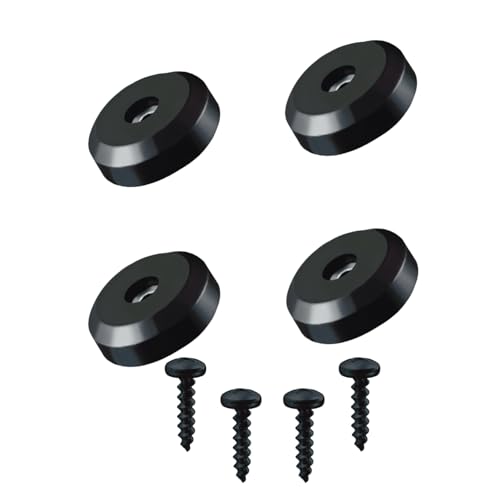
This 4-pack features 40mm diameter, 15mm height feet with built-in stainless-steel washers and screws for a secure install. The manufacturer emphasizes professional-grade anti-slip and shock absorption qualities and easy installation with a Phillips screwdriver.
The taller profile increases isolation distance and damping compared with low-profile bumpers, making these suitable for subwoofers where more vertical decoupling is desired to reduce cabinet-to-floor coupling.
Hudson Hi‑Fi Bigfoot Rubber Pads – 4-Pack

Bigfoot pads are larger non-adhesive rubber discs (approx. 2.37″ diameter, 1.5″ tall) with a Durometer 50 rating. These non-skid feet are designed for heavier components in the 60–100 lb range and provide substantial isolation and floor protection without adhesive.
The firmer material and taller profile make these helpful where support and load distribution are critical, and where users prefer repositionable mounts or rubber-on-floor contact rather than adhesive bonding.
Hudson Hi‑Fi Silicone Isolation Feet (4-Pack, 1″)

These 1″ adhesive silicone pads use a Durometer 20 formulation to absorb up to 95% of targeted micro-vibrations. Each pad supports lighter components and aims to improve precision and clarity by reducing resonance between equipment and surfaces.
They work well for smaller subwoofers, turntables, or as supplemental isolation where high-frequency decoupling is desired without large footprint mounts.
Buying Guide: How To Choose Rubber Feet For Your Subwoofer
Selecting the right rubber feet involves matching material, mount type, load capacity, and isolation needs to your subwoofer and room setup. Below are key factors to consider.
Material And Durometer
- Soft Silicone (Lower Durometer) – Better at damping micro-vibrations and preventing bass muddiness; ideal for turntables and lighter subwoofers.
- Harder Rubber (Higher Durometer) – More durable under heavy loads and prevents excessive compression; useful for large subwoofers and heavy cabinets.
- Hybrid (Metal Core + Rubber) – Combines load distribution with decoupling; suitable for very heavy gear.
Mount Type: Adhesive Vs. Screwed Vs. Non-Adhesive
- Adhesive Pads – Quick install, best for permanent or semi-permanent setups; surface prep required for strong bond.
- Screw-Mounted Feet – Provide mechanical attachment and higher security under heavy loads; requires drilling or existing mounting holes.
- Non-Adhesive Pads – Repositionable and floor-friendly; rely on weight and friction for isolation.
Load Capacity And Size
- Check the manufacturer’s weight support per pad. Divide total equipment weight by the number of feet to confirm safety margin.
- Larger diameter pads distribute weight and reduce surface pressure; taller pads increase decoupling distance for improved isolation.
Vibration Reduction Goals
- For tighter, cleaner bass, prioritize materials and geometries that target low-frequency coupling.
- If the aim is to prevent cabinet rattles on floors, choose firmer pads with greater surface area or screw mounts.
Floor Protection And Slip Resistance
- Soft pads prevent scratches and scuffs on hardwood and tile floors.
- Non-slip bases or rubber rings ensure the subwoofer stays in place during transients.
Installation And Serviceability
- Screw-mounted feet offer easier service access and are less likely to detach under heavy use.
- Adhesive feet simplify retrofits but may leave residue if removed; consider removable adhesive pads where reconfiguration is likely.
Comparison Perspectives
- Weight Versus Isolation – Heavier subwoofers often need firmer supports; lighter speakers benefit from softer silicone for micro-damping.
- Permanent Vs. Temporary Setup – Choose screws for permanence and stability; adhesive or non-adhesive for flexibility.
- Budget And Quantity – Multi-packs of small bumpers are cost-effective for many contact points; larger pads cost more but provide better isolation per pad.
- Room And Floor Type – Hard floors may require softer or larger pads to reduce transmission; carpeted floors change contact needs and may need towers or larger diameter bases.
Use the above comparisons to match the mechanical and acoustic needs of your subwoofer system. Measure current mounting points, consider the total weight, and decide if you prefer permanence (screws) or convenience (adhesive/non-adhesive) before selecting a product.