
Best RV Surround Sound Receivers for Clear Campground Audio
Answering the needs of RV owners who want crisp, room-filling sound without a lot of setup, these options are designed for portable, in-vehicle entertainment. The top picks below focus on 5-channel or 5.1-channel configurations, Bluetooth streaming, and RV-friendly inputs. Ideal for campers who want simple hookup, versatile inputs, and solid multi-zone or multi-device control. The buyer’s best fit depends on desired features like HDMI, Bluetooth range, and number of input options.
| Product | Key Strength | Best For |
|---|---|---|
| Pyle 100W 5 Channel PFA540BT | Bluetooth, HDMI, FM antenna, 5-channel | RV owners needing basic 5-channel power with wireless streaming |
| Pyle 100W 5.1 Channel PFA560BT | Higher power, 5.1 channel, multiple inputs | Compact setups needing more inputs and stronger output |
| Pyle PDA7BU | 200W, karaoke-ready, USB/SD | Group campsites or entertaining spaces with karaoke |
| iRV32V2 | 3 zones, HDMI ARC, Bluetooth, USB | Multi-zone RV audio with AV control |
| iRV66 | 5.1 surround, multiple HDMI outputs | Dedicated RV theater sound with AV connections |
Pyle 100W 5 Channel PFA540BT

The PFA540BT offers 100 watts across five channels with Bluetooth streaming and a built-in LCD display for easy setup. An included 12V adapter and remote control are designed for RV or small room installations. Best for: RV owners who want a straightforward, compact multi-channel receiver with wireless music from smartphones or tablets. Limitation: HDMI options are present but may not cover all modern home theater configurations.
Pyle 100W 5.1 Channel PFA560BT
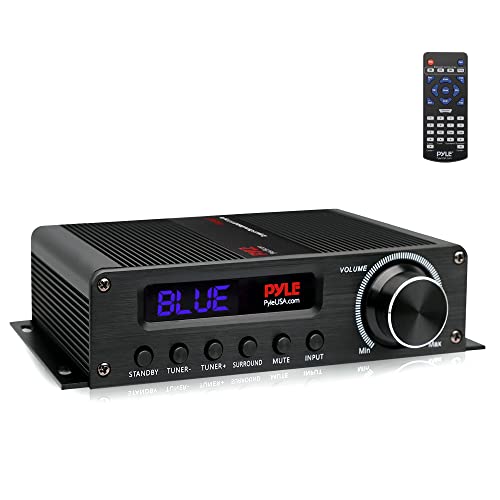
This amplifier delivers 100W peak across 5.1 channels and adds multiple inputs, including RCA subwoofer output, HDMI in/out, and FM antenna input. It enables flexible AV setups for RV interiors that require more connectivity than a basic stereo. Best for: campers who want robust audio with more input options and a fuller surround experience. Caution: The included features may exceed needs for ultra-simple setups, increasing wiring complexity.
Pyle PDA7BU Bluetooth Home Theater Amplifier

The PDA7BU packs 200 watts into five channels with a subwoofer output and karaoke-friendly features. It includes dual mic inputs, USB/SD, and Bluetooth streaming. Best for: RV groups that want a ready-made, karaoke-capable unit with flexible media options. Limitation: Higher power means a larger footprint and more setup space in smaller RV cabinets.
iRV Technology iRV32V2

The iRV32V2 supports 3 zones with HDMI in/out, ARC, and Bluetooth 4.1 for seamless device linking. An accompanying app enables remote control, helping RV residents manage zones and inputs from a distance. Best for: RV owners seeking multi-zone control with modern HDMI connectivity. Caution: App reliability may depend on the device and OS version used in the RV crew.
iRV66 3-Zone RV Sound System

The iRV66 delivers 5.1 surround, Bluetooth 4.1, and multiple HDMI outputs with ARC for RV theater setups. Best for: RV enthusiasts seeking a dedicated theater-like experience with multiple HDMI interfaces. Limitation: The complexity of 5.1 wiring may require more planful installation in compact RV interiors.
Buying Guide: Key Purchase Considerations
- Power and channels: For room-filling sound in an RV, aim for 5-channel or 5.1-channel receivers with at least moderate power (60–100W per channel recommended for larger spaces).
- Input options: Consider HDMI, RCA, USB/SD, FM, and Bluetooth if you plan to use streaming devices, satellite radios, or karaoke features.
- Zones and control: If you want multi-room audio, prioritize products advertised with 2–3 zones and mobile app controls for remote operation.
- Form factor: RV installations require compact units with mounting options. Check the dimensions and weight to fit cabinet space.
- Connectivity with existing gear: HDMI ARC support helps connect to small TVs; Bluetooth helps with phone streaming without cables.
- Ease of use: Displays and remote controls should be simple to operate in a moving RV environment where quick adjustments are common.
- Reliability on the road: Look for devices with stable wireless interfaces and solid remotes, since RV travel can cause antenna or signal variations.
Frequently Asked Questions
- What is the difference between 5-channel and 5.1-channel RV receivers?
Five-channel typically means five speakers with a dedicated amp for each channel; 5.1 adds a dedicated subwoofer channel for deeper bass.
- Do these receivers require a separate amplifier?
Many listed models are integrated amplifiers with built-in power. Some can be paired with external amps if more power is needed.
- Can I use Bluetooth to stream from a phone to an RV stereo?
Yes, Bluetooth is supported on all listed models for wireless streaming from modern smartphones and tablets.
- Is HDMI ARC important for RV setups?
ARC allows a TV to send audio to the receiver via a single HDMI cable, simplifying connections in compact RV spaces.
- What should I consider when choosing between a basic and a feature-rich unit?
Basics are easier to install and cheaper; feature-rich units offer more inputs, zones, and media options but require more space and setup planning.
| Feature | Recommendation |
|---|---|
| Multi-zone support | Helpful for RVs with separate living and sleeping areas |
| HDMI inputs/ARC | Useful for TV connection and easy device switching |
| Bluetooth | Essential for wireless music from phones and tablets |
| Size | Compact units fit small cabinets or closets |