
Best Self-Build Speaker Kits for DIY Audio Enthusiasts
Answering the demand for hands-on audio projects, these self-build speaker kits let you assemble your own Bluetooth or radio-equipped speaker. They’re best for hobbyists who want practical engineering experience, students exploring electronics, and families seeking interactive STEM activities. Below are five well-rounded kits chosen for clarity, accessibility, and clear instructional support.
Summary of Selected Products
- CYOEST DIY Bluetooth Speaker Kit Wood Case — Best for compact, wood-cased builds and classroom STEM projects
- Swhmc DIY Bluetooth Speaker Kit for Kids 8-12 — Best for beginners and parent-child activities
- BANRIA DIY Bluetooth-Compatible Speaker Soldering Kit with FM Radio — Best for learners who want recording and multiple inputs
- JIUWU STEM Projects Kit for Portable Wood Bluetooth Speaker — Best for creative, kid-friendly woodworking and electronics
- diymore DIY Bluetooth Speaker Kit USB Mini Stereo Amplifier — Best for rollers who want multiple audio sources and a soldering practice
CYOEST DIY Bluetooth Speaker Kit Wood Case

Best for: Students and hobbyists who want a wooden, self-contained build with clear, simple assembly. The kit includes laser-cut wooden components, two 2-inch full-range speakers, a dual-channel Bluetooth amplifier, and straightforward instructions. It supports wireless connection to a phone or computer and requires four batteries (not included). It’s ideal for STEM education and small-room listening, delivering a compact, elegant finish.
Why selected: This kit emphasizes a solid balance of sound quality and ease of assembly with a wooden case, making it approachable for classroom projects or home experiments. It offers practical hands-on experience in engineering and circuit concepts.
Caution: Power relies on external batteries; ensure you have compatible batteries on hand before starting.
Swhmc DIY Bluetooth Speaker Kit for Kids 8-12

Best for: Young learners and families seeking an easy-to-build, visually engaging project with LED lighting. It’s a solder-free kit with a portable handle and 20 LED lights that pulse with the music, paired with a full-range dual-channel speaker for clear sound.
Why selected: It combines simple assembly with a visually appealing light show, making it a strong STEM education choice for ages 8–12 and parent-child activities.
Caution: Battery not included; ensure proper battery selection before use.
BANRIA DIY Bluetooth-Compatible Speaker Soldering Kit

Best for: Learners who want advanced features, including a radio, multiple input options, and a one-click recording function. The kit supports Bluetooth, AUX, USB-disk, and TF cards, with a color LED display and power-off memory.
Why selected: This is a versatile kit that teaches multiple input methods, wireless music playback, and basic digital recording concepts, making it suitable for more capable hobbyists and classrooms exploring multimedia playback.
Caution: Soldering is required; beginners should practice basic soldering skills or start with a pre-soldered model.
JIUWU STEM Projects Kit for Portable Wood Bluetooth Speaker

Best for: Beginners and youth ages 12–14 who want a practical woodworking-based electronics project. The kit focuses on snap-together wooden parts to assemble a Bluetooth speaker with a simple, non-soldering approach. It emphasizes hand-eye coordination, logical thinking, and patience.
Why selected: It blends woodcraft with electronics, appealing to students who enjoy making something tangible and personalized while learning basic principles of circuits and wireless tech.
Caution: The kit is designed for beginners; more complex projects may require additional guidance or tools not included in the box.
diymore DIY Bluetooth Speaker Kit USB Mini
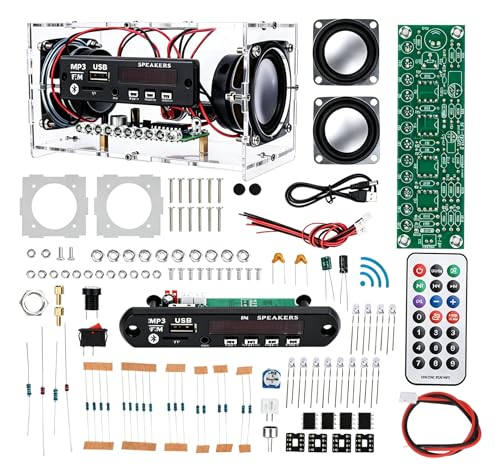
Best for: Learners who want hands-on soldering practice and a multifunction setup with USB, Bluetooth, AUX, TF, and FM radio. This kit supports remote control operation and multiple audio sources for flexible listening experiences.
Why selected: It provides a practical soldering project with broad compatibility for different audio inputs, making it suitable for electronics enthusiasts and classroom sessions focused on soldering skills.
Caution: Requires soldering; beginners should follow safety guidelines and consider practicing basic soldering before attempting more complex steps.
Buying Guide
What should you look for in a self-build speaker kit?
Consider assembly difficulty, whether soldering is required, available power options, and the enclosure style. Wood cases offer a classic look and good acoustics, while acrylic or compact enclosures save space. Check if the kit includes speakers, amplifier, and wiring, or if you must source parts separately.
Which features matter most for beginners?
Look for solder-free options, clear step-by-step instructions, and a straightforward build process. LED features or a handle for portability add appeal but aren’t essential for learning basics.
What about learning outcomes?
STEM-focused kits help learners understand acoustics, circuitry, and Bluetooth or radio operation. Projects that emphasize hands-on building, problem solving, and teamwork tend to offer the strongest educational value.
Where to start depending on age?
- Ages 8–12: Favor solder-free kits with guided steps and engaging visuals, like the Swhmc and JIUWU kits.
- Ages 12–14: Consider kits with basic soldering and more complex features, such as the BANRIA or diymore kits.
- Teens and adults: Explore kits with broader input options, recording features, or more durable enclosures, like the BANRIA and CYOEST options.
Care and maintenance tips
- Use fresh batteries or a proper power source when a kit is battery-powered.
- Inspect connections before powering to avoid shorts.
- Keep speakers away from moisture and ensure proper ventilation during soldering.
FAQ
- Do these kits require prior electronics experience?
Most beginner-friendly kits require minimal experience, with ample instructions. - Are they suitable for group activities?
Yes, several kits are designed for parent-child collaboration or classroom use. - Do kits include power supplies?
Some include all components except batteries or power adapters; verify before purchase. - Are there safety considerations?
Soldering involves hot tools; follow safety guidelines and supervise youth under adult guidance.