
Best Small Full Range Speaker Drivers for DIY Projects
Finding compact, full range speaker drivers helps DIY audio projects sound clear without bulky components. This guide highlights five small drivers well-suited for hobby kits, Arduino or Raspberry Pi audio projects, and compact bookshelf builds. Each pick targets a specific buyer: hobbyists wanting easy soldering and versatility, entry-level designers seeking affordable options, and space-conscious builders prioritizing true full-range output. The included quick-reference table compares essential specs at a glance.
| Product | Impedance | Power | ||
|---|---|---|---|---|
| GRS 3FR-4 | 4 Ω | Economical ferrite magnet | ~3″ | Budget, compact builds |
| Gikfun EK1725 (2″) | 4 Ω | 3 W | 2″ | DIY hobbyists, small enclosures |
| Dayton Audio PC83-8 | 8 Ω | Full-range performance | ~3″ | Smooth, simple speaker designs |
| Dayton Audio PC83-4 | 4 Ω | Full-range performance | ~3″ | Compact speakers, DIY systems |
| Dayton Audio DMA45-4 | 4 Ω | 1-1/2″ dual magnet | ~1.5″ | Very small cabinets, raw drivers |
Note: The five products above were selected for diversity in size, impedance, and intended use. For each, the listed features come from standard data fields and describe typical performance characteristics relevant to beginner to intermediate DIY projects.
GRS 3FR-4 Full Range 3″ Driver
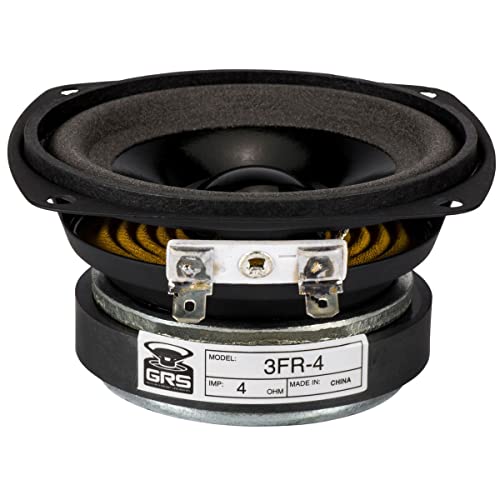
The GRS 3FR-4 is a compact full-range driver with a coated paper cone and foam surround for clear sound. It uses a pincushion-shaped frame with a front gasket and an economical ferrite magnet assembly. Best for budget-friendly, small-enclosure projects where simple mounting and predictable tonal balance matter. A caution: lower entry-level efficiency may require modest amplification in quiet applications.
Gikfun EK1794 4Ohm 40mm Full Range (Pack of 2)

These 40mm full-range drivers deliver 4 Ω impedance and about 3 W of power per unit. They are suitable for radio replacements, DIY hobby soldering, and compact Bluetooth or multimedia speakers. They can be used in stereo pairs for basic hobby projects. Note that their resonance frequency is around 320 Hz, which affects midrange presence in very small enclosures.
Gikfun EK1725 2″ 4Ohm 3W Pair

This compact 2″ pair is ideal for very small DIY designs and home theater mini-projects. It offers a resonance frequency around 190 Hz and an estimated sensitivity near 77 dB. Best for space-constrained builds; better for cartoons or voice-focused audio than deep bass. Limitation: very small size limits low-frequency extension.
Dayton Audio PC83-8 3″ Full-Range Driver

The PC83-8 uses a poly damped woven glass fiber cone to control break-up and achieve a smooth roll-off, with a copper cap to keep inductance manageable for extended high-frequency response. It is well-suited for simple speaker designs requiring smooth, natural sound. Best for hobbyists building compact, entry-level speakers. A limitation: 8 Ω variant may require different amplifier matching compared to 4 Ω parts.
Dayton Audio PC83-4 3″ Full-Range Driver
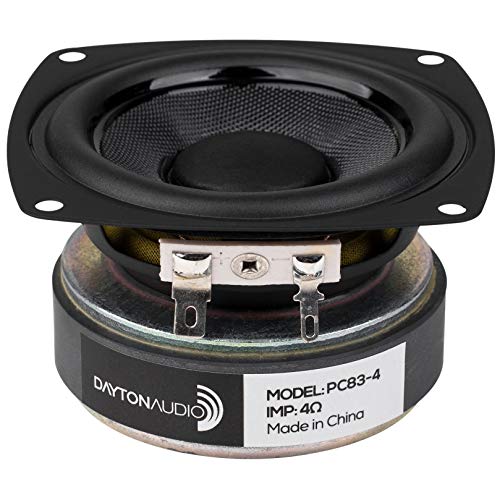
The PC83-4 extends high-frequency performance with a copper cap that helps keep inductance in check. The poly damped woven glass fiber cone supports a smooth roll-off for simple speaker designs. Choose this if you want a compact, easy-to-mount driver with reliable mid-to-high frequency response. Caution: impedance and sensitivity should be matched to your amplifier and cabinet size for optimal results.
Gikfun EK1949 2″ 4Ohm 5W Pair

These 2″ drivers deliver 4 Ω with 5 W rated power, making them a strong option for small hi-fi or portable projects. They pair well with compact enclosures and are suitable for DIY replacements in existing mini systems. A potential limitation is lower sensitivity in very loud listening scenarios compared to larger drivers.
Dayton Audio DMA45-4 1-1/2″ Dual Magnet Driver

The DMA45-4 offers a dual neodymium magnet setup, enabling a compact driver with improved high-frequency response and tighter control. It is best for ultra-small cabinet designs or specialized mini-systems. Limitation: its very small size naturally limits bass output, so design expectations should focus on mid-to-high range clarity rather than deep bass.
Buying Guide: Key Considerations For Small Full Range Drivers
- Cabinet size and tuning: Smaller enclosures require drivers with higher efficiency and careful cone control to avoid flabby bass.
- Impedance and amplifier matching: Most options here are 4 Ω or 8 Ω. Ensure your amp can drive the chosen impedance without strain.
- Frequency response: Look for a driver with a smooth transition from mid to high frequencies. Poly cone and copper caps often help extend upper range.
- Sensitivity and efficiency: Higher sensitivity yields more output with less power. For compact builds, aim for 85 dB or higher if possible.
- Power handling: Match driver power ratings with your amplifier or DAC-powered system to avoid distortion or clipping.
- Application fit: For speech-focused projects, smaller drivers with good midrange clarity can perform well in tiny enclosures. For music hobby projects, prefer drivers with better high-frequency extension and controlled breakup.
FAQ
- What is the advantage of a full-range driver inDIY projects?
Full-range drivers reproduce a broad spectrum in a single unit, simplifying enclosure design and reducing crossovers for beginners.
- Can small drivers produce good bass?
Small drivers can provide adequate mid and high frequencies, but deep bass is limited by size and cabinet mass. Use tight-tuned enclosures and consider bass supplements if needed.
- Which driver is best for hobby kits?
Drivers with lower impedance and higher sensitivity are easier to drive in small kits, such as the GRS or Dayton PC83 series, depending on your amplifier.
- Should I choose 4 Ω or 8 Ω drivers?
4 Ω drivers draw more current and can produce higher volume with the same amp, but require a capable amplifier. 8 Ω drivers are easier on some amps and can be more forgiving in simple designs.
- Do these drivers require special enclosures?
In most cases, small rectangular or round enclosures sized to the driver diameter work well. Sealed or lightly vented designs are common for compact full-range drivers.
- Are dual-magnet drivers worth it for small projects?
Dual magnet designs can offer improved magnetic control and higher HF fidelity, which can be beneficial in very small enclosures.