
Best Small Speakers for Desktop: Pick the Right Compact Audio Upgrade
Answering the search intent, these compact desktop speakers deliver clear sound without clutter. They suit different buyers: students and small-space desks benefit from compact USB-powered models; traditionalists may prefer 2.0 stereo setups with easy volume control; and those who want minimal cables will lean toward USB-C or USB-powered options. Below are five top picks with clear advantages and practical trade-offs so you can choose confidently for everyday computer listening, gaming, or streaming.
Summary table of chosen products
| Product | Key Benefit | Best For |
|---|---|---|
| [Upgraded] Computer Speakers for Desktop PC | Plug-n-Play USB, broad OS compatibility | Windows/macOS/Linux users seeking simple setup |
| Computer Speakers for Desktop PC Monitor, USB Plug-in, Wired | Adaptive-channel-switching and clip-on monitor use | Desk engineers needing monitor-height placement |
| Amazon Basics Stereo 2.0 Speakers for PC or Laptop | Two-speaker USB-powered setup with volume control | Simple, reliable everyday listening |
| Creative Pebble V3 Minimalistic 2.0 | Clear dialog processing, USB-C with clutter-free cabling | Multimedia and casual viewing on USB-C PCs |
| Amazon Basics USB-Powered Computer Speakers | Compact, plug-and-play with headphone jack | Ultra-portable, space-saving desks |
[Upgraded] USB Computer Speakers for Desktop PC

Best for Windows and mixed-OS users who want a straightforward plug-and-play USB option. This LIELONGREN model emphasizes quick setup and broad compatibility with Windows, macOS, Linux, and Chrome OS. It’s especially suitable for students, home offices, or shared workstations that require reliable sound without extra drivers. A potential limitation is dependence on a free USB port for power and playback, which may be a concern on very slim devices.
Key features: USB plug-and-play, Windows 7/8/10/11 compatibility, macOS/Linux/Chrome OS support. Simple taskbar playback selection makes it easy to set as the default device.
Who this is best for: Users who want minimal setup steps and broad OS compatibility on a desktop or laptop.
Why selected: It covers multiple operating systems with a straightforward USB connection, reducing setup friction for mixed device environments.
Limitations to note: May require manual device switching in some systems when multiple audio outputs are present.
Computer Speakers for Desktop PC Monitor, USB Plug-in

This wired USB soundbar-style speaker system combines USB power with adaptive-channel-switching for PCs and laptops. It’s well-suited for desk setups where a single small sound source mounted near the monitor saves space. The built-in USB-C adapter expands compatibility for newer laptops that rely on USB-C. A caveat is that this model isn’t compatible with TVs or projectors, so it’s better for computer-centric use rather than living-room setups.
Key features: USB devices compatible (Windows/macOS/ChromeOS/Linux), built-in USB-C adapter for USB-C devices, dual drivers and bass capability described in marketing materials.
Who this is best for: Desk workers and students who want a compact computer-centric soundbar with simple USB connections.
Why selected: Combines easy USB playback with expanded compatibility for new laptops via USB-C, while maintaining a compact form factor.
Limitations to note: Not intended for TV or home theater use; performance depends on PC audio output.
Amazon Basics Stereo 2.0 Speakers for PC or Laptop

Two compact USB-powered speakers with in-line volume control provide a straightforward, reliable listening experience for daily tasks. They are best for users who want a budget-friendly, plug-and-play setup without needing Bluetooth or extra adapters. A limitation is the absence of a built-in digital input; it relies on the PC’s 3.5mm output and USB power for operation.
Key features: USB-powered, stereo 2.0, in-line volume control, 3.5mm auxiliary input, compact pair design.
Who this is best for: Anyone seeking a simple, dependable two-speaker system for work or study on a PC or laptop.
Why selected: It’s a reliable, no-fruss setup that minimizes cables while delivering adequate desk audio enhancement.
Limitations to note: Lacks advanced bass or software features found in larger or newer USB-C models.
Creative Pebble V3 Minimalistic 2.0 USB-C Desktop Speakers
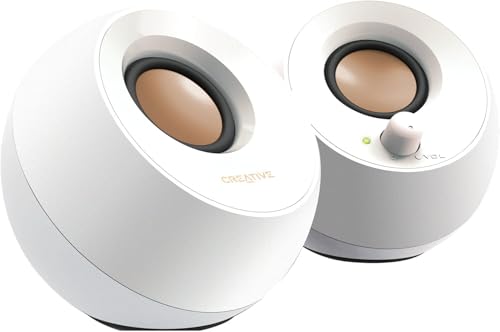
The Creative Pebble V3 focuses on a clutter-free USB-C setup with strong power and clear dialog processing. It’s best for multimedia consumption on USB-C laptops, desktops, or tablets where space is limited. It excels in delivering crisp high-end detail with a simple two-satellite design. A caution: performance depends on the host device’s USB-C power output, and some older PCs may require adapters.
Key features: USB-C powered, 8W RMS with up to 16W peak, Clear Dialog processing, minimal cabling, 2.0 setup with 3.5mm AUX input support.
Who this is best for: Users with USB-C ports on their computer seeking quiet, compact speakers for everyday media and calls.
Why selected: Combines solid voice clarity and space-saving design with easy plug-and-play USB-C connectivity.
Limitations to note: May require USB-C power port that can provide enough wattage for maximum output.
Amazon Basics USB-Powered Computer Speakers

These compact USB-powered speakers emphasize portability and ease of use, with a front-mounted volume control and a 3.5mm headphone jack. They’re ideal for laptops, dorm rooms, or any compact desk where minimizing cables matters. A limitation is their modest power output, which may be less suitable for users seeking room-filling sound in larger spaces.
Key features: USB-powered, front volume control with on/standby, 3.5mm headphone jack, plug-and-play.
Who this is best for: Students and travelers who need an ultra-portable desk audio solution.
Why selected: Very small footprint with simple controls, making it ideal for tight desks and on-the-go workspaces.
Buying Guide: Small Desktop Speakers
How do I choose the right size and power?
For compact desks, prioritize smaller 2.0 or soundbar-style units. USB-powered options are excellent for minimal cables and easy power delivery. If you need louder audio, look for higher wattage or drivers with passive radiators, but be mindful of desk space and heat from extended use.
Which connection should I pick?
USB-powered speakers are easiest with desktops and laptops, offering simple plug-and-play. USB-C models suit newer devices with power delivery. If you want to use headphones sometimes, choose a model with a front headphone jack.
What about sound quality vs. price?
Two-speaker setups often deliver balanced sound and clean midrange for speaking voices and music. Soundbar-style USB speakers can provide bigger perceived bass without needing a separate subwoofer. Consider your primary use: video calls, gaming, or casual listening.
Are there any compatibility concerns?
Most models in this list support Windows, macOS, Linux, and Chrome OS. If you rely on USB-C only ports, pick a model advertised as USB-C compatible or with a USB-C adapter built-in.
How should I position desktop speakers?
Place speakers at ear level and equidistant from your seating position. Angle them slightly toward you to improve direct sound. If you have a small monitor arm or shelf, the height and angle can influence dialogue clarity and bass perception.
What is a good buying strategy?
Start with a compact, USB-powered two-speaker system for baseline listening. If you need more bass or space efficiency, consider a soundbar-style USB option or a computer speaker set with advanced drivers. For occasional gaming or movies, a model with Clear Dialog processing can help voices stay crisp during action scenes.
Frequently Asked Questions
- Q: Do I need drivers to use these speakers?
A: No drivers are typically required; plug-and-play via USB or auxiliary input is common. - Q: Can USB-powered speakers replace desk speakers connected to a computer?
A: They can, for most daily tasks, but very high volume or deep bass preferences may require AC-powered or larger setups. - Q: Are USB-C speakers backward compatible with USB-A ports?
A: Many models include adapters or are designed to work with both ports; verify the product description. - Q: Will these speakers improve built-in laptop sound?
A: Yes, they typically offer clearer audio, louder output, and better bass than most built-in laptop speakers. - Q: Is external sound better for video calls?
A: Yes, external speakers with a clear dialog feature can improve voice clarity during calls. - Q: Do they require an outlet?
A: USB-powered speakers draw power from the connected device; some AC-powered units require a wall outlet.