
Best Sound Recorders for Film Fans and Filmmakers: Find Your Ideal on-Set Audio Companion
The buyer’s intent here is clear: locate reliable, film-friendly sound recorders that deliver clean, broadcast-worthy audio in diverse environments. This guide curates five top options, highlighting who each model suits best, why it stands out for film projects, and any limitations to know before you buy. Ideal for independent filmmakers, documentary crews, and location sound professionals, these selections balance portability, sound quality, and robust inputs. A quick summary table below helps compare key points at a glance.
| Product | Best For | Key Benefit | Limitations |
|---|---|---|---|
| Zoom H4 Essential Handheld Recorder | Small crews, on-the-go shoots | 4-track recording with flexible inputs | May require accessories for advanced mics |
| Zoom H1 XLR 2-Channel Recorder | Quick setups, interview runs | Two XLR/TRS inputs, portable | Limited tracks, simple UI |
| Zoom F3 Professional Field Recorder | Run-and-gun shoots | 32-bit float, reliable in dynamic environments | Higher price point |
| Zoom H5 4-Track Handheld Recorder | Flexible mic options, studio-style field work | Interchangeable capsules | Extra accessories may be needed |
| Zoom H6 Studio Handy Recorder | Multi-microphone setups | Six tracks with 32-bit float | Bulkier than ultra-portables |
Zoom H4 Essential Handheld Recorder for Musicians, Podcasters & Filmmakers

The Zoom H4 Essential offers a flexible 4-track workflow that supports music, interviews, podcasts, and film audio. It provides built-in stereo mics and the ability to connect external mics or instruments, or route signals through a mixer or soundboard via two XLR/TRS inputs. This makes it well-suited for small crews and on-location shoots where you need reliable, grab-and-go capture with room to grow. Best for filmmakers who want a versatile on-camera or handheld solution without sacrificing upgrade potential.
Best for: indie filmmakers and location sound operators who value multiple recording paths and straightforward operation. Why selected: strong all-around performance with flexible inputs and multiple recording modes. Caution: external gear integration may require additional cables or adapters for complex rigs.
Zoom H1 XLR 2-Channel Recorder for Filmmakers, Musicians & Podcasters

The Zoom H1 XLR 2-Channel Recorder emphasizes simplicity with two XLR/TRS inputs and pro-quality capture up to 96kHz in 32-bit float. It suits interview-driven shoots or quick run-and-gun sessions where dependable, clean audio is essential but space and setup time must stay minimal. The waveform display helps you monitor levels at a glance, reducing the risk of clipping in dynamic scenes.
Best for: on-location interviews and small crews needing immediate, reliable results. Why selected: straightforward operation with solid input flexibility and real-time level awareness. Caution: limited track count may require careful mic placement and post-editing to separate sources.
Zoom F3 Professional Field Recorder for Filmmakers & Musicians

The Zoom F3 is built for real-world, high-stakes recording. It features 32-bit float recording to prevent clipping and handle a wide dynamic range. Dual locking XLR inputs ensure secure connections in busy field setups. This model is ideal for professional film projects where you must reliably capture dialogue and effects in challenging environments without pre-emptive level adjustments.
Best for: professional sets and field crews that require robust reliability in dynamic conditions. Why selected: 32-bit float reduces the risk of distortion in unpredictable sound fields. Caution: higher price point and a steeper learning curve for some users.
Zoom H5 4-Track Handheld Recorder for Filmmakers & Musicians
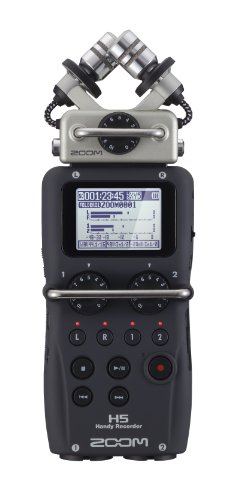
The H5 introduces a modular capsule system, allowing swapping in a detachable X/Y capsule (XYH-5) and extended signal capacity. The recorder supports four-track simultaneous recording, making it suitable for small to mid-sized productions that benefit from flexible mic configurations. It also contributes to reduced handling noise with its shock-mounted mics. Best for: projects requiring quick capsule changes and a blend of studio-like fidelity with field practicality. Caution: additional capsules or accessories may be needed to reach full potential.
Zoom F6 Professional Field Recorder for Filmmakers & Musicians

The Zoom F6 is designed for multi-mic productions with six XLR inputs and up to 14 tracks, offering extensive production flexibility. Its 32-bit float recording provides a broad dynamic range without clipping, making it suitable for complex soundscapes in film. Timecode I/O ensures precise synchronization with video workflows. Best for: larger field setups, Foley stages, or on-set productions needing many simultaneous sources. Caution: heavier and more feature-dense than lightweight options.
Zoom H2 Essential Handheld Recorder for Musicians, Podcasters & Filmmakers

The H2 expands capture options with three mics and nine patterns, delivering versatile stereo and surround-like recordings up to 32-bit float/96kHz. Its “set it and forget it” gain approach reduces risk of clipping during unpredictable shoots. It also doubles as a USB microphone when connected to a computer or mobile device, recording software-free backups directly to SD. Best for: journalists, field researchers, or doc crews needing varied mic patterns and dependable backup. Caution: not as feature-rich for multi-source field recording compared with six- or four-input units.
Buying Guide
What to prioritize when selecting a film-focused voice recorder:
- Input options: Choose the number and type of inputs you need. More mics and line-level inputs offer flexibility for room tones, dialogue, and ambient sounds.
- Dynamic range and clipping protection: 32-bit float can dramatically reduce the risk of distortion on volatile shoots, but consider your typical dynamic range and whether you need this level of protection.
- Portability vs. capability: Lightweight handheld recorders are great for quick interviews and run-and-gun work, while larger multi-input models excel on controlled sets or where sound design requires many sources.
- Capsule system and expandability: Interchangeable capsules or external mics can tailor your rig to angles, rooms, and sound sources.
- Sync and workflows: Timecode I/O and reliable SD card recording help keep audio in sync with video during post-production.
Frequently Asked Questions
- What is 32-bit float recording, and why does it matter for film audio?
32-bit float recording preserves a wide dynamic range, preventing clipping even when levels spike. This is especially useful in film projects with loud effects or unpredictable dialogue levels.
- Should I choose a multi-input recorder over a compact model?
Multi-input recorders are better for complex shoots with several microphones, while compact models work well for quick interviews or single-mource captures with minimal setup.
- How important is timecode I/O for filmmaking?
Timecode I/O ensures precise frame-accuracy between audio and video, which simplifies syncing during post.
- Can a recorder double as a USB microphone?
Some models offer USB mic functionality, allowing you to record directly into a computer for backup or streaming, which can be valuable for field reporting.
- What matters most for on-set reliability?
Secure connections, robust power management, and stable media (SD or CF cards) are essential to avoid mid-shoot failures.