
Best SPDIF Coaxial to Optical Adapters for Home Theater and Audio Systems
Looking for a reliable way to convert coaxial to optical (Toslink) or vice versa? This article highlights five top Amazon picks that support bidirectional conversion, broad audio formats, and easy plug-and-play setup. Ideal for TV owners, soundbar users, and home theater enthusiasts who want flexible, lossless digital audio connections without extra software. The selected models emphasize compatibility with LPCM, DTS, Dolby Digital, and high sample rates up to 192 kHz. A quick buyer’s table follows to help compare key features at a glance.
| Product | Best For | Input / Output | Notes |
|---|---|---|---|
| PROZOR 192K Bi-Directional Optical Converter | All-in-one bi-directional converter | Toslink & Coaxial | Supports 192 kHz/24-bit |
| LiNKFOR 192kHz Coaxial to Optical Converter | Long-distance, built-in cables | Coaxial / Toslink | Built-in 1m cables |
| Bi-Directional Coax Digital Audio Adapter | Compact, flexible setup | Coaxial & Toslink | Plug & play |
| LUKFOCAB Digital Coaxial/Optical Converter | Bi-directional with repeater | Coaxial & Toslink | Built-in amplification |
| diaogenlee Optical/Coaxial Bi-Directional Adapter | Versatile modes, good range | Optical & Coaxial | Three usage modes |
PROZOR 192K Bi-Directional Optical Converter

The PROZOR device functions as a true bi-directional converter between coaxial and Toslink. It supports input selection via a switch, enabling either coaxial-to-Toslink or Toslink-to-coaxial paths. Ideal for buyers upgrading older AV receivers or gaming setups that require flexible routing of digital audio formats, including LPCM 2.0, DTS, and Dolby Digital. The unit advertises up to 192 kHz sampling rate for high-resolution output. Best for: users needing a single, compact box for two-way digital audio conversion without external cables. Caution: verify that your cable lengths stay within recommended distances to minimize latency or signal loss.
LiNKFOR 192kHz Coaxial to Optical Converter
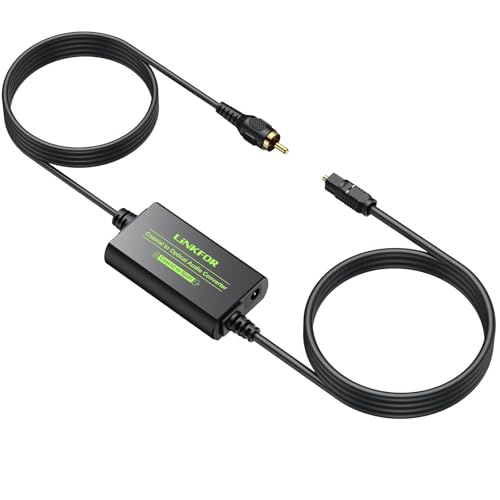
LiNKFOR’s model emphasizes long-distance capability with built-in 1-meter Toslink and 1-meter coaxial cables. It converts Coaxial Digital Signal to Optical SPDIF Toslink, supporting multiple sample rates up to 192 kHz and 24-bit depth. Best for: setups needing a ready-to-use kit with built-in cables for cleaner routing. It is well-suited for older TVs, soundbars, and amplifiers requiring lossless digital audio. Limitation: built-in cables limit placement flexibility to the included cable lengths.
Bi-Directional Coax Digital Audio Adapter

This compact two-way converter supports Coaxial and Toslink in both directions. It’s plug-and-play with noise-free transmission and high-definition audio output, making it a solid choice for compact setups where space is a constraint. Best for: users who want a simple, dependable option for switching between input types without extra software. Caution: some older receivers may require manual PCM mode adjustments to avoid decoding issues.
LUKFOCAB Bi-Directional Digital Audio Converter
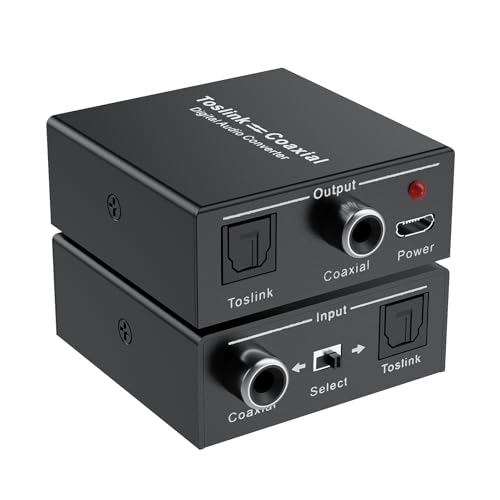
The LUKFOCAB device supports two-way conversion between coaxial and optical with an input switch to choose either SPDIF (Optical/Toslink) or Coaxial. It handles Dolby, DTS, PCM, and supports sampling up to 192 kHz. It also functions as a repeater to extend signal distance. Best for: users needing a built-in amplifier function and distance extension. Caution: verify power supply compatibility with your setup, as it uses a micro USB input for power.
diaogenlee Optical/Coaxial Bi-Directional Adapter

diaogenlee offers a versatile bi-directional adapter with three usage modes, including digital-to-analog options. It supports 192 kHz sampling, multi-channel surround formats, and uncompressed LPCM/PCM. Best for: buyers seeking a flexible 3-mode device that can act as converter, repeater, or splitter. Limitation: the multi-mode capability may require more careful configuration to reach optimal performance in complex setups.
Buying Guide
Key considerations when choosing a SPDIF coaxial to optical converter:
- Bidirectional capability: If you need to switch directions, ensure the device explicitly supports both coaxial-to-optical and optical-to-coaxial paths.
- Audio formats and sampling rates: Look for support of LPCM, DTS, Dolby Digital (AC3), and high sampling rates (prefer 192 kHz/24-bit) if you want lossless or high-fidelity output.
- Input/output options: Consider whether you prefer built-in cables or require flexible external cabling to fit your space.
- Power and installation: Check if the unit requires external power or can be powered via a USB, and confirm that setup is truly plug-and-play without software.
- Use case alignment: For home theaters, ensure compatibility with your receiver and TV. For audio enthusiasts, prioritize high-resolution support and longer transmission distance if needed.
- Physical footprint: If space is limited, choose a compact module; otherwise, a model with built-in cables can simplify routing.
Frequently Asked Questions
- What is the main benefit of a bi-directional SPDIF converter?
It allows you to convert signals in either direction between coaxial and optical formats, reducing the need for multiple devices. - Do these converters support Dolby Digital and DTS?
Yes, most models advertise support for Dolby Digital (AC3) and DTS in various formats depending on the device. - Can I use these with a soundbar or a TV?
Yes, they are designed to connect digital audio outputs to receivers, soundbars, or amplifiers supporting the corresponding input format. - Is 192 kHz/24-bit audio supported by all models?
Many units advertise up to 192 kHz/24-bit, but always confirm the specific model’s capabilities before purchase. - Do these devices require drivers?
No, most listed options are plug-and-play and do not require drivers or software. - Are built-in cables advantageous or restrictive?
Built-in cables simplify setup and reduce cable clutter, but they limit placement flexibility compared to detachable cables.