
Best SPDIF to Optical Converter for Clear Sound and Easy Setup
Looking for a reliable SPDIF to optical converter to connect legacy audio gear with modern TVs or soundbars? This guide highlights five top options that are easy to use, support common formats like DTS and Dolby Digital, and suit different setups. The best picks are aimed at home theater enthusiasts, DIY audio enthusiasts, and users moving from coaxial to optical without losing sound quality. Below, each product is evaluated for who it’s best for and why it stands out, plus a practical buying guide to help you compare features and decide.
Summary table of selected products:
| Product | Brand | Best For | Notes |
|---|---|---|---|
| PROZOR 192K Bi-Directional Optical Converter | PROZOR | Users seeking bidirectional conversion between coaxial and Toslink | Supports 192 kHz/24-bit, DTS, Dolby AC3 |
| Azduou Bi-Directional Digital Audio Converter | Azduou | Plug-and-play simplicity for optical/coaxial swaps | Bi-directional with high-definition output |
| LUKFOCAB Bi-Directional Coax/Toslink | LUKFOCAB | Longer cable runs and repeater capability | 192 kHz/32-bit capable, built-in signal amplification |
| LiNKFOR 3.5mm To SPDIF Converter | LiNKFOR | 3.5mm to digital optical for easier upgrades | 2-channel PCM output, 48 kHz |
| LiNKFOR 192kHz Coaxial To Optical Converter | LiNKFOR | Coaxial to optical with included cables | 192 kHz sampling, built-in cables |
PROZOR 192K Bi-Directional Optical Converter

The PROZOR unit offers bidirectional conversion between coaxial and Toslink with a single input switch. It supports LPCM 2.0, DTS, and Dolby Digital AC3, making it suitable for home theater setups that need flexible input options. It handles up to 192 kHz sampling and 24-bit depth for high-quality digital audio output. Best for users who want a compact, versatile converter that can swap between input types without extra cables.
Who it’s best for: multimedia lovers who use both coaxial and optical devices and want easy toggling. Limitations: no mention of USB power requirements in the listing—ensure a power source is available if your setup requires it.
Azduou Bi-Directional Digital Audio Converter

The Azduou converter is designed for two-way optical-coaxial conversions with an emphasis on noise-free, high-definition audio output. It’s a straightforward plug-and-play device with no driver requirements, making it ideal for users who want a simple upgrade without software setup. Best for basic home entertainment systems where optical and coaxial outputs need to be interchangeable.
Best for: users prioritizing a no-fuss, plug-and-play experience. Caution: while it advertises high-definition output, verify compatibility with your specific AVR or speaker system before purchase.
LUKFOCAB Bi-Directional Coax/Toslink
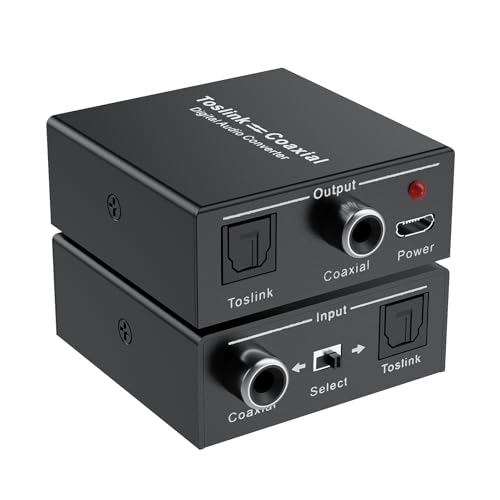
This model emphasizes two-way audio conversion with a user-selectable input switch between SPDIF optical and coaxial. It supports Dolby, DTS, PCM, and up to 192 kHz sampling. A built-in amplification chip can extend signal distance, and a 5V micro USB power cable is included. Best for users who need a repeater function to accommodate longer cable runs.
Choose this if: you need a converter that doubles as a signal repeater. Limitation: dependency on USB power may require nearby power access in some setups.
Bi-Directional Coax Digital Audio Adapter

Offering a two-way conversion between coaxial and Toslink, this device is plug-and-play with no software. It promises noise-free transmission and high-definition audio output, suitable for amplifiers and speakers requiring flexible input formats. Best for users who want a simple, reliable converter without extra setup steps.
Better for: straightforward coaxial-to-optical needs in a compact form factor. Limitation: may not specify support for very high-resolution formats beyond standard 5.1 channel content.
LiNKFOR 192kHz Coaxial To Optical Converter
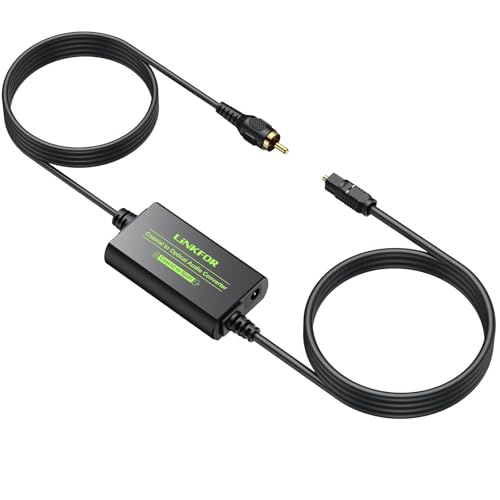
LiNKFOR’s device focuses on coaxial-to-optical conversion with built-in cables for easier installation and longer reach. It supports 192 kHz sampling and 24-bit depth for lossless digital audio, with LPCM 2.0, DTS, and Dolby Digital formats. Best for setups requiring included cables and higher sampling rates without additional adapters.
Choose this for: a ready-to-go solution with built-in cables. Caution: ensure the included cables fit your routing path and connector positions.
Buying Guide
What should you consider when choosing an SPDIF to optical converter?
- Bidirectional support: If you need to swap directions (coaxial to optical or optical to coaxial), prefer models explicitly labeled as bidirectional.
- Audio formats and sampling: Look for LPCM 2.0/5.1, DTS, and Dolby Digital. Higher sampling rates like 192 kHz are beneficial for high-fidelity systems.
- Input/output compatibility: Verify your devices’ connectors (Toslink/optical vs coaxial RCA) and whether you need built-in cables or a separate cable kit.
- Power requirements: Some units require USB power; ensure a convenient power source is available near the converter.
- Latency and signal integrity: Prefer units with low-noise transmission and, if possible, built-in amplification for longer cable runs.
- Plug-and-play setup: For users prioritizing simplicity, choose drivers-free operation with clear on-device controls.
FAQ
- What does “bidirectional” mean in these converters?
It means the device can convert in both directions between optical (Toslink) and coaxial digital audio signals. - Do these converters require software or drivers?
Most listed models are plug-and-play and do not require drivers. - Can I use these with a soundbar or AV receiver?
Yes, they are designed to feed digital audio into amplifiers, soundbars, or AV receivers that accept optical or coaxial inputs. - Will 192 kHz support improve my music?
Higher sampling rates can improve detail for capable systems, but the audible benefit depends on your gear and content. - Are built-in cables included with every model?
Some models include built-in Toslink and/or coaxial cables; others require separate cables. - Is a power adapter needed for all units?
Not all require it, but several rely on USB power; check the product listing to confirm power needs.