
Best Speaker Cable to RCA Converter Guides for Clear Audio
Answer: When converting speaker cable to RCA, choose adapters that provide solid conductivity, easy installation, and clear signal transfer. These five products cover solderless, screw-terminal, and bare-wire options suitable for DIY setups, home theaters, and repair projects. The best pick depends on your wiring preferences and whether you prioritize quick installation or a more permanent connection.
| Product | Brand | Best For | Length/Size |
|---|---|---|---|
| RECOIL Speaker Wire to RCA Adapter With Female Coupler | RECOIL | DIY adapters with dual cables for quick, solderless use | 1 ft |
| caojunzhen RCA to Speaker Wire Adapter | caojunzhen | Repairing worn RCA cables or extending runs | 6.6 ft |
| CableCreation RCA to Speaker Wire Adapter | CableCreation | Reliable repair with color-coded leads | 3.3 ft |
| MOBOREST RCA to Speaker Wire Adapter, Solderless | MOBOREST | Screw-terminal, easy DIY wiring | 2-pack |
| Additional options listed above | Various | Varied uses | Varied |
RECOIL Speaker Wire To RCA Adapter With Female Coupler

The RECOIL adapter uses 99.99% oxygen-free multi-strand copper wire and features twisted pair technology to minimize static and popping. The nickel-plated, split-tip connectors offer improved signal transfer. Best for DIY enthusiasts who want a compact, solderless hookup with reliable electrical contact. Suitable for simple speaker-to-RCA conversions in custom AV racks or auxiliary audio projects.
Who it’s best for: hobbyists or installers needing a straightforward, durable connector that preserves signal quality. Why selected: high-purity copper and twisted pair design reduce signal loss and noise.
Caution: Ensure polarity is consistent with your system to avoid phase issues, as the adapter does not inherently indicate guide polarity on the wire ends.
caojunzhen RCA to Speaker Wire Adapter

This RCA-to-speaker-wire adapter is designed for repair and extension of existing RCA cables. It uses high-quality 20 AWG wire and an alloy RCA plug to minimize signal loss while conveying high-quality sound. Best for repairing worn RCA cables or creating custom-length runs in home theaters or audio setups.
Who it’s best for: users needing a simple repair solution or an affordable adapter to re-purpose bare wire into an RCA connection. Why selected: strong copper conductors and robust construction support durable connections.
Caution: It is primarily a repair-and-extend solution; for new installations, consider purpose-built adapters with clearly defined polarity and mounting options.
CableCreation RCA to Speaker Wire Adapter

The CableCreation adapter focuses on easy repair with color-coded leads to distinguish center (positive) and shell (negative). It uses 20 AWG oxygen-free copper conductors to reduce signal loss and promote clear audio. Best for quick DIY fixes where visual polarity cues aid correct connections.
Who it’s best for: users who value quick, visual polarity identification and straightforward installation. Why selected: clear color cues and good copper quality assist in reliable signal transfer.
Caution: Ensure proper identification of positive and negative leads during installation to avoid phase or channel confusion.
MOBOREST RCA to Speaker Wire Adapter, Solderless
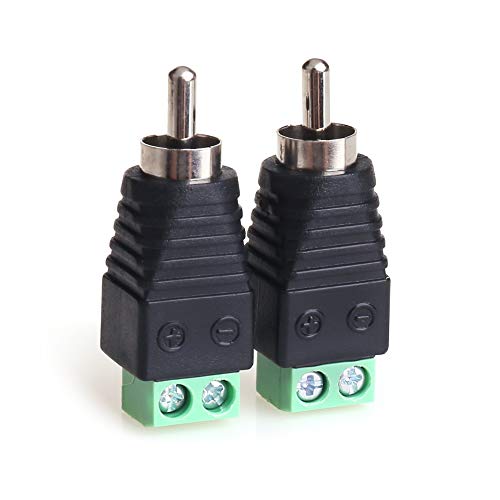
This solderless adapter uses screw terminals to secure stripped speaker wire directly to RCA terminals. It includes clearly marked positive and negative polarity with color-coded terminals. Best for DIY home theater setups where quick, tool-free wiring is preferred and space is tight behind AV gear.
Who it’s best for: installers who want a reliable, tool-free solution and straightforward polarity matching. Why selected: screw-terminal design eliminates the need for soldering or crimping tools.
Caution: Ensure the stripped wire is properly tightened; loose screws can lead to poor contact and intermittent audio issues.
Buying Guide: How To Choose The Right Speaker Cable To RCA Converter
- Choose between soldered, screw-terminal, or open-end bare-wire adapters. Solderless options save time but may offer less permanent connections; screw-terminal options provide stable, durable terminations.
- Look for higher-purity copper (oxygen-free) and appropriate gauge (commonly 20 AWG for these adapters) to minimize resistance and signal loss.
- If polarity labeling isn’t explicit, prefer color-coded leads (red/black) or connectors with marked positive/negative to avoid phase issues.
- Consider the depth and width behind AV equipment. Narrow-profile adapters fit in tight spaces behind receivers or gaming consoles.
- For cable repair, look for bare-wire or repair-oriented adapters. For new builds, select adapters with robust connectors and locking features if available.
- Nickel-plated connectors and high-quality copper conductors enhance longevity and reduce corrosion risk in humid or high-use environments.
- Ensure the RCA plug type (male) matches your receiver or amplifier inputs and that the adapter supports your overall signal chain without introducing unintended impedance.
FAQ
- What is the main purpose of a speaker wire to RCA adapter? To convert bare speaker cable or speaker-wire ends into RCA-compatible connectors for audio equipment that accepts RCA inputs.
- Do these adapters affect sound quality? They can affect signal quality based on build quality, copper purity, and connection method. Higher-purity copper and secure connections reduce loss and noise.
- When should I choose solderless vs. screw-terminal adapters? Choose solderless for quick setups; choose screw-terminals for durable, tool-free, long-term connections in tight spaces.
- Is 20 AWG suitable for all adapters listed? 20 AWG is common for these adapters and balances ease of use with adequate conductivity in typical home audio runs.
- Can I mix RCA adapters with various brands? Yes, as long as connectors are standard RCA male/female types and polarity is observed, though consistent build quality helps maintain signal integrity.
- Do I need to repair my RCA cables before using these adapters? If a cable is damaged, these adapters can be used to extend or re-terminate wires, but ensure the entire signal path remains intact for best results.