
Picking speakers for a dance studio means balancing volume, clarity, portability, and connectivity. Below is a concise comparison table of the five selected options from the list, followed by focused reviews and a practical buying guide to help you choose the right speaker setup for rehearsal, instruction, or performance preparation.
| Product | Type | Notable Features |
|---|---|---|
| PreSonus Eris 3.5 Studio Monitors | Near-field Powered Monitors (Pair) | Accurate sound, 50W Class AB, compact |
| Ortizan C7 Dual-Mode Studio Monitors | Active 2.0 Monitors (Pair) | Bluetooth 5.3, USB DAC, multiple inputs |
| Edifier R1280T Powered Bookshelf Speakers | Active Bookshelf (Pair) | Dual AUX, bass/treble controls, wood enclosure |
| Harman Kardon Aura Studio 4 | Bluetooth Home Speaker (360°) | 360° soundstage, ambient lighting, down-firing subwoofer |
| MEVOSTO Active Bookshelf Speakers 36W RMS | Powered Bookshelf (Pair) | 5″ woofer, BT 5.4, USB digital audio, bass/treble adjust |
PreSonus Eris 3.5 Studio Monitors, Pair

The PreSonus Eris 3.5 are compact near-field powered monitors that prioritize accurate, neutral sound reproduction. Listed features emphasize studio-quality accuracy and a tight low end thanks to woven-composite woofers. The pair delivers 50 watts of Class AB amplification (25W per speaker), suitable for medium-sized rehearsal rooms when placed near dancers or instructors.
- Strengths: Accurate frequency response useful for hearing tempo and musical details; compact footprint.
- Limitations: Small woofer size limits very deep bass extension for low-frequency-heavy tracks unless supplemented by a subwoofer.
- Use Case: Ideal for instructors who need reliable monitoring to judge timing and musical nuances in close-range setups.
Ortizan C7 Dual-Mode 2.0 Studio Monitors

Ortizan C7 speakers combine near-field monitoring with modern wireless convenience. They include Bluetooth 5.3, USB with a 24-bit DAC, RCA, and 3.5mm AUX inputs. The drivers (3.5″ carbon fiber woofer and 0.75″ silk dome tweeter) and an electronic 2-way crossover aim to deliver clear mids and smooth highs.
- Strengths: Flexible connectivity (Bluetooth, USB DAC, RCA, AUX) makes switching sources easy for classes and playback devices.
- Limitations: Mid-bass performance may be limited for large studio spaces; placement matters for best dispersion.
- Use Case: Good for studios needing wireless streaming from phones or tablets plus accurate near-field monitoring for choreography sessions.
Edifier R1280T Powered Bookshelf Speakers
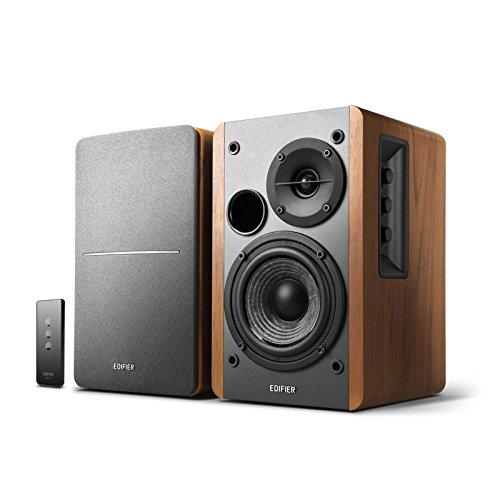
The Edifier R1280T are classic powered bookshelf speakers with dual AUX inputs, bass and treble controls, and a wooden enclosure for natural resonance. They include a remote for convenient adjustments and can accept two sources simultaneously via AUX.
- Strengths: Physical tone controls allow on-the-fly EQ to suit different music styles and studio acoustics; wood cabinet can warm sound.
- Limitations: Lacks Bluetooth and digital inputs on this model; may need an external Bluetooth adapter for wireless sources.
- Use Case: Best in studios where wired reliability and simple tonal adjustment are preferred for playback and instruction.
Harman Kardon Aura Studio 4

The Harman Kardon Aura Studio 4 is a Bluetooth-centric speaker that emphasizes 360-degree sound and a visual lighting element. It features a six-speaker array and a 5.2″ down-firing subwoofer, aiming to produce room-filling audio and prominent low-frequency response.
- Strengths: Strong low-end presence from the down-firing subwoofer, wide dispersion for even coverage in open studio spaces, integrated ambient lighting enhances atmosphere.
- Limitations: Designed primarily as a lifestyle/home speaker—monitoring accuracy is secondary to pleasing tonal character.
- Use Case: Suitable for studios focused on open-room playback, group classes, or events where ambiance and broad coverage matter more than studio-accurate reference sound.
MEVOSTO Active Bookshelf Speakers 36W RMS

MEVOSTO active bookshelf speakers include a 5″ woofer, silk dome tweeters, and Bluetooth 5.4 plus USB digital audio. The RMS 36W power and dedicated bass/treble controls aim to deliver a dynamic, bass-forward sound suitable for playback-heavy studio use.
- Strengths: Larger woofer and digital USB input support deeper bass and lower-latency connections for computers and media players.
- Limitations: Performance will vary by room size and placement; may require sub support for very large spaces or bass-heavy choreography.
- Use Case: Works well for instructors who want stronger bass and modern wireless/USB connectivity in a compact bookshelf form.
Buying Guide: Choosing The Right Speakers For A Dance Studio
When selecting speakers for a dance studio, evaluate these key factors to match equipment to your specific needs.
Coverage And Placement
Consider room size and typical placement. Near-field monitors are designed for close listening and are ideal for instructors near the speakers. For group classes or larger, open studios, choose speakers with wider dispersion or a pair positioned to cover the space evenly.
Low-Frequency Needs
Dance music often relies on strong bass. Small bookshelf or near-field monitors can reproduce midbass clearly but may lack deep sub-bass. If you need powerful low end, pair monitors with a dedicated subwoofer or select speakers with larger woofers/down-firing sub drivers.
Power And SPL
Check amplifier power and maximum SPL capability. Higher wattage and efficient drivers help fill bigger rooms without distortion. For rehearsal rooms, aim for speakers that can deliver clear output at rehearsal volumes with minimal clipping.
Connectivity And Latency
Assess how you’ll play music: phone/tablet streaming, laptop, or DJ controller. Bluetooth offers convenience but can introduce latency; modern codecs and Bluetooth 5.x reduce lag. For critical timing or laptop-based playback, prioritize USB, optical, or wired RCA/AUX inputs for lower latency and reliable sync.
Tone Control And EQ
Speakers with built-in bass/treble controls or monitors with flat response plus an external mixer let you tailor playback to room acoustics and music genres. This is useful when switching between pop, electronic, and acoustic tracks.
Portability And Durability
If you move speakers between studios or to events, consider weight, handles, and battery operation. Portable Bluetooth speakers with good battery life are convenient but may sacrifice the monitoring accuracy of powered studio monitors.
Acoustic Environment
Room acoustics significantly affect perceived sound. Hard floors and reflective surfaces common to dance studios emphasize brightness and bass. Treat rooms with rugs, curtains, or absorption panels where possible to improve clarity and reduce unwanted reflections.
Budget And Expandability
Balance initial cost against expandability. A pair of accurate monitors plus a subwoofer often outperforms a single lifestyle speaker at similar cost. Look for options that allow adding a subwoofer or an external mixer later.
Comparison Perspectives
- For Accurate Monitoring: Choose near-field studio monitors like the PreSonus Eris line for tonal fidelity and precise midrange.
- For Versatile Connectivity: Ortizan and MEVOSTO models provide Bluetooth and USB DACs for mixed-device workflows.
- For Room-Filling Playback And Atmosphere: Harman Kardon Aura Studio 4 provides broad dispersion and visual lighting for group classes.
- For Simple Wired Reliability And EQ Controls: Edifier R1280T offers straightforward analog inputs and onboard tone adjustments.