Best Speaker for Music Production: Top Monitors for Clear, Accurate Sound
Choosing the right near-field monitors is essential for music production, mixing, and critical listening. This guide highlights five reliable options tailored for desktop setups, offering balanced frequency response, low-end clarity, and practical features like input variety and tone shaping. Each pick is evaluated for accuracy, build quality, and value, helping you compare how they perform in real-world studio environments.
Summary of chosen products:
| Product | Brand | Key Benefit | Inputs |
|---|---|---|---|
| PreSonus Eris 3.5 Studio Monitors (White) | PreSonus | Accurate near-field reference with strong bass for its size | 2 x RCA/1 x 1/8″ TRS |
| Mackie CR3.5 Creative Reference Monitors | Mackie | Built-in tone knob for quick shaping of bass and highs | TRS, RCA, 3.5mm, headphone out |
| Ortizan C7 Dual-Mode Monitors | Ortizan | Versatile inputs with Bluetooth for wireless listening | RCA, USB DAC, Bluetooth 5.3, 3.5mm |
| OHAYO 60W Computer Speakers | OHAYO | Powerful desktop listening with Bluetooth and wired inputs | 3.5mm, RCA, Bluetooth 5.3, USB powered |
| M-AUDIO BX3 Studio Monitors | M-AUDIO | 120W system with Kevlar woofer for deep bass | RCA, TRS, XLR |
PreSonus Eris 3.5 Studio Monitors (White) — Near Field

The Eris 3.5 compact monitors deliver studio-quality, accurate sound ideal for music production, hi-fi listening, or multimedia work. They offer a clear, expressive representation with a solid low end thanks to woven-composite woofers. With 50 watts of Class AB dual amplification (25W per speaker), they provide ample volume without sacrificing tonal balance or clarity. These monitors support near-field use, reducing room coloration and enabling precise mixing decisions. They are a practical choice for desktop setups where space is at a premium.
Mackie CR3.5 Creative Reference Monitors

Mackie CR3.5 combines studio-quality sound with a user-friendly tone knob and versatile inputs for a multi-use desktop setup. The monitors include TRS and RCA connectors for interfaces and playback devices, a 3.5 mm input for PCs or consoles, and a built-in headphone output. The tone control lets you shape the sound quickly—boosting bass or sparkling highs—to suit gaming, streaming, or casual listening, while maintaining a transparent studio reference baseline.
Ortizan C7 Dual-Mode Studio Monitors
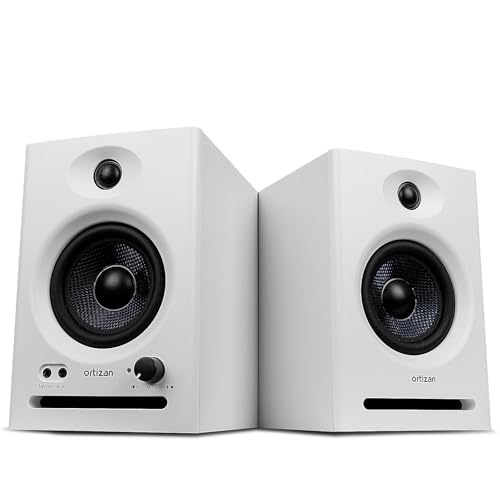
Ortizan C7 provides flexible wired and wireless listening options with Bluetooth 5.3 and USB DAC support. The 3.5-inch mid-bass driver and 0.75-inch silk dome tweeter offer clean midrange and smooth highs, suitable for monitoring while producing music or creating content. The dual-mode design supports plugging into a computer for accurate playback, while Bluetooth enables convenient wireless listening for reference or casual use. The built-in DAC minimizes signal loss and preserves audio fidelity.
OHAYO 60W Computer Speakers

OHAYO delivers a robust 60W total power with Bluetooth 5.3 and a 3.5 mm/RCA input set for flexible desktop use. The 0.75-inch carbon fiber silk dome tweeter and a 3-inch carbon fiber full-range driver create crisp highs and solid mid-bass. A rear bass port helps deepen the low end, while a front panel volume knob supports quick adjustments. The MDF enclosure minimizes resonance for clearer, studio-like sound in small rooms or dorm setups.
M-AUDIO BX3 Studio Monitors

M-AUDIO BX3 monitors deliver a 120-watt powered system with an acoustically inert MDF cabinet and a bass-reflex design. The 3.5-inch Kevlar woofer and 1-inch silk-dome tweeter offer a wide listening sweet spot and precise imaging. The rear ports extend bass response, and the system includes high and low EQ controls to dial in the ideal balance for music production, streaming, or gaming in compact spaces.
Buying Guide: Key Purchase Considerations
When selecting near-field monitors for music production, consider these factors to align with your workflow and room constraints:
- Size and space: Smaller monitors fit desks and studios with limited space, but ensure they still deliver reliable low-end presence.
- Frequency response and accuracy: Look for monitors that provide honest midrange and bass without excessive coloration; linearity matters for mixing decisions.
- Power and headroom: Adequate amplification preserves dynamic range, especially for compositional work that requires loud playback without distortion.
- Input versatility: Multiple inputs (RCA, TRS, 3.5mm, USB DAC, Bluetooth) simplify connections to interfaces, PCs, or mobile devices.
- Room treatment: Near-field listening reduces reflections; pairing monitors with basic acoustic treatment improves translation across systems.
- Tone shaping and controls: Built-in EQ, tone knobs, or DSP features help tailor sound for different genres or personal preference.
- Build quality and warranty: Durable cabinets and reliable drivers reduce setup headaches in busy studios.
- Workflow considerations: Some monitors include headphone outs or convenient front-panel controls for quick edits during sessions.
In practice, the best option depends on your listening goals, connectivity needs, and budget. If you need compact, accurate monitors for near-field work, the PreSonus Eris 3.5 and M-AUDIO BX3 deliver strong accuracy and sufficient headroom. For added flexibility, Mackie CR3.5 and Ortizan C7 provide input variety and convenience features like tone control or Bluetooth. OHAYO 60W monitors offer high output for gaming or multimedia, with Bluetooth and wired inputs to cover diverse use cases.