
Best Speaker Level to Line Level Interface Options for Home Audio
Answering the common need to convert speaker-level outputs to line-level inputs, this guide highlights practical interfaces for adding subwoofers, feeding powered amplifiers, or integrating legacy gear. This selection targets buyers building or upgrading home theaters, multi-room systems, or car audio setups. Each product is chosen for clarity, compatibility, and ease of use across typical home and auto environments.
Summary of chosen products:
- SVS SoundPath Speaker Level Subwoofer Adapter – Best for adding a sub to legacy systems with clean RCA line outputs.
- Xantech SLLC1 Speaker Level to LINE Converter – Best for integrating legacy speaker outputs with line-level inputs in multi-room or AV setups.
- Scosche FAI4 Speaker Level Converter – Best for upgrading factory or aftermarket car stereos with 4-channel or 2-channel amplification.
- Aramox Speaker Level Output Converter – Best for versatile, broad-spectrum use in both car and home audio, with easy tuning for bass.
- Russound CAS44/CAA66/CAM6.6 Adapter (Male to Female) – Best for modular, branded home audio systems requiring adapter compatibility.
SVS SoundPath Subwoofer Adapter

This adapter converts speaker-level outputs to a line-level RCA signal, helping to add a subwoofer to legacy amplifiers without dedicated sub outputs. It is best for users upgrading an older stereo or receiver to include bass management. The device accepts speaker-level inputs and provides 24K gold-plated RCA line-level outputs for a secure sub connection. Caution: ensure your subwoofer accepts line-level RCA inputs and that your system’s power handling remains within safe limits.
Xantech SLLC1 Speaker Level To LINE Converter
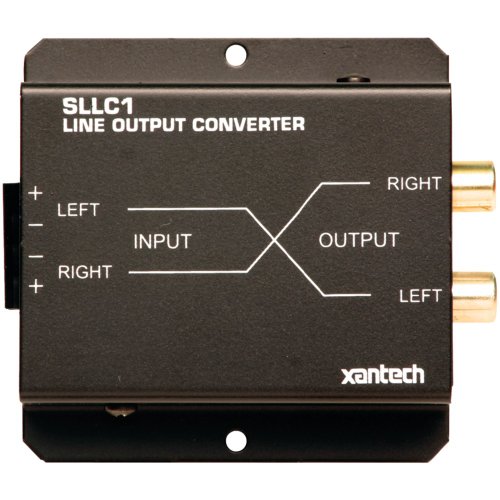
Designed for use with auxiliary amps and stereo line-level outputs, the Xantech SLLC1 converts speaker-level signals to line-level signals for reliable integration with powered amplifiers. Best for multi-room or home theater setups where a higher-power amp is used downstream. This model emphasizes straightforward conversion to ensure minimal signal loss during transfer. Limitation: intended for line-level downstream devices; avoid using with high-gain, noisy power supplies that may introduce hum.
Aramox Dual Channel Line Level Converter

This two-channel adapter supports converting speaker-level outputs to line-level signals for both left and right channels, enabling better bass control and downstream amplification. It is versatile for vehicle systems, home theaters, and integrated setups. Best for users needing separate left/right channel control and improved sound staging. Caution: performance depends on the quality of the source amplifier; excessive input may cause clipping if the upstream amp is powerful and not properly attenuated.
Russound CAS44/CAA66/CAM6.6 Adapters

Russound adapter options provide compatibility across Russound-branded components, including the CAS44, CAA66, and CAM6.6 series. Best for existing Russound ecosystems requiring a simple male-to-female adapter to bridge equipment. Selection reason: strong compatibility with Russound installations and straightforward wiring. Limitation: compatibility scope is best limited to Russound-branded ecosystems; verify port types before purchasing.
Buying Guide
- Identify whether you need a car, home theater, or multi-room solution. Car-specific converters focus on auto-grade wiring and impedance, while home audio units emphasize RCA outputs and line-level fidelity.
- Input vs. output levels: Ensure the device handles speaker-level inputs and provides stable line-level outputs or RCA jacks. Look for 24K gold-plated connectors for reliability and corrosion resistance.
- Channel count: For stereo systems, a two-channel converter suffices; for multi-channel setups, select a four-channel or dual-channel unit to maintain channel separation.
- Source compatibility: If upgrading an older amp, confirm that the converter’s output matches the subwoofer or amplifier’s input requirements (RCA, XLR, etc.).
- Loss and fidelity: Choose devices that advertise minimal signal loss and clear high-frequency response to preserve audio quality when passing from speaker level to line level.
- Installation simplicity: Look for adapters with straightforward wiring and clear labeling to reduce setup time and avoid mis-wiring.
- Limitations to watch: Some adapters cannot provide true preamp gain; they only convert impedance, so downstream amplification may still be needed to reach desired loudness.
Frequently Asked Questions
- What is a speaker level to line level interface used for? It converts the high-level speaker output to a low-level line signal suitable for subwoofers or additional amplification stages.
- Can these adapters improve bass with an older receiver? Yes, they enable connection of subwoofers or extra amps to legacy equipment lacking dedicated line-level outputs.
- Are there risks of signal loss with these converters? Some loss can occur, but many models minimize this with high-quality connectors and proper impedance matching.
- Should I buy a two-channel or four-channel converter? Choose based on your system: two-channel for stereo setups, four-channel for multi-zone or multi-channel configurations.
- Is a car-specific converter different from a home audio converter? Yes; car units optimize for vehicle power and impedance, while home units prioritize RCA compatibility and line-level fidelity.
- Do I need a separate preamp with these adapters? Not always; some downstream amps provide sufficient gain, but a preamp can help in systems with marginal headroom.