
Best Speaker Selector Volume Control Guide for Your Home Audio
Answering the question “which speaker selector with volume control should I buy?” this guide compares top options to help you pick the right model for your setup. Ideal for small to mid-size home theaters, multi-room zones, or outdoor entertainment, these selectors manage multiple speaker pairs from a single amplifier while offering independent volume or zone controls. This overview highlights who benefits most from each model, plus practical trade-offs to consider before purchasing.
| Product | Best For | Key Benefit |
|---|---|---|
| Monoprice SSVC-4.1 | Homes with multiple 4-ohm zones | Strong impedance protection and per-zone volume |
| Monoprice 2-Channel A/B | Two-source, two-destination needs | Independent volume for each path with simple setup |
| Pyle PSLSW4.5 | Compact multi-room systems | Independent volume controls across four zones |
| Monoprice SSVC-6.1 | Six-channel multi-room listening | Good protection and per-zone control |
| OSD Audio RSVC4 | Balanced distribution with four zones | Volume control and amp protection |
Monoprice SSVC-4.1 Single Input 4-Channel Speaker Selector
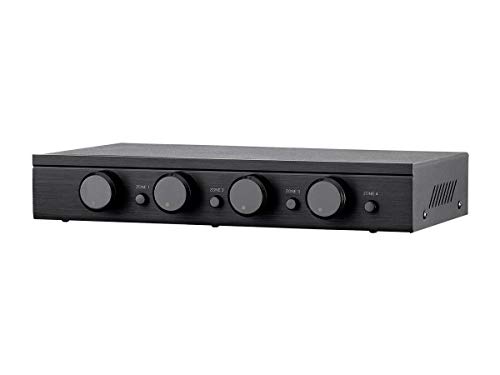
The Monoprice SSVC-4.1 connects four speaker pairs to one amplifier with automatic impedance protection. It supports 100 watts per channel continuously and 200 watts per channel peak, making it suitable for mid-sized home audio systems. Minimum amplifier impedance is 5 ohms when four 4-ohm loads are used, or 6 ohms with 8-ohm speakers. Each zone has its own on/off switch and volume control, enabling targeted listening without affecting other zones. Best for: setups needing robust protection and per-zone control in 4-zone configurations. Caution: verify amplifier impedance compatibility when using a mix of 4-ohm and 8-ohm speakers.
Monoprice 2-Channel A/B Speaker Selector

This model provides two sources routed to two destinations with built-in independent volume controls. It handles up to 100 watts per channel and accepts bare speaker wire up to 14 AWG. Best for: users who want simple two-source, two-destination switching with adjustable volume per output. Caution: fewer zones means less flexibility for larger multi-room setups.
Pyle 4 Channel Speaker Selector Switch PSLSW4.5
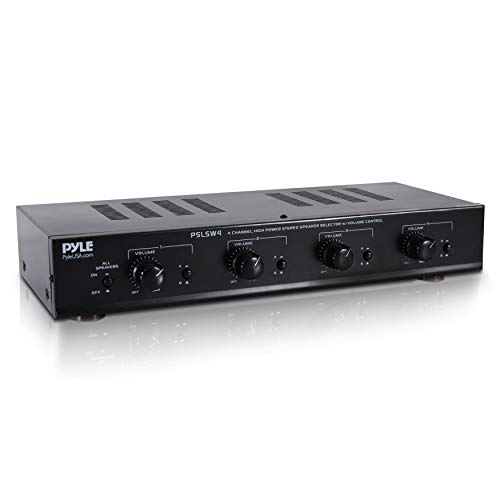
The Pyle PSLSW4.5 distributes up to four speaker pairs with independent volume controls for each zone. It is compact and designed for home theater or stereo systems, supporting 8-ohm impedance speakers and 100 W per channel. Best for: users needing a slim, tabletop option with separate volume per zone. Limitation: some installations may require longer speaker wire runs or more robust mounting space in tight setups.
Monoprice SSVC-6.1 Single Input 6-Channel Speaker Selector

The SSVC-6.1 expands to six channels for larger multi-zone listening. It features automatic impedance protection and 100 watts per channel continuous power, 200 watts peak. Impedance minimums are 4.6 ohms with four 4-ohm speakers or 5.3 ohms with 8-ohm speakers. Each zone includes a dedicated on/off and volume control. Best for: bigger homes or rooms needing more independent speaker control. Caution: ensure your amplifier supports the aggregate load when multiple zones operate simultaneously.
OSD Audio RSVC4 4X Speaker Selector with Volume Control

OSD Audio RSVC4 offers reliable distributed audio with four zones and a built-in volume control per zone. It is compatible with amplifiers rated up to 2 x 80 W RMS and supports connecting multiple loudspeakers safely. Best for: value-minded setups needing four independent listening zones with protection for amplifiers. Caution: verify overall system impedance and power requirements when pairing with multiple wired zones.
Buying Guide: How to Choose the Right Speaker Selector With Volume Control
What to consider when selecting a speaker selector with volume control:
- Number of Zones: Match the number of zones to your room layout and future expansion plans. More zones add complexity, but provide greater listening flexibility.
- Power Handling: Ensure the selector can handle the amplifier’s wattage per channel and the speaker load. Overloading can distort or damage equipment.
- Impedance Protection: Look for automatic impedance protection to guard amplifiers when multiple speakers are active.
- Independent Volume: Decide between per-zone volume controls and shared controls. Independent controls offer more precise multi-room balance.
- Physical Footprint: Consider width and depth to fit your cabinet, shelf, or rack. Compact designs save space in smaller setups.
- Wiring: Check compatibility with 14 AWG or thicker speaker wire, and plan for clean cable routing in your room.
- Compatibility: Confirm the selector works with your speaker impedance (4, 6, or 8 ohms) and your amplifier’s impedance rating.
- Installation: Some models mount on a shelf; others are tabletop-friendly. Choose based on your room arrangement and accessibility.
Frequently Asked Questions
- What is a speaker selector with volume control best used for? – It enables safe multi-zone listening from a single amplifier, with independent volume control per zone to tailor sound in different rooms or areas.
- Do all selectors protect amplifiers from impedance issues? – Many models include automatic impedance protection, but check the product specifications to confirm.
- Can I connect 4-ohm and 8-ohm speakers to the same selector? – Some selectors support mixed loads with impedance protection; verify the minimum amplifier impedance for your chosen configuration.
- Is independent volume control better than a shared control? – Independent controls give precise balance across zones, especially useful in multi-room or multi-user environments.
- How many speakers can a typical 4-channel selector handle? – It varies by model; common options support two to four speaker pairs per channel, with some models offering up to six zones.
- Do I need to use the included volume controls, or can I adjust on the amplifier? – Volume per zone on the selector isolates listening levels in different rooms and helps protect amplifiers from overdrive when multiple zones are active.