
Connecting a TV to external speakers can improve dialogue clarity and overall soundstage. Below is a quick summary table of popular adapters covered in this guide, followed by focused product sections and a practical buying guide to help pick the right adapter for your setup.
| Product | Type | Primary Use |
|---|---|---|
| PROZOR Digital To Analog Audio Converter DAC | Digital-to-Analog (Toslink/Coaxial → RCA/3.5mm) | TV optical/coax outputs to analog speakers/receiver |
| SOOMFON Bluetooth Transmitter For TV | Bluetooth Transmitter/Receiver (3-in-1) | Wireless audio to headphones/speakers from TV |
| 1Mii Bluetooth 5.3 Transmitter Receiver | Bluetooth Transmitter/Receiver (AptX/Low Latency) | Low-latency wireless audio for TV and home stereo |
| JSAUX RCA To 3.5mm Cable | Wired RCA ↔ 3.5mm Aux Cable | Direct analog connection between TV/amp and speakers |
| VCE 3.5mm Female To 2 RCA Splitter | 3.5mm To RCA Y Cable | Adapters for phones/tablets or TV aux outputs to RCA |
PROZOR Digital To Analog Audio Converter DAC

Type: Toslink/Coaxial Digital To RCA/3.5mm Analog Converter. This unit converts TV optical or coaxial digital outputs into analog L/R RCA and a 3.5mm jack simultaneously.
Key Features: Supports sampling rates up to 192kHz/24bit; dual analog outputs (RCA and 3.5mm); powered via 5V USB. Notes that conversion is one-way (digital→analog) and requires a 5V/1A supply.
Why Use It: Ideal when a TV only offers digital audio (Toslink/SPDIF) and your amplifier or passive speakers need analog inputs. The simultaneous outputs let you feed both a receiver and a headphone/aux input.
SOOMFON Bluetooth Transmitter For TV 3-in-1

Type: Bluetooth 5.0 Transmitter/Receiver with LCD; supports dual connections and adjustable volume.
Key Features: Dual connection to two headsets/speakers; long-range 10–30m performance depending on obstacles; optical, AUX, and RCA bypass inputs; LCD status and built-in volume control.
Why Use It: Use when you want wireless audio from a TV to Bluetooth headphones or speakers. Dual-link is useful for sharing audio with another listener. Built-in volume control can help if the paired device lacks adequate controls.
1Mii Bluetooth 5.3 Transmitter Receiver
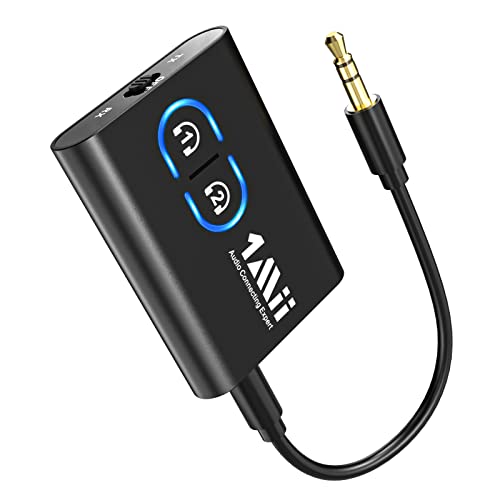
Type: Bluetooth 5.3 Transmitter/Receiver with aptX Low Latency and Adaptive codecs.
Key Features: Latest Bluetooth 5.3 compatibility; aptX Low Latency to reduce AV sync issues; 2-in-1 TX/RX modes to either send TV audio or allow non-Bluetooth speakers to receive audio.
Why Use It: Best for setups where audio-video synchronization is critical (movies/gaming) and you need a low-latency wireless link or to add Bluetooth capability to an older stereo or TV.
JSAUX RCA To 3.5mm Cable 6.6ft

Type: Bi-directional 3.5mm ↔ RCA cable (6.6 ft), nylon braided for durability.
Key Features: Dual shielding and gold-plated connectors; oxygen-free copper core; color-coded red/white RCA plugs for left/right. Works for smartphones, tablets, TVs, and stereo receivers with analog jacks.
Why Use It: Useful for direct analog connections where the TV has a 3.5mm headphone/aux output or the receiver expects RCA inputs. The cable’s shielding reduces interference in typical home setups.
VCE 3.5mm Female To 2 RCA Splitter Male Stereo Audio Y Cable
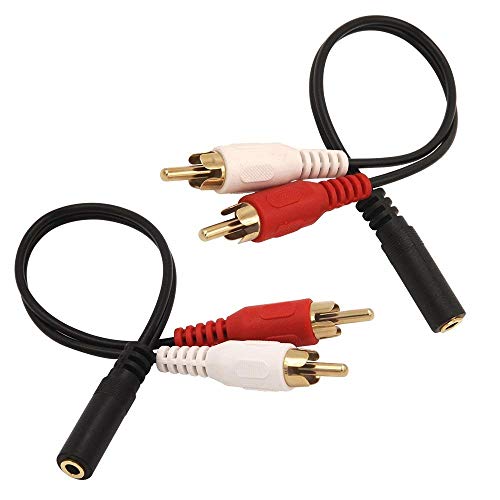
Type: 3.5mm Female To Dual RCA Male Y Cable (8 inch), gold-plated connectors.
Key Features: Universal fit allowing devices with a 3.5mm output to connect to RCA-equipped sound systems; oxygen-free copper conductors and gold-plated connectors; shielding and strain relief for durability.
Why Use It: Handy when converting a headphone or aux output from a TV, laptop, or phone into a left/right RCA connection for speakers or an amplifier.
Buying Guide: How To Choose The Right Adapter For TV To Speakers
Choosing the best adapter depends on the outputs available on your TV and the inputs on your speakers or amplifier. Consider the following dimensions:
- Identify TV Audio Outputs: Common TV outputs include Toslink optical, coaxial SPDIF, 3.5mm headphone/aux, RCA (analog), and sometimes HDMI ARC/eARC. Match the adapter to the available output.
- Speaker Input Types: Determine whether your speakers/receiver accept RCA, 3.5mm aux, bare speaker wire, or require an amplifier. Passive speakers need an amplifier between TV and speaker wire.
- Digital-to-Analog Needs: If the TV only has digital outputs (optical/coax), use a DAC such as the PROZOR to convert to RCA/3.5mm analog. Ensure the DAC supports the TV’s sampling rate.
- Wireless Options: For Bluetooth streaming, choose a transmitter with the Bluetooth version and codecs you need. aptX Low Latency or aptX Adaptive reduces lip-sync delay for video. Dual-link transmitters allow two headsets or speakers simultaneously.
- Signal Direction and Compatibility: Verify whether the adapter is one-way or bi-directional. Many DACs are digital→analog only; simple RCA↔3.5mm cables may be bi-directional for analog signals only.
- Cable Gauge & Build Quality: For speaker repair adapters or bare-wire to RCA leads, prefer 20AWG or thicker for short runs. Look for oxygen-free copper, shielding, and gold-plated connectors to minimize loss and corrosion.
- Latency And Use Case: For watching TV or gaming, choose low-latency Bluetooth adapters. If using wired connections, latency is negligible; prioritize secure connections and grounding to avoid hum.
- Power And Additional Requirements: Some converters need external USB power. Confirm you have an available USB port or power adapter that meets the specified voltage/current requirements.
- Multiple Outputs: If you need to feed multiple devices, consider converters with simultaneous outputs (RCA + 3.5mm) or use splitters that preserve signal integrity.
- Installation And Labels: Color-coded connectors and clear polarity markings simplify hookup for stereo channels and speaker polarity.
Comparison Perspectives
- Best For Digital-Only TVs: Use a DAC (PROZOR) to bridge optical/coax to analog.
- Best For Wireless Freedom: Choose a Bluetooth transmitter with aptX/Low Latency (1Mii) or dual-link features (SOOMFON) depending on needed range and pairing.
- Best For Simple Analog Hookups: Use JSAUX or VCE cables for direct 3.5mm ↔ RCA connections when both devices provide analog ports.
- Best For Speaker Repair/Replacement Leads: Use 20AWG bare-wire-to-RCA adapters (CableCreation, BERLAT, RULGOI) to maintain signal quality for short runs.
If you share the exact TV model and speaker/receiver inputs, further tailored recommendations can ensure compatibility and optimal performance.