Best Speaker Volume Control Box for Home Audio
Quick Overview: This guide compares popular speaker volume control boxes and multi-zone speaker selectors for managing multiple speaker pairs from a single amplifier. Below is a summary table of the selected products to help you scan features quickly.
| Product | Type | Key Feature |
|---|---|---|
| Pyle 4 Channel Speaker Selector Switch (PSLSW4) | Multi-Zone Selector | 4 Pairs, Independent Volume |
| Monoprice SSVC-4.1 Single Input 4-Channel | Speaker Selector | Impedance Protection, Zone On/Off |
| OSD SVC100 In-Wall Volume Control | In-Wall Volume Control | Impedance Matching, 100W |
| TENEALAY RCA Audio Volume Controller RC11 | Inline RCA Attenuator | Compact Line-Level Control |
| Pyle 6Channel PSPVC6.5 Speaker Selector | Multi-Zone Selector | Controls Up To 6 Pairs |
Pyle 4 Channel Speaker Selector Switch – PSLSW4
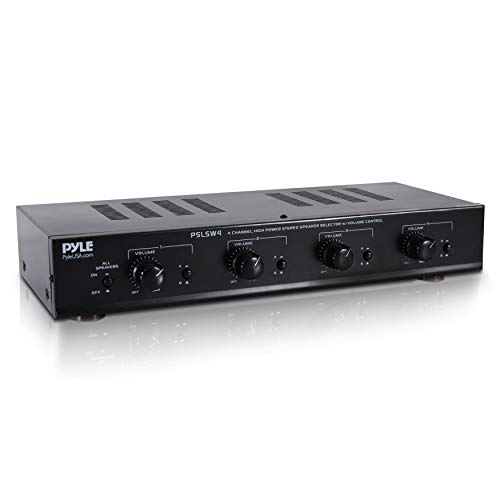
This unit is a compact multi-zone speaker distributor that supports up to 4 speaker pairs. It accepts screw-type connectors for up to 14AWG speaker wire and is designed for use with 8 ohm speakers.
- Power Handling: 100W max per channel.
- Controls: Independent audio source channel volume controls for each pair.
- Operation: Push-button activation allows mixing or isolating zones.
- Best For: Small to medium multi-room setups where individual pair volume control is needed without rewiring the amplifier.
Monoprice SSVC-4.1 4-Channel Speaker Selector With Volume
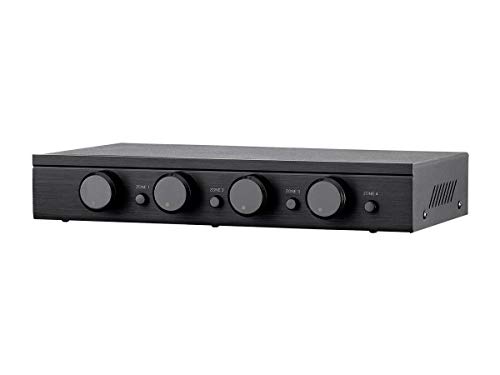
The Monoprice SSVC-4.1 provides automatic impedance protection and per-zone on/off and volume controls for up to four speaker pairs from a single amplifier connection.
- Protection: Automatic impedance protection circuitry safeguards the amplifier.
- Power Handling: 100 watts/channel continuous; 200 watts peak.
- Compatibility: Works with multiple speaker impedances (5Ω minimum when configured as specified).
- Best For: Users who want built-in safety features and discrete control across four zones.
OSD 100W In Wall Volume Control SVC100
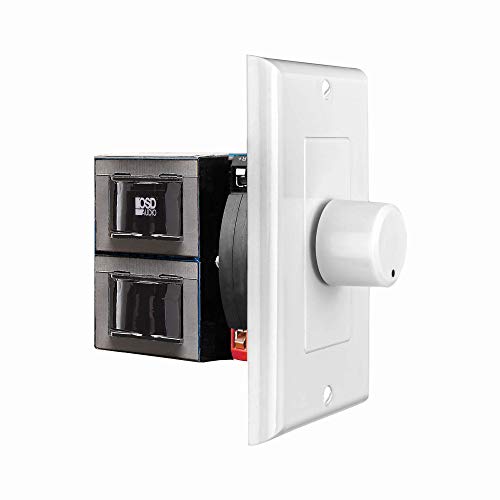
The OSD SVC100 is an in-wall rotary volume control rated at 100 watts per channel and includes adjustable jumpers for impedance matching when multiple pairs are paralleled.
- Impedance Matching: Front-mounted jumpers stabilize load on the amplifier when adding multiple speakers.
- Volume Function: Independent control of a speaker pair; minimal bass roll-off.
- Installation: Fits standard in-wall junction boxes for a clean, permanent control point.
- Best For: Fixed installations where concealed controls and impedance protection are priorities.
TENEALAY RCA Audio Volume Controller RC11

This compact line-level attenuator provides a simple way to adjust RCA input/output volume without amplification. It’s intended for source-level control between devices.
- Connections: RCA analog input and output sockets for easy integration with AV gear.
- Function: Passive attenuator — adjusts volume up/down without boosting signal.
- Use Cases: Useful for controlling volume of a line-level source such as a subwoofer line or an aux input to a receiver.
- Best For: Users needing a small inline volume control at the source rather than speaker-level distribution.
Pyle 6Channel Speaker Selector PSPVC6.5

The Pyle PSPVC6.5 expands multi-zone capability to six speaker pairs, each with individual volume control for flexible zone management from one hub.
- Zone Capacity: Controls up to 6 pairs, suitable for larger homes or commercial spaces.
- Compatibility: Designed to work with a variety of amplifier power levels and speaker sizes (4–12 inches).
- Installation: Hub-style distribution simplifies wiring and zone adjustments.
- Best For: Installations where multiple zones or outdoor/indoor speaker groups need centralized control.
Buying Guide: How To Choose A Speaker Volume Control Box
Selecting the right volume control or speaker selector requires matching system needs, amplifier capacity, and installation style. Below are key considerations and comparison perspectives.
Number Of Zones And Scalability
Decide how many speaker pairs you plan to control now and in the future. Choose a 4-zone unit for small setups or 6-zone/higher if you anticipate expansion.
Impedance Protection And Amplifier Safety
Impedance protection prevents overloading the amplifier when multiple speakers are connected in parallel. Look for selectors with automatic protection circuitry or impedance-matching jumpers for in-wall controls.
Power Handling And Speaker Compatibility
Match the box’s power rating to the amplifier and speaker specs. Check continuous and peak wattage handling and minimum amplifier impedance requirements when multiple zones are active.
Control Type: In-Wall, Inline, Or Hub
- In-Wall Controls: Provide a clean look and local volume control per room. Ideal for built-in systems.
- Hub/Selector Boxes: Centralized control for multiple zones; easier to access for adjustments.
- Inline Attenuators: Best for source-level control or simple adjustments without speaker-level distribution.
Installation And Wiring Considerations
Consider wire gauge support (common: up to 14AWG), connector types (screw terminals vs binding posts), and whether the unit fits junction boxes for in-wall models. Plan speaker cabling runs and access to a central amplifier location.
Feature Trade-Offs
- Volume Granularity: Rotary controls often provide finer adjustments than push-button steps.
- Zone On/Off: Useful for quickly muting areas without changing volume settings.
- Passive vs Active: Passive attenuators don’t amplify and will not compensate for signal loss; match to preamp or receiver levels.
Use Case Examples
- Whole-Home Audio: Use a hub selector with impedance protection and zone controls (4–6+ zones).
- Single-Room Built-In Speakers: In-wall volume controls provide discrete local adjustment.
- Source-Level Control Only: Inline RCA attenuator is a compact option for controlling an individual component.
When evaluating products, cross-check amplifier specs, speaker impedances, and expected daily use to choose the most appropriate control box for reliability and performance.