
Best Speakers for Making Music: Desktop Monitors for Clear, Studio-Style Sound
Answering the question “which speakers are best for making music at my desk?” this guide highlights five practical options. Each selection targets a common buyer type—hobbyist producers, home studio setups, casual listeners, gamers who value audio, and vinyl lovers—so you can choose confidently based on how you work and play. The following table compares key traits to help you decide at a glance.
| Product | Best For | Input Options | Notes |
|---|---|---|---|
| OHAYO 60W | Compact desktop users and gamers | 3.5mm Aux, RCA, USB | Strong bass, integrated sound card |
| Ortizan C7 | Near-field monitoring with wireless | RCA, Bluetooth 5.3, 3.5mm AUX | 24-bit DAC via USB |
| PreSonus Eris 3.5 | True studio monitoring on a budget | TRS, RCA | 50W stereo pair |
| Mackie CR3.5 | Multi-purpose desktop and gaming | TRS, RCA, 3.5mm | Tone knob, headphone out |
| Edifier MR4 | Professional-grade home studio use | TRS, RCA, AUX | Near-flat response, MDF cabinet |
Below you’ll find five detailed product sections. Each one includes why the item is a strong pick for music creation, who should buy it, and any practical limits to consider.
OHAYO 60W Desktop Speakers For Music and Gaming

Best for compact desktop setups requiring solid, room-filling sound. The 60W total power and dual-driver design deliver crystal highs and fuller mids, aided by a rear bass port for deeper low-end. An integrated sound card helps reduce latency during gaming or recording. The MDF enclosure minimizes resonance for clearer output. This option is well-suited for small rooms or home offices where space is at a premium.
Best for: gamers and desk-workers who want louder, well-balanced sound without external amplifiers. Caution: the bass may overwhelm small desk spaces if volume is cranked too high in a tight room.
Ortizan C7 Dual-Mode 2.0 Studio Monitors

Best for near-field listening with flexible connectivity. The C7 pair supports RCA and Bluetooth 5.3 for wireless playback, plus a 3.5mm AUX input for direct device connections. A built-in 24-bit DAC enhances digital fidelity, useful for content creators who need accurate sound reproduction when mixing or monitoring. The 3.5-inch woofer and 0.75-inch tweeter provide clear mids and smooth highs, making them suitable for detailed music production and TV/movies as well.
Best for: home studios and multi-device setups that value wired stability and wireless convenience. Caution: Bluetooth may introduce occasional latency when used with live monitoring in sensitive recording scenarios.
PreSonus Eris 3.5 Powered Studio Monitors

Best for authentic studio-like sound in a compact pair. The 50-watt amplification powers 3.5-inch woven-composite woofers and 1-inch silk-dome tweeters for tight bass and balanced highs across a wide range. Designed to reveal detail in music and media, these monitors are well-suited for mixing, mastering, or general reference listening in a small studio or desk setup.
Best for: musicians and content creators who need clean, accurate monitoring without a large footprint. Caution: Some users may prefer a larger woofer for bigger rooms or louder bass if monitoring bass-heavy genres.
Mackie CR3.5 Creative Reference Monitors

Best for versatile desktop use, including gaming and music production. The CR3.5 pair blends studio-grade sound with a practical tone knob to tailor bass and highs, adding a touch of warmth or clarity as needed. It includes TRS and RCA inputs plus a 3.5 mm connection, and a built-in headphone output for silent monitoring. This makes the system user-friendly for beginners and pros alike.
Best for: users who want adjustable tonal response and straightforward integration with existing gear. Caution: the tone knob can subtly change the bass balance; set it carefully for reference work.
Edifier MR4 42W Powered Monitor Speakers
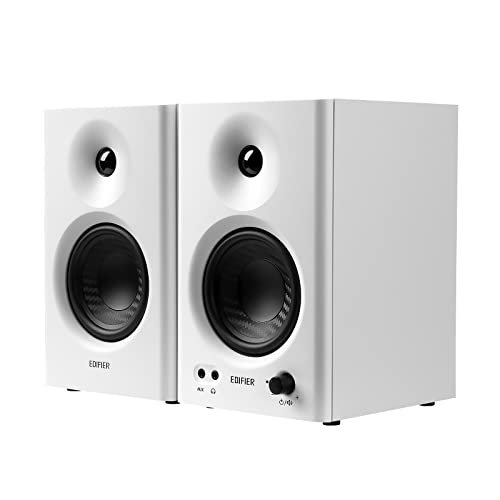
Best for near-field reference in a clean, professional package. The MR4 pair features a refined two-way design with a 1″ tweeter and 4″ woofer to deliver a balanced, accurate sound suitable for music production and gaming. The MDF cabinet reduces unwanted resonance, contributing to a stable listening image. Multiple inputs including TRS, RCA, and AUX help accommodate diverse setups.
Best for: studio-minded listeners who want transparent sound with flexible connections. Caution: not the best option for bass-forward genres in very small rooms without a subwoofer.
Buying Guide
What should you consider when choosing speakers for making music?
- Room size and placement: Smaller rooms benefit from near-field monitors to minimize reflections and listening fatigue.
- Input flexibility: Look for multiple inputs (RCA, TRS, AUX, USB, Bluetooth) to match your devices.
- Sound signature: Studio monitors tend to be flatter for mixing, while consumer speakers may boost bass or highs for casual listening.
- Power and headroom: More wattage helps maintain clarity at higher volumes without distortion, especially for dense mixes.
- Build and enclosure: MDF cabinets reduce resonance; rigid enclosures help preserve transient response.
- Ports and bass: Rear-ported designs typically extend low-end; consider placement away from walls to avoid boomy bass.
- Connectivity with peripherals: If you use a turntable, mixer, or audio interface, confirm compatible inputs and impedance.
Practical buying tips
- For tight spaces, prefer compact two-way monitors with front-facing ports.
- If you need wireless flexibility, prioritize Bluetooth 5.0+ with a stable codec and low latency options for casual listening.
- Always test with your typical music and production material to confirm the tonal balance and stereo imaging.
FAQ
- What is the main difference between studio monitors and regular computer speakers?
Studio monitors aim for a flat frequency response for mixing, while regular computer speakers often color the sound for entertainment. - Do I need a subwoofer with 2.0 bookshelf monitors?
Not always, but adding a subwoofer can improve low-end extension for bass-heavy genres or large rooms. - Is Bluetooth suitable for critical music production?
Bluetooth compression can affect fidelity; use wired connections for mixing and precise monitoring when possible. - Can I use gaming consoles with studio monitors?
Yes, via 3.5mm, TRS, or RCA connections depending on the monitor’s inputs. - Which is better for beginners: a tone-controlled monitor or a flat-response monitor?
A tone-controlled monitor can be friendlier for casual listening, while a flat-response monitor is better for learning precise mixing. - Are powered monitors easier to set up than passive speakers?
Yes, powered monitors combine amp and speaker in one unit, simplifying setup for most users.