Best Speakers for Old Record Player: Clear, Modern Sound for Vintage Setups
Looking for great-sounding speakers to pair with an old record player? This guide highlights five suitable options that balance vintage charm with modern convenience. Each pick offers a different strength—from built-in amplification to Bluetooth streaming—so you can choose based on your turntable compatibility, room size, and desired connectivity. The top buyers are audiophiles seeking warm, natural tones, listeners who want simple plug‑and‑play setups, and those who need versatile inputs for TVs, PCs, or gaming consoles. Below, you’ll find concise product overviews, a quick compare table, and practical buying guidance.
| Product | Best For | Key Advantage |
|---|---|---|
| Electrohome EB10 | Turntables with Bluetooth streaming | Built-in amplifier; compact size |
| RIOWOIS DS6701NP | Multi-device connections | No receiver needed; multiple inputs |
| Saiyin 40W | Turntables with Bluetooth and subwoofer option | Sub out support; strong wireless option |
| FUNLOGY 14W USB | Desktop or gaming setups | USB powered; compact and tilt design |
| Edifier R1280T | Studio-like listening and dual inputs | Two AUX inputs; remote control |
Electrohome Huntley Powered Bookshelf Speakers

Best for: Small spaces and turntable enthusiasts who want built‑in amplification. The Electrohome EB10 family delivers a warm, natural sound with compact 3‑inch drivers that keep space at a premium. A built‑in amplifier simplifies setup, making it ideal for vinyl fans who want a straightforward, all‑in‑one solution without an external receiver. The design emphasizes balanced playback suitable for living rooms, bedrooms, or dorm spaces where clutter matters.
Why chosen: It combines a warm tonal profile with versatile inputs, including Bluetooth 5 for wireless streaming and RCA/Aux for legacy gear. Its 3‑inch drivers support clear midrange presence, helping vocals and instruments sound natural from turntable sources to TV and PC use.
Caution: As with compact bookshelf designs, bass response is modest; pair with a subwoofer if deeper low‑end is desired for larger rooms or music with heavy bass.
RIOWOIS DS6701NP Powered Bookshelf Speakers

Best for: Buyers who want to simplify connections across multiple devices without a receiver. These 40W per pair speakers operate without an external amplifier, making them convenient for modern setups where the turntable or TV can send audio directly. Ideal for small living rooms or home offices where clean, wireless streaming and easy wiring are priorities.
Why chosen: They support Bluetooth 5.3 for smooth wireless playback and include multiple wired inputs (AUX, Optical, TV-ARC). The lack of an external amp reduces cable clutter and setup steps for users upgrading from passive speakers.
Caution: The system relies on proper Bluetooth compatibility with your turntable’s transmitter; ensure your turntable can output Bluetooth to avoid compatibility issues. Optical/ARC connections require appropriate cables (not included).
Saiyin Bluetooth Bookshelf Speakers

Best for: Buyers who want a feature‑rich Bluetooth‑focused setup with an eye toward adding a subwoofer later. The Saiyin system emphasizes a strong Bluetooth experience with a 0.5‑inch silk dome tweeter and a 4‑inch woofer for a surround‑like effect, plus a dedicated sub‑out for future expansion.
Why chosen: The 5.3 Bluetooth pairing and subwoofer output give you flexibility for both music and home theater needs. It supports multiple wired inputs including Optical and coaxial, enabling seamless connections to TVs and record players that support digital audio. It is suitable for those seeking richer highs and a more cinematic feel without a heavy investment in separate gear.
Caution: Some turntables only output when paired with a Bluetooth transmitter; verify your turntable’s capabilities before purchase to avoid incompatibility with Bluetooth streaming.
FUNLOGY USB Powered Desktop Speakers

Best for: Desk‑bound listeners and gamers who want a compact, easy‑to‑use option. The 14W system is USB powered, which makes it convenient for laptops, desks, and dorm rooms where a wall outlet may be limited. The 30° tilt directs sound toward the listener, improving clarity for close listening scenarios.
Why chosen: Its plug‑and‑play setup avoids drivers and Bluetooth pairing, offering straightforward operation. The compact design saves desk space while delivering clear mids and crisp highs with a surprisingly solid bass response for its size.
Caution: USB‑powered speakers may rely on the host device for power; in very limited USB power environments, you may notice lower volume levels compared to wall‑powered options.
Edifier R1280T Powered Bookshelf Speakers
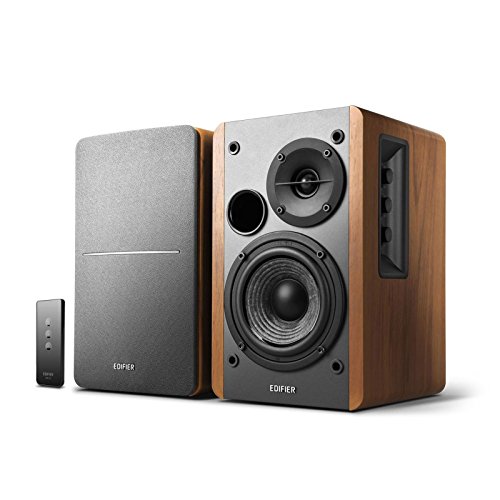
Best for: Those seeking a classic studio‑monitor vibe with dual inputs and remote control. The R1280T combines two AUX inputs for easy device switching, a natural sound profile with silk dome tweeters, and convenient control features that fit near a computer desk or small studio space.
Why chosen: The 42 watts RMS power supports clean, balanced sound across a range of genres. The separate bass and treble controls on the side enable quick tuning for different rooms and listening preferences.
Caution: The wood enclosure contributes to a warmer sound, but bass response may still be limited in very large rooms without a subwoofer.
Elimavi 30W X 2 Powered Bookshelf Speakers

Best for: Home theater‑style setups where wall mounting or discreet placement is needed. The Elimavi system uses dual 4‑inch woofers to deliver full‑frequency stereo sound and includes mounting options for flexible room placement.
Why chosen: With a 3.5mm/RCA input, it supports a variety of devices and preserves a clean aesthetic with a wood‑grain exterior. The built‑in design and mounting clips enable a tidy installation in living rooms, studies, or media cabinets.
Caution: The system’s full effect relies on proper room acoustics; larger rooms may require additional bass reinforcement for the most impactful listening experience.
Buying Guide: How To Choose The Right Speaker For Your Old Record Player
Know your turntable compatibility. Some turntables require a preamp or an external amp, while others can drive powered speakers directly. Check whether your setup needs Bluetooth, Optical, or RCA connections to ensure compatibility with your existing devices.
Consider your room and usage. For small spaces, compact powered bookshelf speakers with built‑in amps can minimize cable clutter. For home theater or larger living rooms, look for models with subwoofer outputs or higher wattage to fill the space.
Power and driver size matter. Larger drivers (3–4 inches or more) generally deliver fuller bass and clearer mids, especially with vinyl. If you primarily listen to acoustic records, prioritize natural tonal balance and stability over raw volume.
Connectivity options. If you plan to stream from a phone or tablet, Bluetooth is convenient. Optical or ARC connections are valuable for TV use. Some models offer dual inputs, enabling simultaneous playback from a turntable and a TV, which can be a strong selling point.
Expandability. If you anticipate adding a subwoofer later, pick speakers with a dedicated sub output. This preserves the overall system coherence as you scale your setup.
FAQ
- Do I need a separate amplifier for powered speakers? Not necessarily. Powered speakers include a built‑in amplifier; passive speakers require a separate amp.
- Can I connect a turntable to Bluetooth speakers? If your turntable has Bluetooth output, yes. If it uses a traditional RCA/phono output, you may need a Bluetooth transmitter or an active powered speaker with appropriate inputs.
- Is Optical input necessary for vinyl playback? Not for basic vinyl playback. Optical inputs are useful when connecting to TVs or digital equipment, but many turntables and boxes use RCA or AUX for analog vinyl playback.
- Should I buy two identical speakers? Yes, for true stereo imaging. Matching the left and right channels improves phase coherence and the overall soundstage.
- Can I mount bookshelf speakers on the wall? Many models include wall mounting options or brackets. Confirm compatibility with your chosen model and follow proper mounting guidelines.