
Best Spring Clip Speaker Connectors for Accessible, Secure Wiring
Best spring clip speaker connectors offer quick, reliable connections for hobbyists and professionals alike. This guide highlights five top options suited for different wiring needs, from heavy gauge to compact 2‑pin setups. Ideal buyers include home theater enthusiasts, DIY installers, and audio upgrades for legacy systems. The table below compares each pick at a glance.
| Product | Best For | Key Benefit |
|---|---|---|
| Sewell Deadbolt Flex Pin Banana Plugs | Older receivers and speakers | Prevents fraying, gold-plated for durability |
| Honbay 4-Pin Terminal Blocks | Multi-channel setups | Spring loaded, easy 4‑pin connections |
| uxcell 2 Way Spring Terminal WP2-3 | Compact dual‑pin needs | 2 pins, push type, solid load |
| Amxinwang Banana Plugs (4 Pieces) | Flexible wiring, color coding | Flex pin design, dual screws |
| CNCESS Pin Banana Plug to 4mm Jack | Binding post compatibility | Secure contact with 4mm jacks |
Sewell Deadbolt Flex Pin Banana Plugs For Spring Terminals

The Sewell Deadbolt plugs are designed for legacy spring clip terminals, offering protection against wire fraying and corrosion. They accept wires up to 10 AWG, making them suitable for larger gauge runs. The 24K gold-plated copper weave provides a clear signal path, which helps minimize resistance and signal loss in older gear. Best for: users upgrading to robust, corrosion-resistant connections on traditional receivers and speakers. Limitations: may be more than needed for thin speaker wires; ensure compatibility with your spring clip measurements.
Honbay 4-Pin Terminal Blocks
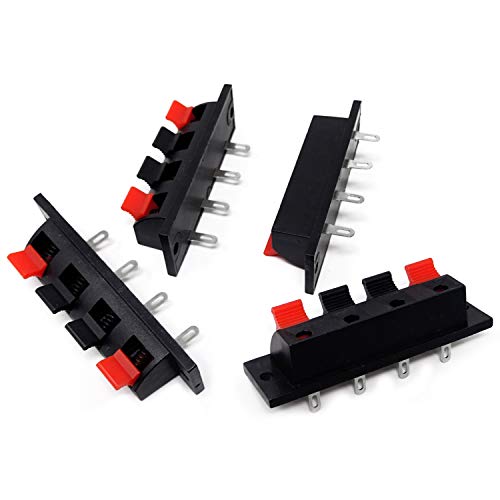
The Honbay set includes four 4-pin terminal blocks with a push-release mechanism. This configuration is well-suited for multi-channel amplifiers and speakers, simplifying quick swaps or channel testing. Best for: systems requiring multiple spring-clip connections in a compact, easy-to-use format. Caution: ensure your terminal spacing matches the block configuration to avoid crowding or shorting nearby conductors.
uxcell 2 Way Spring Terminal WP2-3

The uxcell WP2-3 provides a two-pin, two-position spring‑clip terminal with a 50V/3A rating, color-coded red and black. Fits AWG 24–16 wires, which makes it versatile for common home audio projects. Best for: quick installs where color-coded polarity and simple push-spring action save time. Limitation: higher current draws may exceed the rating in demanding setups; verify power needs before use.
Amxinwang Banana Plugs With Flex Pins

Amxinwang’s banana plugs feature a flex pin design with dual screws to secure the speaker wire. They are gold-plated for corrosion resistance and color-coded to indicate positive (red) and negative (white). The welding-free design makes installation easy for spring terminals, wall plates, or home theater setups. Best for: users who want secure, color‑coded connections with simple installation. Caution: ensure the plugs fit your spring terminals, as some jacks may require a tighter pin or different spacing.
CNCESS Pin Banana Plug To 4mm Jack

This plug converts pin banana plugs to a 4mm female banana jack, offering compatibility with binding posts and spring clips. It supports bare wire or spade forks, enabling flexible wiring options. Best for: systems that need reliable binding post connections with a spring clip interface. Limitation: ensure the 4mm jack mating is compatible with your equipment’s binding posts to avoid poor contact.
Nakamichi FanLock 2mm Flex Pin Plugs

Nakamichi’s FanLock Excel Series uses 24k gold plating and a 2mm flex pin design. The copper core and gold plating aim to reduce resistive losses and corrosion, which can help with consistent signal delivery in automotive or home systems. Best for: audio enthusiasts who prioritize durable, corrosion-resistant connectivity. Condition: ensure clearances around spring terminals to accommodate the flex pin length.
uxcell 2 Way Spring Terminal WP2-204
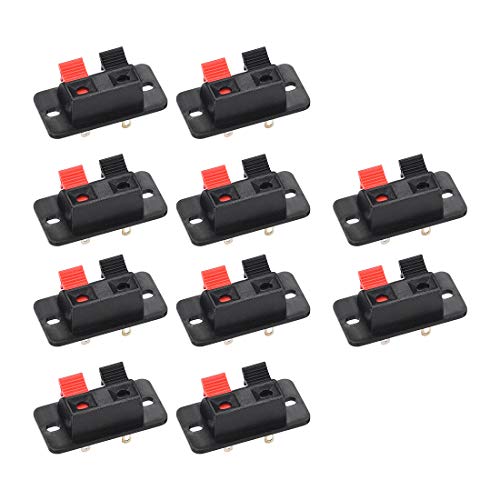
This 10-pack of 2-way spring terminals offers red/black polarity coding with dual pins and push-type operation. It’s a scalable option for larger projects or lab setups requiring multiple channels. Best for: bulk installations where consistent two-pin spring connections are needed. Limitation: not all terminals are compatible with every speaker wire gauge—verify the wire size before purchasing.
Buying Guide: Key Purchase Considerations
- Wire gauge compatibility: Check the maximum AWG rating and ensure your speaker wires fit without crowding the terminal.
- Terminal type and polarity: Ensure the color coding (red/black) matches your system’s polarity to prevent phase issues.
- Gold plating and corrosion resistance: Gold-plated contacts reduce oxidation and improve signal integrity, especially in humid environments.
- Installation method: Consider whether you prefer push-release terminals or screw/dual-screw designs for secure connections.
- Compatibility with equipment: Verify that the plug or terminal type matches your receiver, amplifier, binding posts, or spring clips.
- Number of channels: For multi-channel systems, options like 4-pin or multi-pack terminal blocks can simplify wiring.
Frequently Asked Questions
- What are spring clip speaker connectors used for?
They provide quick, reliable connections for speaker wires without soldering, and they work with spring-loaded terminals on many receivers and amps. - Are gold-plated connectors better for all setups?
Gold plating reduces oxidation and can improve signal reliability, especially in corrosive environments or with frequent reconnects. - Can I mix different types of connectors in the same system?
Yes, as long as the connectors are compatible with the spring-clip terminals and speaker binding posts in your system. - How do I choose between 2-pin and 4-pin terminal blocks?
Choose 2-pin blocks for simple, single-channel connections; opt for 4-pin or multi-pin blocks when wiring multiple channels or speakers in parallel. - What is flex pin design and why is it important?
Flex pin designs allow the pin to flex slightly, improving contact reliability and reducing wear on spring terminals during repeated insertions. - Is there a risk of short circuits with these connectors?
Use proper insulation and routing, ensure clean terminations, and confirm that color-coded leads do not touch each other.