
Best Standard Bass Guitar Strings to Suit Any Style and Skill Level
Looking for dependable standard bass guitar strings that deliver consistent tone and playability? This guide highlights five well-regarded options, explaining who each is best for and why. Perfect for players updating gear, beginners seeking reliable setup, and seasoned players exploring a familiar phrasing on common gauges.
Summary of chosen products:
| Product | Best For | Key Benefit |
|---|---|---|
| Ernie Ball Regular Slinky Bass Strings | Versatile players seeking a balanced tone | Widely used gauge 50-105 with rich, balanced tone |
| Ernie Ball Super Slinky Bass Strings | Players wanting a lighter feel | Popular 45-100 gauge with bright, balanced tone |
| CashBeat 4-String Stainless Steel | Budget-conscious players needing durability | Calibrated gauges for easy setup |
| D’Addario XL Nickel Bass 45-100 | All-around performers | Bright tone with reliable intonation |
| D’Addario NYXL 45-100 Regular Light | Players seeking tuning stability | Enhanced durability and tuning stability |
Ernie Ball Regular Slinky Nickel Wound Bass Strings

Best for players seeking a reliable, well-balanced standard gauge. The Regular Slinky set uses 50-105 gauges, delivering a rich, balanced tone that suits rock, funk, and pop bass lines. These strings are widely adopted by professional players, offering a dependable baseline for tone and feel.
Who it’s best for: Intermediate to advanced players who want consistent feel and a familiar string tension across a 4-string bass. Why selected: The 50-105 gauge remains one of the most popular 4-string configurations, balancing tension, sustain, and playability. Caution: Heavier gauges may require slight truss-rod or neck adjustments for optimal action.
Ernie Ball Super Slinky Nickel Wound Bass Strings

Best for players who prefer a lighter touch with a bright, musical edge. The Super Slinky set uses 45-100 gauges, offering a lighter feel with a strong, balanced tone suitable for fast playing and articulate lines.
Who it’s best for: Beginners learning technique or players who want easier fretting and quicker string response. Why selected: The popular 45-100 gauge provides comfortable tension for many players while preserving rich harmonics. Caution: Lighter gauges may be more prone to fret buzz if setup isn’t optimized.
CashBeat 4 String Stainless Steel Small Ball End

Best for budget-minded players who still want durability and precise gauges. These 4-string strings use stainless steel cores with nickel-plated winding, delivering a durable playing experience and a versatile tone for various styles.
Who it’s best for: Players replacing old or broken strings on a budget without sacrificing consistent feel. Why selected: Calibrated gauges—1 mm, 1.4 mm, 2 mm, and 2.5 mm—help ensure straightforward setup and reliable playability. Caution: Stainless steel strings can feel stiffer for players with a lighter attack.
D’Addario XL Nickel Bass 45-100

Best for players seeking a reliable all-around option with a bright, tight tone. XL Nickel strings offer strong intonation and durability, with a wrap wire that supports a reliable, versatile bass sound across genres.
Who it’s best for: Players who want a long-lasting, bright-toned set that handles a variety of styles. Why selected: Their construction emphasizes reliable intonation and durability for gigging musicians. Caution: Some players may prefer a slightly heavier or brighter set depending on genre preference.
D’Addario NYXL 45-100 Regular Light

Best for players needing enhanced tuning stability and strength. NYXL strings are designed with a reengineered core-to-wrap ratio for a versatile feel while maintaining familiar tension, delivering stronger tuning stability and enhanced harmonics.
Who it’s best for: Professionals and dedicated players who value tuning stability and string durability for frequent performances. Why selected: NY Steel core wire improves tuning stability and break strength. Caution: They may feel stiffer to players who prefer ultra-light gauges.
CashBeat 5 String Stainless Steel Small Ball End

Best for players using extended-range bass or those upgrading a 5-string setup on a budget. The 5-string set uses stainless steel cores with nickel-winding and offers precise gauges for easy installation and a balanced tone across all strings.
Who it’s best for: Musicians upgrading to or maintaining a 5-string bass without overspending. Why selected: The calibrated gauges—1 mm, 1.4 mm, 2 mm, 2.5 mm, and 3 mm—support consistent tension and playability. Caution: The heavier low B may feel stiffer for beginners.
D’Addario Balanced Tension Bass Strings EXL160BT
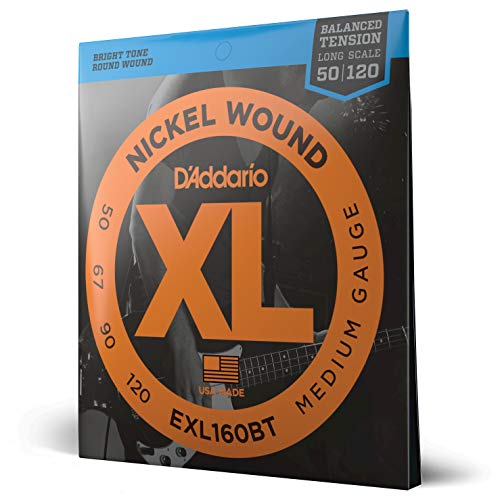
Best for players who value uniform feel across strings. Balanced Tension sets aim for the same fret-hand pressure on each string, helping with even response and a well-rounded voice across the fretboard.
Who it’s best for: Players seeking a uniform tactile experience and dependable intonation. Why selected: The design prioritizes balanced tension for predictability across strings. Caution: The balanced tension concept may feel slightly different to players used to standard tension sets.
La Bella 760FS Deep Talkin Bass Flatwound

Best for players seeking a vintage, mellower tone and smooth playability. The Deep Talkin flatwound set uses flatwound construction and a standard long scale, delivering a distinct, rounder feel and warmer sustain.
Who it’s best for: Players chasing a smooth, jazz-leaning tone or a classic bass voice. Why selected: Flatwounds offer a softer attack and a different resonance profile compared to roundwound sets. Caution: Flatwounds can be slower to settle in and may feel less bright out of the box.
Buying Guide: Key Considerations For Standard Bass Strings
- Gauge and feel: Heavier gauges (50-105) tend to offer more tension and sustain, while lighter gauges (45-100) reduce finger fatigue and string buzz. Choose based on playing style and setup tolerance.
- Tone goals: Nickel rounds deliver brightness and versatility; flatwounds produce vintage warmth; balanced tension sets emphasize uniform feel across strings.
- Playing style and genre: Rock and metal players may favor brighter, durable sets; blues and jazz players might prefer mellower or flatter options for nuance.
- Durability and longevity: NYXL and XL sets emphasize strength and tuning stability, which is beneficial for frequent performers.
- Maintenance: Coated versus uncoated options affect tone loyalty and longevity; most standard sets listed are nickel-wound and uncoated, offering straightforward maintenance.
- Installation and setup: Some sets include explicit gauges per string; ensure your bass nut, bridge saddles, and truss-rod setup accommodate the chosen gauges.
FAQ
- What gauge is considered standard for 4-string bass strings?
Common options include 50-105 (Regular Slinky) and 45-100 (Super Slinky) for balanced, versatile tones.
- Which strings provide the best tuning stability?
Sets like D’Addario NYXL are designed for improved tuning stability due to core-to-wrap engineering.
- Are flatwound strings suitable for modern styles?
Flatwound strings offer a mellower, jazz-oriented tone and slower attack, which some players use for vintage vibes.
- Should I choose coated or uncoated strings?
Coated strings last longer but can alter brightness and feel; uncoated strings are brighter with a quicker response.
- What is the benefit of balanced tension sets?
Balanced tension aims to apply similar fret-hand pressure across strings, aiding consistency in feel and intonation.
- Can I switch between 4-string and 5-string sets easily?
5-string sets use wider gauges and longer scale lengths; compatibility depends on your bass hardware and nut width.