
Best Stereo Amplifier With Equalizer for Home Karaoke and Theater
Answering your search for a stereo amplifier with a built-in equalizer, these picks offer adjustable tone controls, multiple inputs, and reliable power for home theaters, karaoke, and parties. Best for multi-room setups, home studios, or small venues, each model here provides a different balance of power, connectivity, and ease of use. Use this guide to compare capabilities and pick the one that fits your room size, speaker configuration, and how you plan to use EQ to shape your sound.
| Product | Key Strength | Best For |
|---|---|---|
| Facmogu Home Amplifier with Equalizer | 5-Band EQ, USB/SD, multiple inputs | Karaoke nights and small gatherings |
| Pyle Bluetooth Hybrid Home Amplifier | Dual 10-band EQ, 6-channel power, multiple inputs | Home theater and karaoke setups |
| Viprh 2000W Stereo Amplifier | 5-band EQ, multi-input, karaoke friendly | Home theater and party use |
| DEANFINN 2000W 2.0 Channel Amplifier | 10-band EQ, USB/SD, versatile inputs | Versatile home entertainment |
| Donner MAMP7 2-Channel Bluetooth Amplifier | EQ controls, 100W RMS, multiple inputs | Home parties and small venues |
Pyle Bluetooth Hybrid Home Amplifier
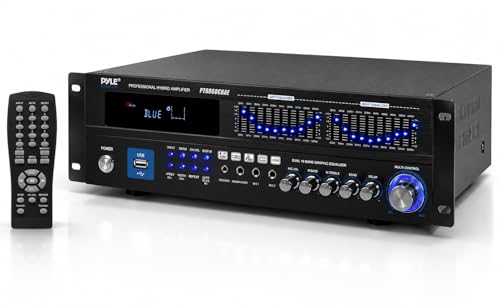
The Pyle 6-Channel Hybrid Home Theater Amplifier targets larger home setups with substantial peak power (2000W) and a built-in dual 10-band EQ. It supports FM radio, USB playback, and a range of inputs including HDMI, optical, coaxial, and DVD inputs, plus Bluetooth streaming. Best for buyers who want a powerful all-in-one solution for a karaoke night or a multi-speaker home theater. Caution: The large feature set can complicate setup for smaller rooms; ensure you have adequate space and compatible speakers.
Pyle Home Stereo Receiver with Bluetooth

This 4-channel amplifier offers 800W peak power along with a USB input for MP3 playback, Bluetooth 5.0 connectivity, and dual mic inputs for karaoke. Its built-in cross-mode controls and reverb options make it a solid mid-range option for home entertainment and casual party use. Best for: users who want straightforward Bluetooth streaming and simple mic support without extreme power. Limitation: It does not emphasize high-end studio-grade EQ and can be less powerful for large rooms.
DEANFINN 2000W 2.0 Channel Amplifier

With 800W rated power and 2000W peak, this DEANFINN model includes a 10-band graphic EQ and multiple input modes, including USB/SD card, RCA, AUX, and more. Its 4-ohm to 16-ohm compatibility makes it flexible for several speaker configurations. Best for: larger rooms or events where precise tone shaping across many genres matters. Limitation: Some users may need external subwoofers to achieve deeper bass responses.
Viprh 2000W Stereo Amplifier

The Viprh model delivers a high-power 400W rated (2000W peak) with 4-16Ω compatibility and 5-band EQ. It supports USB/SD card playback and AUX/DVD inputs with a line output for subwoofers. Best for: home theater enthusiasts who want strong karaoke performance with flexible input options. Caution: It lacks optical input support in some configurations, so verify compatibility with your TV or digital sources.
Donner Stereo Receivers Home Audio Amplifier

Donner’s 1000W peak, 4-channel amplifier emphasizes multiple input modes, including Bluetooth 5.3, USB, RCA, AUX, mic inputs, and FM radio. It features a multifunction remote to adjust treble, midrange, bass, echo, and Talkover. Best for: budget-conscious buyers who want straightforward control of sound shaping and a robust set of inputs for small venues or home parties. Limitation: No HDMI input, which may matter for some modern TVs.
Donner MAMP7 2-Channel Amplifier

Donner’s MAMP7 offers Bluetooth 5.3, EQ controls, 100W RMS power, and 225W in bridge mode. It supports multiple inputs and can be used for home parties, live sound, DJs, and garage setups. Best for: users needing a compact, versatile amp with good EQ control for mid-sized rooms. Limitation: No built-in subwoofer management; relies on external subwoofers for deeper bass.
Buying Guide
What to consider when choosing a stereo amplifier with an equalizer:
- Power needs: Match RMS or peak power to your speakers and room size to avoid distortion or underpowered playback.
- EQ capabilities: Decide between fixed vs. graphic EQ and the number of bands. More bands offer finer control but can be complex.
- Input and output options: Ensure you have the right connections (USB, SD, AUX, HDMI, optical, coaxial, mic inputs) for your gear.
- Karaoke features: If you plan to sing, look for multiple mic inputs with independent volume or reverb controls.
- Bluetooth and wireless: For streaming, verify Bluetooth version and range; some models also support multi-room playback.
- Footprint and mounting: Rack-mountable units save space; consider cabinet ventilation for high-power amps.
- Reliability and compatibility: Check speaker impedance support (4–16 ohms) and whether you need subwoofer outputs or bass management.
Quick comparison tips
- Best for karaoke and parties: models with multiple mic inputs and strong EQ options.
- Better for home theater: look for higher power, robust input variety, and subwoofer outputs.
- Choose this if you need simple setup: pick a lighter, user-friendly model with clear MIDI-like controls.
Frequently Asked Questions
- What is an EQ on an amplifier used for?
It allows you to boost or cut specific frequency ranges to tailor sound for your room and preferences. - Do I need an external subwoofer with these amplifiers?
Not always. Some amplifiers include bass management or sub outputs; others may require a separate subwoofer for deeper bass. - Can I connect a TV to these amplifiers?
Yes, many models support AUX, optical, or coaxial inputs suitable for TVs and media players. - Are 2-channel amps enough for a party setup?
They can be, especially with external loudspeakers and intelligible room coverage, but higher-powered multi-channel amps offer more headroom. - Is Bluetooth sufficient for reliable music in a large room?
Bluetooth works well for casual listening, but for large rooms or parties, wired connections or a dedicated receiver may be more reliable. - What should I consider when choosing mic inputs?
Number of inputs, independent controls, and compatibility with dynamic or condenser mics determine karaoke practicality.