
Best Stereo Audio Selector Switches for Clean, Flexible Audio Routing
Answering the need for clean, reliable audio routing, these stereo audio selector switches help separate or combine multiple devices with minimal signal loss. They’re ideal for gamers, home theater setups, content creators, and multi-device offices. Each pick focuses on clear analog signal paths, simple use, and flexible input/output configurations. The following selections emphasize bi-directional or multi-input switching, without power requirements, and are chosen for ease of integration with common home audio gear.
Buyer table (quick reference):
| Product | Best For | Key Strength |
|---|---|---|
| BolAAzuL 4-Way RCA L/R & 3.5mm Switcher | Gamers and AV hobbyists with multiple sources | Bi-directional 4-port with flexible 3.5mm/RCA combos |
| FlyroadUp 4×1 RCA L/R + 3.5mm Aux | Home theater and content creators | No power needed; 3.5mm/RCA flexible routing |
| Pyle 4-Channel Speaker Selector | Multi-speaker setups | Handles 100W/Ch and 8 Ohm min impedance |
| SOLUPEAK S1 4-Way RCA Audio Switch | Audiophile-focused, compact setups | High-quality connectors and solid build |
| SGEYR Audio Switch 3.5mm Bi-Directional | Desk or office audio switching | Low impedance with reliable 3.5mm path |
BolAAzuL 4-Way RCA L/R & 3.5mm Switcher

Bi-directional 4-port audio switch supports connecting four sources to one output or routing one source to four outputs. It supports flexible combinations—3.5mm to 3.5mm/RCA or RCA to 3.5mm/RCA—with the caveat that the same channel should not carry both 3.5mm and RCA simultaneously. The design is passive analog, preserving original sound quality with no added latency. Best for gamers, AV hobbyists, and content creators who need switchable routing without extra power.
Best for: Multi-source gaming rigs, home studios, and AV setups needing simple, lossless switching. Limitations: Do not connect 3.5mm and RCA on the same channel at once.
FlyroadUp 4×1 RCA L/R + 3.5mm Aux Bi-Directional
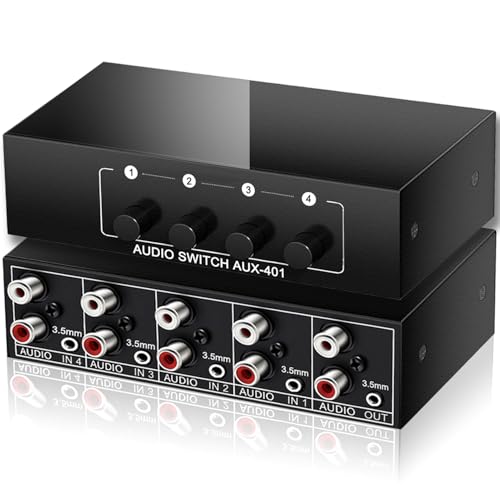
Bi-directional switch for four sources to one output or one source to four outputs. It supports 3.5mm input with 3.5mm/RCA outputs or RCA input with 3.5mm/RCA outputs. No power required and a push-button design for precise routing. Best for home theater users and creators who need quick, straightforward source switching without cables rearrangement. Caution: ensure only one output is active at a time to maintain correct routing.
Pyle 4-Channel High Power Stereo Speaker Selector

Designed to distribute a stereo signal to up to four separate speaker pairs. It supports up to 100 Watts per channel and accepts 14-gauge speaker wires, with a minimum impedance of 8 Ohms. Best for multi-room or larger speaker setups needing individual channel control. Limitation: requires proper amplification per channel to handle higher wattage in large rooms.
SOLUPEAK S1 4 Way RCA Audio Switch
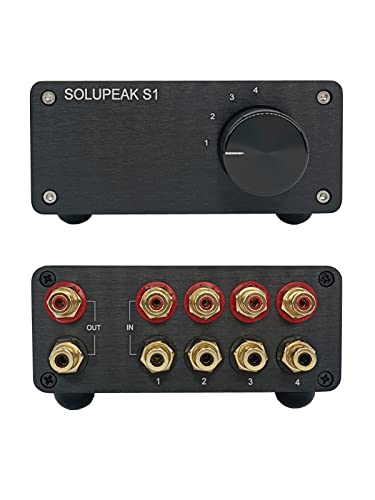
Upgraded immersion gold PCB ensures lossless signal transmission with high-quality RCA interfaces and a robust aluminum chassis. This compact option lets you connect up to four stereo sources to a single output, using a rotary knob for selection. Best for audiophiles seeking a durable, space-saving switch. Note: when used as 1-in-4-out, outputs are not simultaneous.
SGEYR 3.5mm Bi-Directional Audio Switch

Bi-directional 3.5mm switch for 1×2 or 2×1 configurations, designed for desk or office use. It features a durable metal shell and gold-plated headphone jack for reliable performance. Best for quick switching between multiple devices like phones and computers. Caution: designed primarily for 3.5mm connections; does not handle all 3.5mm headphone configurations.
FlyroadUp 3.5mm Aux + RCA L/R Bi-Directional

Bi-directional with eight-input to one-output or one-input to eight-output routing. Supports flexible 3.5mm and RCA configurations and is plug-and-play with no power required. Best for expansive media centers and users who manage many audio sources. Limitation: ensure only one active output at a time to avoid signal conflicts.
4 Way 3.5mm Stereo Audio Switch

Passive 4-in-1-out selector designed for 3.5mm connections, enabling quick switching without cable changes. Compact form factor (about 2.6 x 2.5 x 1.1 inches) makes it suitable for small setups or desk spaces. Best for 3.5mm devices like headphones and headphones-only systems. Limitation: not compatible with four-segment headphones.
TENEALAY 4-Way 3.5mm Audio Switch
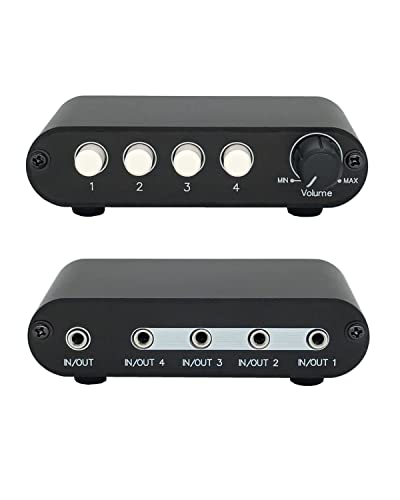
4-in-1-out with 1-in-4-out capability, plug-and-play, no power supply required. It supports four inputs and one output, with a note that if you need multiple outputs simultaneously, you must press and lock multiple buttons. Best for compact multi-source listening in small spaces. Caution: simultaneous multiple outputs require manual selection and locking.
Buying Guide
- Input/output needs: Determine whether you need 3.5mm, RCA, or dual compatibility and whether you require 1-in-4-out or 4-in-1-out configurations.
- Power requirements: Most are passive with no power needed. If you require active amplification or enhanced buffering, check product specs.
- Impedance and wattage: For speaker-based setups, verify minimum impedance (Ohms) and wattage per channel to avoid underpowering speakers.
- Channel management: Bi-directional switches are versatile but ensure that only one output is active at a time to prevent signal conflicts.
- Build quality: Look for metal housings and gold-plated RCA or 3.5mm connectors for durability and reduced contact resistance.
- Space and layout: Compact switches fit tight desks, but larger multi-output units suit home theaters or studios with several devices.
FAQ
- What is a stereo audio switch used for?
- Do these switches require power?
- Can I use these with headphones?
- Is it safe to connect multiple outputs at once?
- What configuration should I choose for a game room?
- What is the main difference between RCA and 3.5mm switches?
A stereo audio switch routes multiple audio sources to one or more outputs, allowing flexible management of devices like game consoles, PCs, TVs, and speakers without swapping cables.
Most listed switches are passive and do not require power. Some high-end models may include powered buffering, but that is not typical for basic 3.5mm and RCA configurations.
Yes, many switches support headphone outputs. Check the product’s compatibility notes to ensure proper impedance matching and connector types.
Typically, these devices are designed so only one output is active at a time. Engaging multiple outputs simultaneously can cause signal conflicts or degraded audio.
For a game room with multiple sources, a 4-in/1-out or 1-in/4-out bi-directional switch provides the most flexibility and quick source switching without reconnecting cables.
RCA is common for line-level audio and home theater gear, while 3.5mm is used for headphones and portable devices. Bi-directional models offer flexible routing between these formats.