
Best Stereo Line Level Booster Preamps for Clearer Audio Playback
Answering the question for anyone looking to boost weak line-level signals, this guide highlights five reliable stereo line level boosters. These devices are best for budget audiophiles, home theater enthusiasts, PC enthusiasts, or anyone upgrading a turntable or low-output source. Each entry includes who it’s best for, key strengths, and practical caveats to help you choose confidently.
| Product | Best For | Key Strength | Notes |
|---|---|---|---|
| Douk Audio L1-MiINI | Audiophiles seeking high output and upgradeable op-amps | 20 dB gain, NE5532P with pluggable socket | 26V high-output mood, DIY flexibility |
| Douk Audio L1 Mini | DIYers who want broader inputs/DI N options | Up to 20 dB, multiple inputs/outputs | Wide voltage support, op-amp swap option |
| AtNeDcVh Mini | Turntable lovers needing phono-to-line boost | 20 dB gain, dual NE5532 | Headphone drive; simple RCA/3.5mm |
| multicomp PRO Stereo Line Level Amplifier | Compact setups needing clean gain | 0–15 dB, RCA I/O | Small footprint |
| KH866 12V RCA Preamplifier | Turntable and low-signal sources | 20 dB gain, DC 9–19V | Phono preamp style; versatile inputs |
Douk Audio L1-MiINI Stereo Line Level Booster Amplifier

The L1-MiINI combines a built-in amplification and voltage-boost circuit with adjustable gain up to 20 dB. It supports standard 3.5mm and RCA inputs/outputs, making it suitable for low-volume sources such as smartphones, tablets, TVs, or portable players. Best for audiophiles who want a high-output stage and the ability to swap op amps for tonal variation.
- Best for listeners who want a high-gain, HiFi-sounding booster with room to customize tone via op-amp swap.
- Limitations: relies on discrete voltages; verify compatibility with your power supply to avoid mismatch.
Douk Audio L1 Mini Stereo Line Level Booster
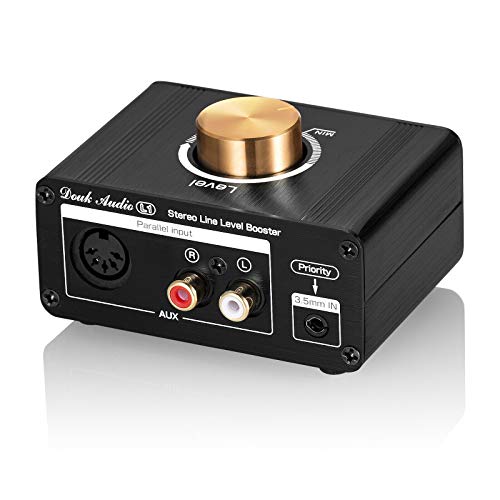
The L1 Mini expands compatibility with multiple I/O options, including 5-DIN if your system uses diverse connections. It shares the same fundamental 20 dB gain and voltage-boost approach as the L1-MiINI, but adds more port flexibility for complex setups. Best for users with varied sources, such as a PC, DVD player, or older audio gear needing a robust line-level lift.
- Better for users who need both 3.5mm and DIN connections in one compact unit.
- Limitation: more complex wiring may require careful cable management.
AtNeDcVh Mini Stereo Preamplifier
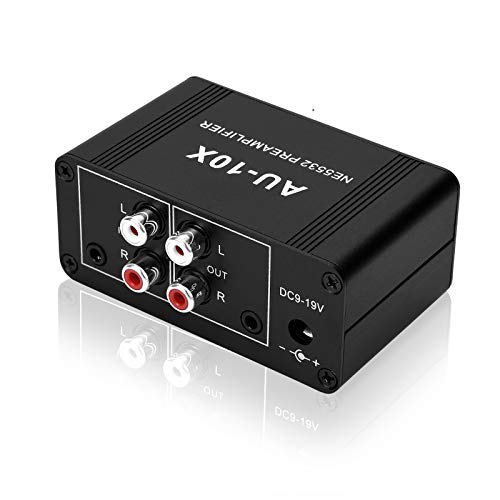
This mini preamp boosts weak signals by 20 dB using NE5532 dual op amps, with RCA and 3.5mm inputs plus a dedicated headphone output. It’s ideal for listeners who primarily need cleaner headphone listening and direct drive for small speakers or powered monitors. Best for budget-conscious users who still want reasonable noise suppression and a straightforward layout.
- Best for headphone-centric listening where a separate output is preferred.
- Caution: headphone output is separate and cannot share ports with other outputs.
multicomp PRO Stereo Line Level Amplifier

The multicomp PRO unit provides a straightforward 0–15 dB gain range with RCA stereo inputs and outputs. Its compact dimensions and a clear 20 Hz–20 kHz response make it a practical choice for simple setups like compact home theaters or desk-based audio rigs. Best for users who want predictable, clean gain without extra features.
- Choose this if you want a small, predictable booster with easy controls.
- Limitation: lacks multiple input types beyond RCA, which may limit legacy gear compatibility.
12V RCA Preamplifier KH866

The KH866 preamp is designed to turn weak signals from turntables into stronger line-level outputs. It supports a 9–19V DC supply and provides a dedicated headphone drive option with constraints on shared outputs. Best for vinyl enthusiasts seeking a simple phono-to-line boost in a compact form factor.
- Best for turntables needing a dedicated phono-to-line boost with a robust gain of 20 dB.
- Caution: the headphone port cannot share with other outputs, which may affect multi-source setups.
Buying Guide: Key Considerations For Choosing A Stereo Line Level Booster
What to look for when selecting a booster:
- Gain range: Most models offer around 0–20 dB. Choose based on how weak your source is and how loud you want the final output.
- Input/output options: If you have legacy gear, ensure RCA and 3.5mm are supported; DIN or 5-pin DIN can be important for older equipment.
- Power requirements: Some boosters accept DC power in wide ranges; confirm compatibility with your amplifier or power supply.
- Op-amp flexibility: Units like the L1-MiINI and L1 Mini advertise NE5532 with socketed op-amps, allowing tonal experimentation for hobbyist users.
- Noise and distortion: Look for low-noise designs and wide frequency response (roughly 20 Hz–20 kHz) for transparent sound.
- Headphone vs. line outputs: Some boosters offer a dedicated headphone output; consider whether you need a shared output or separate paths.
Practical Comparison At A Glance
- Best for high customization: Douk Audio L1-MiINI
- Best for broad source compatibility: Douk Audio L1 Mini
- Best for vinyl-to-line use: KH866
- Best compact option with straightforward gain: multicomp PRO
- Best for headphone-focused listening: AtNeDcVh Mini
Frequently Asked Questions
- Q: Do I need a stereo line level booster if my source already has a strong output?
A: Not necessarily. Use a booster only if your source is noticeably weak or you need more headroom for the amplifier. - Q: Can these boosters be used with a powered speaker system?
A: Yes, connect the booster’s line output to the powered speaker’s line input. - Q: Do boosters affect sound quality or introduce noise?
A: Quality designs minimize noise; however, improper power supply or cheap components can introduce hiss or distortion. - Q: Is op-amp swapping common or required?
A: It’s optional and typically aimed at enthusiasts who want to tailor tonal traits; it’s not required for ordinary use. - Q: Can I use a booster with a turntable directly?
A: If the turntable provides a phono-level signal, you typically need a dedicated phono preamp before a booster to achieve proper RIAA equalization. - Q: Are there compatibility concerns with multi-room systems?
A: Ensure the booster’s outputs match your AVR, amplifier, or active speaker inputs to avoid impedance or level mismatches.