Best Stereo Preamps With Subwoofer Output for Home Audio
Choosing the right stereo preamplifier with subwoofer output can dramatically improve your home audio setup. The following selections cover versatile inputs, high-fidelity sound, and subwoofer integration to help you achieve cleaner bass, richer mids, and clearer highs. The list focuses on models that balance connectivity, build quality, and performance for both casual listening and more demanding setups.
| Product | Brand | Key Benefit | Subwoofer Output |
|---|---|---|---|
| PX2 High Definition Multi-Source Preamp | DYNASTY PROAUDIO | Versatile inputs with Bluetooth and USB DAC | Yes |
| ZP3 Balanced Preamp | Fosi Audio | XLR and RCA flexibility with sub-out | Yes |
| PX1 High Definition Multi-Source Hi-Fi Preamplifier | DYNASTY PROAUDIO | Low-noise circuitry and multiple connections | Yes |
| BT30D Bluetooth 5.0 Receiver Amplifier | Fosi Audio | Bluetooth streaming with RCA and sub-out | Yes |
| AIYIMA A20 2.1 Channel Preamp | AIYIMA | Balanced inputs and HPF with sub-out | Yes |
Note: The table highlights five models that balance connectivity, sound quality, and subwoofer integration to suit a range of home audio needs. Prices are not listed here, but each option provides practical features for improved listening experiences when paired with suitable power amplifiers and loudspeakers.
PX2 High Definition Multi-Source Preamp

The PX2 combines Bluetooth 5.3 streaming and USB DAC capability, enabling digital audio from computers or USB sources. It supports standard stereo PCM formats and offers optimized low-noise circuitry with a 3-band EQ for clear, distortion-free sound. A low-cut crossover helps optimize bass performance when using a subwoofer, making the PX2 suitable for both home theaters and professional-grade listening rooms. Connectivity is flexible, including four RCA line inputs, a Phono input with RIAA preamp and ground, S/PDIF (Optical) input, and a front-panel 1/4″ headphone jack with a low-noise mic preamp. This mix of features supports diverse source options and clean subwoofer integration.
ZP3 Balanced Preamp for Home Audio

The ZP3 emphasizes balanced XLR inputs and outputs along with RCA connections, offering a 3-in/3-out configuration that supports multiple audio sources. It includes a sub-out for integrating a dedicated subwoofer, enhancing low-frequency performance in two-channel and 2.1 setups. Premium build elements such as ELNA capacitors and gold-plated RCA jacks help minimize noise and distortion, contributing to a cleaner sound with wide dynamic range. A remote control adds convenient one-touch input switching and volume adjustments, simplifying system management in a living room or dedicated listening space.
PX1 High Definition Multi-Source Hi-Fi Preamplifier

The PX1 focuses on low-noise circuitry and a 3-band equalizer for precise tonal shaping, along with a wide frequency response and zero distortion. It is designed for flexibility, offering four RCA line inputs, a Phono input with RIAA preamp, an S/PDIF optical input, and a front-panel 1/4″ mic input with a low-noise preamp, plus a headphone output. The PX1 also features multiple outputs, including full-range stereo, a dedicated sub/low-pass path, an X-over option, and a separate headphone channel, enabling optimized speaker and subwoofer configurations for home listening or casual media rooms.
BT30D Bluetooth 5.0 Sub-Out Receiver
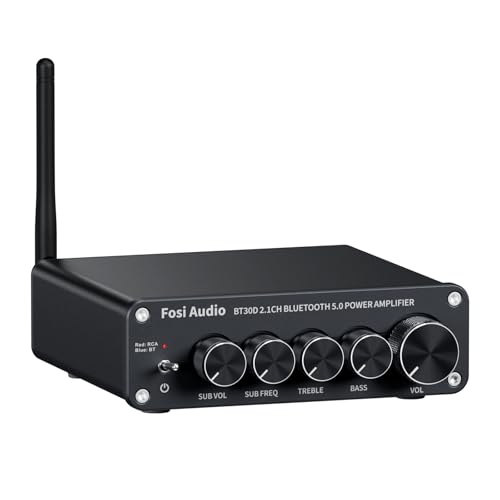
The BT30D is a 2.1-channel Bluetooth receiver with amplified output, designed to drive most passive speakers and subwoofers. It combines Bluetooth streaming with RCA inputs, enabling easy integration into existing systems. Sub-out control and bass/treble adjustments let you tailor the low-end response to your room and listening preferences. The device uses high-efficiency Class D amplification and focuses on delivering reliable performance for home theaters, bedrooms, or small living spaces where wireless convenience matters.
AIYIMA A20 2.1 Channel Preamp

The AIYIMA A20 delivers reference-grade performance with a notable 116dB SNR and ultra-low 0.002% THD+N, delivering pristine, quiet backgrounds and clear musical detail. It includes features tailored for system integration, such as an adjustable High-Pass Filter (60-200 Hz) to protect main speakers from bass distortion, a Sub Out connection for a complete 2.1 setup, and BYPASS mode for external preamp compatibility. Additional flexibility comes from a +3 dB gain option, XLR/RCA input toggling, and a 12V trigger for automating common home theater configurations. It’s designed for enthusiasts seeking versatility and high-fidelity performance.
Buying Guide
Key purchase considerations help you select a preamp that fits your system and room. Consider these perspectives:
- Connectivity: If you need multiple inputs and modern streaming, look for Bluetooth, USB DAC, S/PDIF, and RCA/XLR options. Balanced connections (XLR) provide lower noise and better interference rejection in larger rooms or longer cable runs.
- Subwoofer integration: Ensure there is a dedicated sub-out or bass management (HPF/LPF) to prevent bass from overwhelming mids and highs. A low-cut crossover helps maintain overall clarity when a sub is present.
- Sound shaping: A built-in EQ or tone controls can help tailor the sound to your speakers and room acoustics. Look for a unit with a clean, low-noise signal path to avoid adding coloration.
- Phono stage: If you still spin vinyl, a phono input with RIAA preamp and grounding is essential. This feature adds versatility for those who value analog sources.
- Build and components: High-quality capacitors, relays, and gold-plated jacks reduce noise and distortion. Premium parts are worth considering for long-term reliability and sonic purity.
- Compatibility with existing gear: Check power output (though many preamps are line-level only) and the intended role in your chain—whether as a standalone preamplifier or as part of a larger home theater or 2.1/5.1 system.
- Future-proofing: Consider models with upgrade paths or flexible inputs to accommodate evolving devices, streaming formats, and room changes.
When evaluating these options, compare how each unit handles subwoofer integration, noise floor, and source versatility. For two-channel listening rooms, prioritize models with low noise, clean preamp stages, and a straightforward signal path. For home theaters and larger spaces, emphasize robust connectivity, solid build quality, and reliable bass management to preserve clarity across the spectrum. Always confirm that the unit’s sub-out configuration aligns with your chosen subwoofer and amplifier arrangement to achieve cohesive, accurate bass performance.