
Best Stereo Receiver With HDMI ARC for Home Theater and Music
Answering the search intent, this guide highlights top stereo receivers with HDMI ARC that fit both music listening and home theater setups. It targets buyers seeking simple, versatile connections, clear stereo power, and ARC-enabled control for TV audio. The top picks here are suited for small to medium rooms, budget-conscious setups, or enthusiasts who want easy upgrade paths without a full AV overhaul. Below, quick comparisons and a buying guide help you decide which model fits your needs.
| Product | Best For | Key Arc/Inputs |
|---|---|---|
| Inwa Bluetooth Audio Stereo Amplifier | Compact 2.0 channel systems | HDMI ARC, USB, Optical, Coaxial |
| Denon AVR-S570BT | Home theater with multi-room options | HDMI ARC/eARC, Bluetooth |
| Donner MAMP8 | Budget theater with 5.2 output | HDMI ARC, Bluetooth, USB, Optical |
| Rockville BLUAMP 90 | Bluetooth-focused setups with ARC | HDMI ARC, Optical, USB |
| Pyle PT875BT | Karaoke-friendly home theater | ARC Hi-Def Input, USB |
Inwa Bluetooth Audio Stereo Amplifier

Best for: Small to midsize living rooms where a simple 2.0 channel setup with HDMI ARC is enough. The dual-channel design delivers up to 100W x 2 at 4 ohms with a TPA3221 chip, offering robust power for compact speakers. Its HDMI ARC port enables TV audio pass-through and easy control from connected devices.
Why selected: It combines strong digital inputs (USB, Optical, Coaxial) with Bluetooth 5.3 and HDMI ARC in a compact form. This makes it a practical upgrade for TVs without a separate home theater processor.
Limitation: Marketing lists “100W x 2” at 4 ohms; real-world performance depends on speaker impedance and room acoustics. No built-in multi-room or surround processing.
Denon AVR-S570BT 5.2 Channel AV Receiver

Best for: Home theater enthusiasts who want 8K/4K passthrough and modern HDR support in a single receiver. With 70W x 5 channels and multiple HDMI inputs, it’s designed for multi-room audio and immersive video experiences.
Why selected: The receiver offers eARC compatibility, HDR formats, and built-in Bluetooth for wireless streaming. It provides a broad feature set for TV and music playback in a mid-to-large room setup.
Limitation: Higher complexity and footprint than a simple stereo amp; setup may require additional speaker wiring and calibration for optimal surround performance.
Donner Stereo Receiver MAMP8

Best for: A budget-friendly home theater upgrade that still supports modern inputs. Suitable for media rooms where a 5.2 channel arrangement is desired without an extensive setup.
Why selected: It includes HDMI ARC, Bluetooth 5.3, USB, RCA, optical, and coaxial inputs, plus a Phono option and FM radio. The 5.2 channel capability enables a richer surround sensation at a modest price point.
Limitation: While versatile, it may not match premium AV receivers in critical audio precision or advanced room calibration features.
Yamaha RX-V385 5.1-Channel Receiver

Best for: A reliable mid-range option that blends stereo and surround sound in a compact chassis. Great for music lovers who also want solid TV audio and simple Bluetooth streaming.
Why selected: It supports 4K HDMI inputs with CEC control and Bluetooth, offering a straightforward path from TV to speakers with decent room-filling sound.
Limitation: It’s primarily a 5.1 system; if you need true multi-room audio or advanced room calibration, you may want a more feature-rich model.
Pyle PT875BT 5.2 Channel Bluetooth Home Theater Amplifier
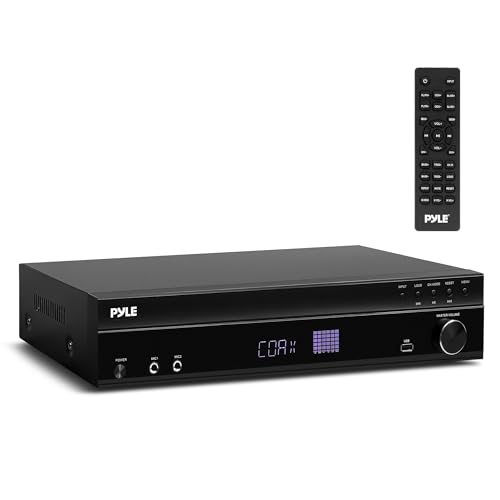
Best for: Karaoke-ready home theater setups that need a built-in microphone input and flexible input options. Ideal for small to medium rooms where music and occasional karaoke are both priorities.
Why selected: This model provides ARC, USB playback, and multiple inputs, including optical and coaxial. The built-in microphone options and Bluetooth streaming cover a wide range of use cases.
Limitation: The emphasis on karaoke features may be overkill for purely audio-focused listening; performance depends on speaker compatibility and room acoustics.
Buying Guide: Key Considerations When Choosing an HDMI ARC Stereo Receiver
What is HDMI ARC and why does it matter? HDMI ARC lets your TV send audio back through the receiver, simplifying cables and enabling TV-based control for volume and power. Ensure the model supports ARC or eARC for best compatibility with modern TVs.
Power and speaker compatibility: Match the receiver’s power rating to your speakers’ impedance (typically 4–8 ohms). Consider headroom for dynamic movie scenes or music with wide dynamic ranges. For stereo setups, prioritize clean amplification and stable channel separation.
Inputs you need: If you rely on streaming devices, USB playback, or turntables, confirm the available inputs (HDMI ARC, USB, optical/coax, Bluetooth, phono, etc.). A model with HDMI ARC and multiple digital inputs offers future-proofing.
Room and layout: Larger rooms benefit from more power or a 5.1/5.2 system, while compact spaces can work well with a strong 2.0 or 2.1 setup. Consider speaker placement and room acoustics when choosing a receiver.
Connectivity ecosystem: If you value wireless streaming or smart home integration, look for built-in Bluetooth or Wi-Fi, and compatibility with streaming services. Multi-room features can be a plus if you plan to expand later.
FAQ
- What does HDMI ARC do on a stereo receiver? It allows your TV to send audio back to the receiver, reducing cable clutter and enabling TV control of volume through the receiver.
- Can I use a stereo amp with a TV without a built-in receiver? Yes, but you may miss advanced surround formats and HDMI pass-through unless the amp includes ARC and sufficient inputs.
- Is 70W x 5 channels necessary for a small living room? For 5.1 setups, 70W per channel is generous in many rooms. For pure stereo listening, less power can be sufficient with efficient speakers.
- Should I choose ARC over eARC? If your TV supports eARC with high-bandwidth audio, choose a model with eARC for the best compatibility and audio quality.
- Do I need a microphone input on my receiver? Microphone inputs are useful for room calibration and karaoke; they are optional if you do not plan to use those features.
- Can I use Bluetooth to connect a phone to these receivers? Yes, most listed models include Bluetooth for wireless streaming from phones, tablets, and laptops.