
Best Stereo Speaker Switch Boxes for Easy Multi‑Room Audio Management
Answering the need for simple, reliable speaker switching across multiple rooms or zones, these stereo speaker switch boxes help you route audio from one or more amplifiers to several speaker pairs. They’re best for home theater setups, multi-room audio, or small commercial spaces where you want quick source changes without re-plugging wires. The top picks here include compact two-zone options and larger multi-zone switches, ideal for both casual listening and more demanding installations.
Overview Table
| Product | Zones / Channels | Best For | Notes |
|---|---|---|---|
| Pyle 4-Channel High Power Stereo Speaker Selector | 4 channels | Small multi-room setups | Supports up to 100W per channel |
| Pyle 4-Zone Speaker Selector Switch | 4 zones | Whole-home or apartment with independent zones | Independent zone on/off per channel |
| PROZOR 2-Zone Speaker Switch Box | 2 zones | Two-area audio in passive systems | Passive, no external power |
| Pyle 8 Channel Speaker Selector Switch | 8 zones | Multi-room or larger home theaters | High power handling, scalable |
| SOLUPEAK P2 2-Way Amp/Speaker Switch | 2 inputs / 2 outputs | Quick A/B comparisons | Passive, banana jack wiring |
Pyle 4-Channel High Power Stereo Speaker Selector – A/B/C/D

- Small multi-room systems with four speaker pairs.
- Handles 100 watts per channel with 8 ohm minimum impedance, and accepts up to 14-gauge wire. A compact 7.48″W x 1.97″H x 4.72″D enclosure keeps wiring neat while enabling four separate speaker pairs to be controlled from a single amp.
- Limited to four zones; not ideal for larger homes without expanding with additional gear.
Pyle 4-Zone Speaker Selector Switch – A/B/C/D

- Whole-home or multi-room configurations with independent zones.
- Each zone has its own on/off control, robust 100-watt per channel capacity, and protection circuitry to prevent overload. Supports 8-ohm impedance with 20Hz-20kHz response for solid sound reproduction.
- Heavier build due to iron construction; may require careful mounting.
PROZOR 2-Zone Speaker Switch Box

- Passive setups needing two independent zones without external power.
- Flexible 2-zone control and dual A/B switching enable quick source changes. Plug-and-play wired via spring clips; no external power required.
- Warning: only one input source active at a time to prevent conflicts.
TENEALAY 2-Way Audio Stereo Speaker Selector

- Two-speaker setups with a compact footprint.
- Controls two speakers from a stereo amplifier, suitable for small living rooms or dorms. Includes clear pair control for simultaneous or alternating listening.
- Impedance limits and 80W max per channel in some models; verify with your amp.
Pyle 8 Channel Speaker Selector Switch
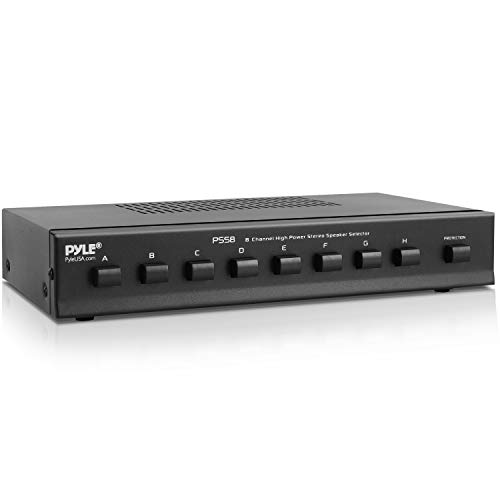
- Larger multi-room installations or home theaters needing eight separate speaker zones.
- Expanded zone control without constant switching; designed to handle multiple rooms while keeping setup manageable.
- May require more wiring planning and space for the unit itself.
Pyle 6 Channel Speaker Selector Switch

- Medium-sized home theater or multi-room layouts needing six zones.
- Independent volume controls per zone and 100W max per channel for robust performance with 8-ohm speakers.
- Two-zone focus could be preferable if you only need two areas; otherwise, consider larger options.
A/B A+B Switch 1 In – 2 Out 2 Way
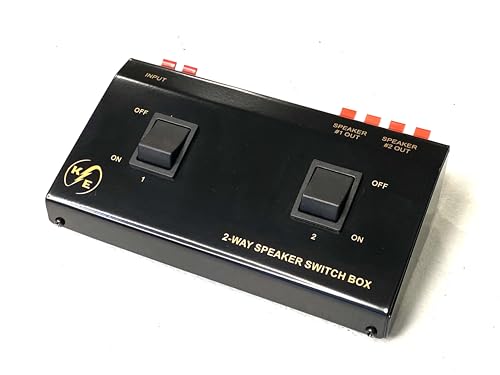
- Simple A/B testing between two speaker setups.
- Sturdy metal construction with 2-way output, suitable for quick comparisons or limited space.
- Not ideal for larger speaker banks or multi-room needs beyond two zones.
SOLUPEAK P2 2 Way Amp/Speaker Switch
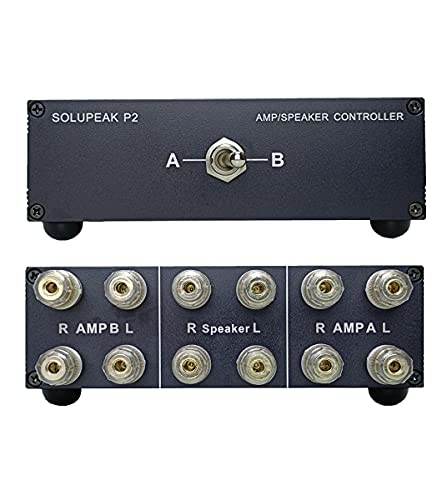
- Quick A/B comparison between two amps or two speakers.
- Flexible 2-IN-1-OUT or 1-IN-2-OUT configuration; passive, plug-and-play with banana jacks supporting up to 12-gauge wire.
- Two-input design means you’ll need to plan wiring if comparing more than two sources.
Buying Guide: Key Considerations For Stereo Speaker Switch Boxes
What should you evaluate before buying a speaker switch box? The following questions help clarify needs and ensure the right fit for your space.
- How many zones do you need? Choose a switch that supports the number of speaker pairs you want to drive. More zones offer greater flexibility but require more wiring and a larger enclosure.
- What is the amplifier power handling? Match the per-channel wattage rating to your amplifier and speaker impedance (typically 8 ohms in these products) to avoid distortion or damage.
- Is it passive or powered? Passive switches are plug-and-play and simple, but some setups benefit from powered units for better drive and protection features.
- Do you need independent zone control? Independent on/off switches per zone help customize listening experiences in each room without changing cables.
- Wiring compatibility? Look for compatibility with 14 AWG to 12 AWG speaker wire and clear terminal types (screw, spring clip, banana jacks).
- Protection features? Some models include overload protection or short-circuit safeguards to protect amplifiers and speakers during use.
FAQ
- What is a speaker selector switch? It is a device that routes audio from one or more amplifiers to multiple speaker pairs, letting you choose which speakers receive sound.
- Can I run multiple amplifiers through one switch? Some models support dual inputs (A/B) but many are designed for one amplifier with multiple outputs. Check the product’s input/output configuration.
- Will a speaker selector affect sound quality? When properly matched to impedance and wattage, a selector should not degrade sound quality; issues typically arise from mismatched cables or impedance.
- Do I need power for these switches? Most listed models are passive and do not require external power; some larger configurations may benefit from protective circuitry.
- How do I choose between two-zone and multi-zone? Two-zone is ideal for compact setups or apartments; multi-zone fits homes with several listening areas and more complex routing.
- Are there safety considerations? Ensure impedance ratings match your speakers (commonly 8 ohms) and avoid overloading amplifiers by distributing power appropriately.