
Best Stereo to Mono Splitter Cable Options for Your Audio Setup
Looking to convert a stereo 3.5mm or 1/4″ signal into two mono channels for mixers, speakers, or recording gear? This guide highlights five reliable splitter cables that closely match typical home studio, DJ, and consumer audio needs. Each entry explains who it’s best for, why it was selected, and any potential limitation to consider. Whether you’re connecting a phone to a mixer or routing laptop output to two mono inputs, the right splitter helps preserve sound quality and minimize noise.
Quick reference: chosen products
- Cable Matters 3.5mm TRS to Dual 6.35mm TS Breakout Cable (6ft)
- RFAdapter 3.5mm Stereo to Dual Mono Cable (6 inch, 2 Pack)
- MOSWAG 3.5mm TRS to Dual 6.35mm 1/4 TS Mono Y Splitter Cable (6.6ft)
- tisino 1/4 inch TRS Stereo to Dual 1/4 inch TS Mono Insert Cable (3.3 feet)
- tisino 1/8″ to 1/4″ Stereo Cable, Dual 1/4″ to 3.5mm Audio Cable (3.3 feet)
Cable Matters 3.5mm TRS To Dual 6.35mm TS Breakout Cable

Best for home studios and hobbyists who need a sturdy 6-foot link from a mobile or laptop to a mixer or monitor via dual 1/4″ inputs. This cable splits the 3.5mm stereo signal into left and right mono channels with dual 1/4″ TS plugs. It uses oxygen-free copper conductors and shielding to reduce noise and maintain clarity. Best for small project studios or DJ setups where two mono lines must be fed into separate inputs.
Best for: casual producers and educators who want a straightforward, durable breakout with clear channel separation. Limitation: longer length may introduce slight signal loss in some budget systems; consider shorter runs if signal integrity is critical.
RFAdapter 3.5mm Stereo To Dual Mono Cable (2 Pack)

Best for compact rigs needing two mono channels from a single stereo jack. The dual 3.5mm mono outputs make it easy to route signals to two mono inputs. Gold-plated connectors and flexible PVC cabling deliver reliable signal with minimal loss. This option suits portable setups, voice recording, or small classrooms where space is at a premium. Limitation: sold in a 2-pack of short cables, so plan accordingly if you need a longer run.
MOSWAG 3.5mm TRS To Dual 6.35mm 1/4 TS Mono Y Splitter Cable
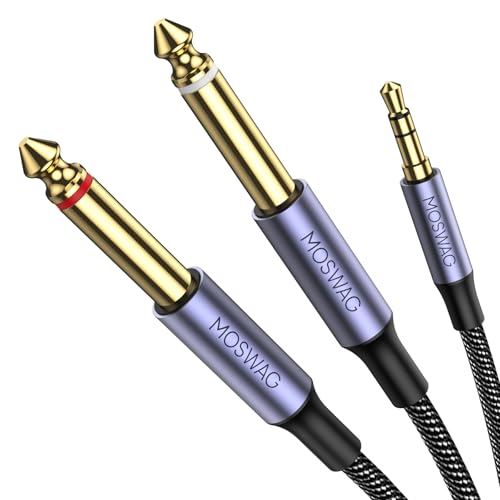
Best for pro-sounding splits in home studios, DJ setups, or live performances where two mono feeds go into a mixer or amplifier. The nylon-braided cord reduces tangling and is designed for heavy use. It accommodates 6.6 feet, offering flexibility for stage layouts. Caution: ensure balance between device output level and input sensitivity to avoid clipping on the mono channels.
tisino 1/4 Inch TRS Stereo To Dual 1/4 Inch TS Mono Insert Cable

Best for insert-style workflows and preamp connections where you need a stereo signal split into two mono lines. This cable is designed for mixing consoles with send/return inserts and can double as a stereo breakout. It’s well-suited for studios that rely on insert points for processors like compressors or EQs. Limitation: primarily suited for insert-style connections; verify your gear supports such routing before purchase.
tisino 1/8″ to 1/4″ Stereo Cable, Dual 1/4″ To 3.5mm Audio Cable

Best for portable players and compact rigs needing a two-mono feed from a 3.5mm source to two 1/4″ inputs. It provides a straightforward split from a small jack to two larger mono jacks. It’s a practical choice for travelers or classroom setups where a laptop, phone, or tablet powers the signal to two separate mono devices. Caution: check compatibility with devices that expect balanced vs. unbalanced connections.
Buying Guide: Key Considerations For Stereo To Mono Splitter Cables
- Connector compatibility: Match your source (3.5mm or 1/8″ TRS) and destination inputs (1/4″ TS mono or insert jacks).
- Cable length: Longer runs can increase attenuation or noise; choose the shortest practical length for your setup.
- Signal quality: Look for OFC conductors, braided shielding, and gold-plated contacts to reduce corrosion and maintain clarity.
- Use case: Consider whether you need a simple stereo-to-dual-mono breakout, an insert cable, or a dual-pack for multi-location setups.
- Durability: Nylon braiding and rugged connectors help in live or travel environments; assess bend radius and strain relief.
- Flexibility: If you frequently reposition gear, a tangle-resistant cable with a flexible outer jacket saves time.
Why choose a stereo-to-mono splitter?
These cables enable separate left and right channels to feed two mono inputs, preserving stereo information in each mono path. They are essential when routing to mixers, powered speakers, or recorders that require two distinct mono feeds rather than a single stereo input.
How to select the right length and format
For desk setups, 3–6 feet is typically adequate; longer runs are useful for stage or classroom layouts. If you need to insert processors via an insert point, consider an insert-style cable like tisino’s option. If you primarily route to two speakers or a mixer, a breakout that uses dual TS plugs is ideal.
Frequently Asked Questions
What is a stereo to mono splitter cable?
A cable that converts a stereo signal into two separate mono channels for left and right outputs, typically via two mono connectors.
Can I use a stereo to mono splitter with a phone?
Yes, for sending audio to a mixer or recording device; ensure the destination accepts mono inputs and supports line-level or mic-level signals as appropriate.
Do all splitters preserve sound quality?
Most do, but longer runs and cheaper materials can introduce noise or loss. Look for OFC conductors and good shielding.
Is insert cable different from a standard splitter?
Yes. Insert cables are designed for mixing consoles with send/return points and may not work as a simple left/right splitter in all setups.
When should I avoid a splitter?
If your equipment requires balanced connections or requires impedance matching, a simple splitter may not be sufficient.
Do these cables affect mic signals?
Splitters primarily affect line-level or instrument-level signals. For mic signals, check impedance and preamp compatibility before use.