Best Strings for a 12-String Guitar: Top Picks for Bright Tone and Easy Playability
If you’re looking to optimize a 12-string guitar, focus on strings that balance bright shimmer with clear sustain. This guide highlights five products that are well-suited for 12-string setups, covering phosphor bronze, bronze, and specialty options. Ideal buyers include beginners seeking a forgiving feel, fingerstyle players needing balanced tone, and rhythm players chasing strong projection. The table below compares the five picks at a glance.
Product Snapshot
| Product | Best For | Core Material | Gauge Range |
|---|---|---|---|
| ALLSET 12 String Guitar | Players seeking crisp, full tones with comfortable play | Adirondack spruce top with Honduran mahogany back and sides | Not specified |
| D’Addario EJ38 12-String Set | Bright, balanced acoustic tone for 12-string | Phosphor bronze wrap on hex core | Light gauge 10-47 |
| D’Addario EJ11 (Light) 6-String | Backup or mixed-string setup for 12-string players using octave pairs | 80/20 bronze core | Light gauge 12-53 |
| 12-pack 12ga. Steel Guitar Strings (USA) | Durable, standard metal string for 12-gauge needs | Plain steel | .012 |
| Ernie Ball Earthwood Medium Light | Warm, projecting tone with mid-range emphasis | Phosphor bronze wound on high-carbon core | 12-54 gauge |
ALLSET 12 String Guitar, A12-BK

Best for players who want a full, expressive 12-string voice with easy upper-fret access. The Adirondack spruce top and Honduran mahogany back and sides deliver crisp, wide-dynamic range tones that respond well to fingerstyle and strumming. The guitar is designed to transfer vibration efficiently, producing clear note separation and sustain. Caution: the guitar’s setup favors players comfortable with a wider string spacing and neck width; beginners may need a short acclimation period.
D’Addario Phosphor Bronze EJ38 12-String Set

Best for players seeking a warm, balanced tone across the 12-string spectrum. The phosphor bronze wrap wire provides traditional acoustic brightness with dependable intonation, suitable for folk, pop, and light blues. The set is a popular standard for 12-string work, offering a familiar feel for players upgrading from lighter or mixed gauges. Limitation: 12-string tension can be higher than standard 6-string setups; ensure your neck and truss rod can accommodate the load.
D’Addario 80/20 Bronze EJ11 (Light) 6-String
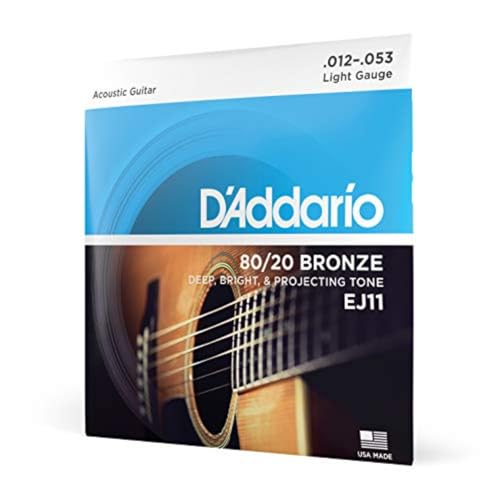
Best for players who alternate between 12-string rhythm work and a reliable 6-string backup. While this is a 6-string set, its 80/20 bronze wrap is known for bright projection. For 12-string players, it’s a cautionary option when a secondary 6-string set is desired for drop tunings or alternate tunings. Limitation: not a dedicated 12-string set; expect different tension and intonation characteristics if used on a 12-string guitar.
12-pack 12ga. Steel Guitar Strings

Best for players using a traditional steel-string feel with a robust, bright attack. The US-made plain steel composition provides reliable intonation and durability. If your 12-string uses a mixed string layout or specific octave pair configuration, verify tension compatibility with your instrument. Limitation: primary use is for standard steel-string guitars; ensure compatibility with a 12-string’s octave string arrangement.
Ernie Ball Earthwood Medium Light (P02146)

Best for players who want a warm, projecting tone with a balanced mid-range. These phosphor bronze strings are wound around a high-carbon hex core to deliver stable tuning stability and familiarity for many 12-string players who prefer a slightly heavier feel. Limitation: as a 12-string option, tension and intonation must be checked against your instrument’s scale length and neck setup.
Buying Guide: Key Considerations For 12-String String Choice
- String Type: Phosphor bronze offers warmth and brightness; phosphor bronze or 80/20 bronze choices will affect brightness and sustain. For classic 12-string textures, phosphor bronze is a common pick.
- Gauge: Lighter gauges are easier to play for beginners and fingerstyle players; heavier gauges deliver more projection but require greater finger strength and neck tension.
- Construction: Wound strings on a hex core provide stable intonation and consistent intonation across octaves. For 12-strings, consider how the octave strings interact with the pairings on your neck.
- Durability vs. Brightness: Bronze sets tend to highlight brightness; lighter sets may feel more supple but can produce less volume on the upper strings.
- Neck Tension: 12-string guitars experience higher tension; ensure the neck and truss rod are properly adjusted and inspected when changing to new gauges or materials.
- Maintenance: Consider NANOWEB or similar coatings for longer life if you frequently play in a sweaty environment or perform live.
FAQ
- Q: Are there strings designed specifically for 12-string guitars? A: Yes, many brands offer 12-string sets with octave and main strings matched for 12-string builds, often labeled as 12-string sets or designed for 12-string guitars.
- Q: Should I use a lighter gauge for a beginner on a 12-string? A: Lighter gauges tend to be easier to press and play, making them favorable for beginners. Upgrading gradually to heavier gauges can preserve tone as technique improves.
- Q: Can I mix string types on a 12-string guitar? A: It’s possible on some setups, but it can alter tension and intonation; consult your guitar’s manufacturer guidelines or a professional technician.
- Q: How often should I change 12-string strings? A: It depends on playing style and environment; frequent players may prefer changing strings every 2-4 weeks, while casual players may do so every 2-3 months.
- Q: Do coated strings last longer on a 12-string guitar? A: Coated strings can extend life by resisting corrosion, but some players report slightly different tension and brightness on octave strings. Test to see how your sound and feel respond.
- Q: Will a 12-string require a different setup after changing strings? A: Not necessarily, but neck relief, truss rod, and intonation can shift slightly with different gauges and materials; a setup check is recommended after string changes.