
Best Studio Microphone Boom Arm for Clean Setup and Easy Positioning
Answer: A studio microphone boom arm helps you position your mic precisely while keeping cables organized and desks uncluttered. This guide highlights five top options suited for different needs—from lightweight Blue Yeti setups to heavier mics—and explains who each is best for. Ideal buyers include streamers, podcasters, gamers, and home studio owners seeking stable, adjustable arms with built-in cable management.
| Product | Best For | Why It Stands Out |
|---|---|---|
| InnoGear Mic Arm Microphone Boom Arm Cable Management | Clean desks, cable-conscious setups | Cable channels, good reach, adjustable angles |
| InnoGear Boom Arm Microphone Mic Stand | Versatile, budget-minded studios | All-around adjustability, strong load handling |
| RØDE PSA1+ Professional Studio Boom Arm | Professional desks with quiet operation | Silent damping, high reach, integrated cable routing |
| FIFINE BM88 Low Profile Microphone Boom Arm | Space-conscious setups | Low profile, sturdy, hidden cable management |
| AAK/AUDIO AA AUDIO ACCESSORY Mic Arm | Heavy microphone rigs | High load capacity, gear-lock stability |
InnoGear Mic Arm Microphone Boom Arm Cable Management

The InnoGear model offers built-in cable management channels, allowing cables to be neatly tucked away by removing rubber covers. This helps create a tidy setup for live streams or recording sessions. It supports a wide range of mic positions with a 135° back-and-forth and 180° up-and-down adjustment, plus a 360° rotatable base. A 14-inch arm plus a 6.3-inch extension riser provides reach up to 32.3 inches horizontally and 37.4 inches vertically. Best for budget-conscious users who value organization and flexible positioning. Caution: ensure desk edge clearance up to 2 inches thick.
InnoGear Boom Arm Microphone Mic Stand
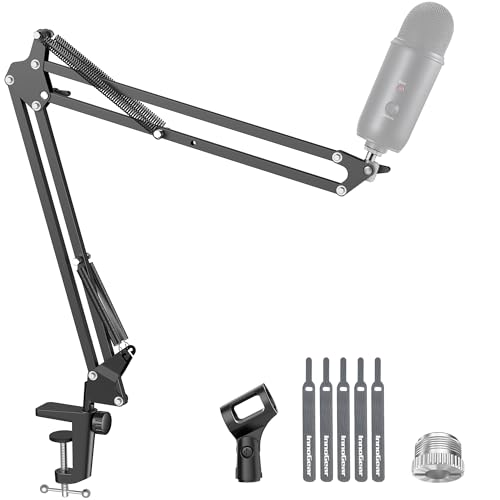
This professional stand emphasizes full adjustability of the arm with 360° base rotation, 135° back-and-forth extension, and 180° up-and-down movement. It is built to endure longer sessions and has a robust construction to handle heavier mics compared with many budget options. Best for podcasters and streamers who need reliable, silent positioning in dynamic setups. Limitation: some users may require additional clamps for thicker desks.
RØDE PSA1+ Professional Studio Boom Arm
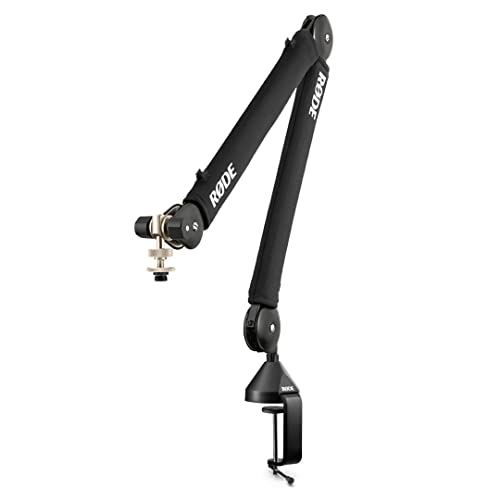
The PSA1+ offers silent spring damping, 360° rotation, and full extension for flexible, distraction-free recording. It clamps to desks up to 70 mm thick and supports mics from 0.25 kg to 1.2 kg, including some shock mounts. Best for professional desks needing quiet operation and neat cable management. Caution: higher-end features come with a price premium compared to basic models.
FIFINE BM88 Low Profile Microphone Boom Arm

The BM88 emphasizes a low-profile design that tucks beneath a monitor, freeing desk space. It features hidden cable management and a sturdy metal build to resist wobble during use. Best for gamers or streamers who need a compact arm that doesn’t obstruct screen visibility. Limitation: payload capacity may be lower than heavy mics or shock-mounted setups.
Aokeo AK-58i Desk Low Profile Mic Boom Arm

The AK-58i arm offers extreme stability with 360° rotation and 180° up-down movement, plus a low-profile design that minimizes visual distraction. It is designed to fit a wide range of mics including Blue Yeti and similar models. Best for users who want a quiet, unobtrusive boom with solid stability. Caution: verify clamp thickness for your desk before purchase.
Frgyee Mic Boom Arm With Heightened Extension

The Frgyee overhead desk mic stand features a high 31.5-inch riser, ideal for overhead setups and crossing monitors without blocking screens. It uses thickened steel materials and upgraded clamps to fit desktops up to 4.2 inches thick. Best for studio spaces that require flexible overhead positioning. Limitation: taller setups can increase footprint on your desk area.
Buying Guide: Key Purchase Considerations
- Weight capacity: Match the arm’s load rating to your microphone, including any shock mounts. Heavier mics require sturdier arms with higher payload.
- Reach and coverage: Consider horizontal and vertical reach. If you monitor while recording, ensure the arm allows easy mic placement without obstructing your view.
- Adjustability: Look for multi-axis movement (360° rotation, 135° back-and-forth, 180° up-down) for versatile positioning during different tasks.
- Desk compatibility: Check clamp thickness and desk edge distance. Some arms fit desks up to 70 mm, others to thicker surfaces.
- Cable management: Built-in channels or clips keep cables tidy and reduce tangling during sessions.
- Noise considerations: Spring damping and quiet operation are important for live recordings to avoid creaks and handling noise.
- Low-profile design: If monitor visibility matters, select a low-profile arm that tucks under the screen.
Frequently Asked Questions
- What is a boom arm best used for?
It allows precise mic positioning, reduces desk clutter, and hides cables for a cleaner setup. - Do I need a heavy-duty arm for a Blue Yeti?
Not always, but heavier mics or shock-mounted setups benefit from higher payload arms. - How high should a mic arm extend?
Choose an arm with enough vertical reach to position the mic near your mouth while keeping your mouth away from your screen. - Are low-profile arms worth it for gaming setups?
Yes, they save desk space and avoid obstructing screen view during intense sessions. - What about cable management?
Prefer arms with integrated channels to keep cables organized and reduce tangling during movement.