Best Studio Monitors With Subwoofer for Accurate Mixing
For music production, video post, and home studios, combining studio monitors with a dedicated subwoofer expands your low-end accuracy and helps you translate mixes to real-world systems. This guide highlights five top-rated subwoofer-equipped monitors to fit a range of budgets and rooms, from compact desktop setups to larger control rooms. Each entry includes key features to help you compare performance, placement, and compatibility with common monitors and DAWs.
| Product | Brand | Type | Key Benefit |
|---|---|---|---|
| PreSonus Eris Sub 8BT | PreSonus | 8″ Active Subwoofer | Compact footprint with Bluetooth for quick setup |
| JBL LSR310S | JBL | 10″ Subwoofer | Deep extension and DJ/club-like tuning options |
| KRK S8.4 | KRK | 8″ Powered Subwoofer | Low-end extension to 30 Hz with high SPL |
| PreSonus Eris Pro Sub 10 | PreSonus | 10″ Active Subwoofer | Big bass with flexible low-pass controls |
| ADAM Audio T10S | ADAM Audio | 10″ Subwoofer | Designed to complement ADAM T-series monitors |
Below, five selections with standout features are explored to help you pick a setup that best matches your room, workflow, and monitoring needs.
PreSonus Eris Sub 8BT — 8″ Subwoofer

The Eris Sub 8BT is an 8-inch front-firing powered subwoofer designed to deliver accurate low-end for music production or multimedia listening. Its compact form fits desktop studios or small control rooms, while the included Bluetooth wireless capability supports flexible placement and easy integration with lifestyle setups. Its woven-composite woofer contributes to tight bass with clean low-frequency extension down to 30 Hz, assisting in producing mixes with a strong yet controllable low end.
Key points: 100-watt output, front-firing design, room-friendly low-end response, Bluetooth for quick pairing, and a focus on studio-quality fidelity. This model is well-suited for users who need solid bass authority without occupying a large footprint.
JBL LSR310S Studio Subwoofer
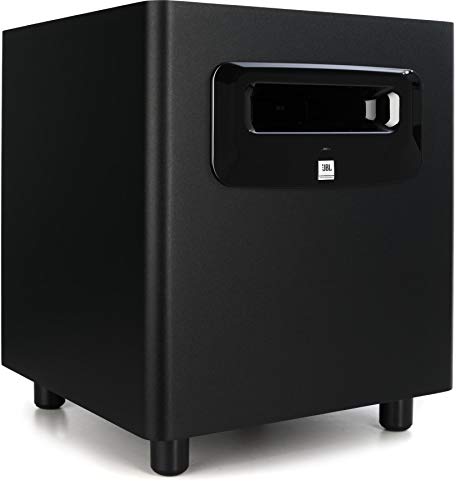
The JBL LSR310S provides deep, dynamic bass for critical listening and production. Its patented port design and specially engineered tuning extend low-frequency response while maintaining clean, accurate output across playback levels. An optional XLF (Extended Low Frequency) setting simulates club-level bass and can help with dance-m music production or bass-heavy projects. With a driver designed for strong LF performance and a high peak SPL, this subwoofer supports long sessions at high levels without compromising fidelity.
Highlights include a tuned port system for extended bass, the XLF feature for club-like bass shaping, and a driver engineered to achieve sub-20 Hz response in real-world listening. Ideal for producers who need substantial low-end impact that remains faithful to the source material.
KRK S8.4 S8 Generation 4 Subwoofer

The KRK S8.4 combines an 8-inch glass aramid composite woofer with a bass extension down to 30 Hz and a max SPL of 112 dB. The user-adjustable crossover and phase controls help tailor the sub across a range of room sizes and monitor pairs. A footswitch option is available to enable or disable the sub and the crossover filter (note: footswitch not included). This design aims to deliver tight, controlled bass suitable for music production as well as home theater use in larger rooms.
Strengths include robust low-end extension, precise crossover management, and a sturdy build that fits professional studio setups. It suits users needing substantial bass without sacrificing clarity in midrange and high-end details.
PreSonus Eris Pro Sub 10 — 10″ Subwoofer

The Eris Pro Sub 10 features a 10-inch front-firing driver with a glass-composite cone, delivering a broad low-end boost for music production or multimedia reference. A front-facing bass-reflex port and a continuously variable low-pass filter (50 Hz to 130 Hz) allow precise control over the upper frequency range that the sub reintroduces to the main monitors. This flexibility makes it a strong match for larger nearfield or mid-field setups, enabling tighter integration with existing loudspeakers.
Considerations include adjusting the low-pass crossovers to avoid masking the monitors’ mids, ensuring phase alignment, and placing the sub for minimum room cancellations. This option provides reliable bass extension with straightforward controls for studio environments.
ADAM Audio T10S Subwoofer

The ADAM Audio T10S is designed to extend low frequencies while maintaining a transparent, musical character with a downward-firing woofer. It is specifically engineered to complement ADAM’s T-series monitors, offering efficient room placement and predictable bass integration. The downward orientation can be advantageous in smaller rooms where vertical space is limited, and it provides flexible room placement options to minimize boundary cancellations.
Key attributes include room-optimized output, a focus on maintaining the high fidelity of the main monitors, and a model that integrates smoothly with ADAM’s own monitoring ecosystem. It’s a good pick for users already investing in ADAM gear who want to preserve a coherent monitoring chain from top to bottom.
Buying Guide: Key Purchase Considerations
- Room size and placement: Larger rooms benefit from higher-powered subs with adjustable crossovers and phase controls. Small desks may require compact subs with room-correction features or careful placement to avoid overloading reflections.
- Monitor compatibility: Ensure the subwoofer’s crossover frequency and phase can be matched to the main monitors. Some brands offer tailored integration with their own speakers for smoother responses.
- Frequency extension and SPL: Consider the needed low-end extension (e.g., 20 Hz to 150 Hz) and the maximum SPL you require for comfortable long sessions without distortion.
- Connectivity: Look for inputs that match your interface (TRS, XLR, RCA) and whether wireless Bluetooth is a practical addition for your workflow or just for convenience during casual listening.
- Controls and flexibility: A configurable low-pass filter, phase alignment, and room EQ or boundary compensation can help tailor bass to the room’s acoustics.
- Build quality and durability: For desktop setups and busy studios, solid enclosures with good damping reduce undesirable resonances and vibrations that color the sound.
- Brand ecosystem: Some manufacturers design subs to pair optimally with their own monitor lines, improving ease of integration and coherence across the signal chain.
In choosing, weigh how much bass authority you need, how much space you can dedicate to placement, and how closely you want the sub to track your monitors’ linearity. The selections above cover a range of room sizes and production styles, enabling you to balance precision, power, and practicality in a single system.