
Find the Right Enclosure — This guide reviews top subwoofer boxes compatible with plexiglass windows and highlights design, tuning, and build features to help you choose a display-ready enclosure for strong bass and visual style.
| Product | Type | Key Feature |
|---|---|---|
| Pyramid BNPS102 Dual 10″ Bandpass System | Bandpass Subwoofer System | Includes amplifier, neon lighting, and amp kit |
| Q Power Dual 12 Inch Vented Subwoofer Box | Dual-chamber Vented | Shared slot port vent, heavy bass |
| QPower Single 12-Inch Dual-Vented Box | Single Vented | 1.65 cu ft, tuned to 42 Hz |
| Skar Audio AR1X12V 12″ Ported Box | Ported/Kerf Port | Armor coated, tuned 36 Hz, 1.75 cu ft |
| Q Power 10 Inch Vented Subwoofer Box | Single 10″ Vented | 1.1 cu ft, tuned 37 Hz |
Pyramid BNPS102 10″ Dual Bandpass Subwoofer System

Type: Bandpass Subwoofer System With Neon Accent Lighting and Included Amp
This package includes a dual 10″ bandpass subwoofer box, a 1100W mono amplifier (BOSS R1100M) with 250W RMS output, and an 8-gauge amplifier kit. The bandpass design typically emphasizes a narrow frequency range for impact, which pairs well with a visible plexiglass window to showcase drivers and lighting.
Key Features: Built-in neon accent lighting, integrated amplifier and installation kit, dual 10-inch subs in a tuned bandpass enclosure. This all-in-one approach simplifies installation when adding visual elements like a plexiglass panel and lighting.
Q Power 12 Inch Dual Vented Subwoofer Box

Type: Dual-Chamber Vented Enclosure
Designed to hold two 12″ subwoofers (not included), this dual-chamber vented box uses a shared slot port vent design to manage airflow and heat. The dual-chamber layout gives room to add a plexiglass window on the front panel to expose both drivers while maintaining port tuning.
Key Features: Dual 12″ capacity, strong bass emphasis, shared slot port vent to improve cooling. The construction and port placement are suitable for integrating a display window without severely impacting port length if planned correctly.
QPower Single 12-Inch Dual-Vented Subwoofer Box

Type: Single Vented MDF Enclosure
With 1.65 cubic feet of internal airspace and a tuning around 42 Hz, this MDF enclosure balances low-end output and compact size. The dual-vented system helps bass performance and thermal management, and the rectangular front can be fitted with a plexiglass window to showcase the woofer cone.
Key Features: Sturdy MDF construction, tabletop portability feature, enhanced bass response, and a vented design that keeps the subwoofer cooler under load.
Skar Audio AR1X12V Single 12″ Ported Subwoofer Box
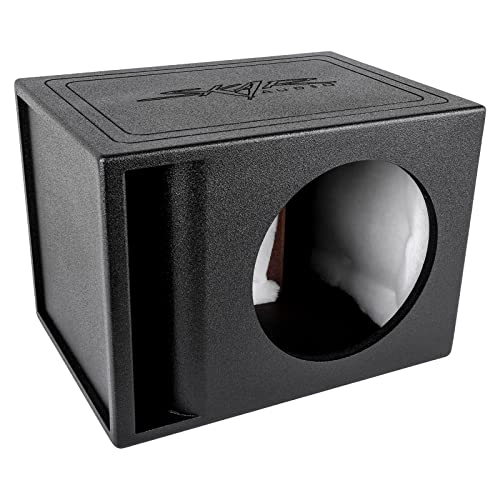
Type: Ported/Kerf Port Enclosure
This armored series enclosure offers 1.75 ft³ internal volume and a 36 Hz tuning, using a 2″ wide kerf port to move more air for louder output. The robust, armored finish suits installations where durability matters, while the front baffle can be modified to include a plexiglass window that protects the driver and shows off lighting.
Key Features: Kerf port design for loud, low output, universal fit, armor-coated finish. Ported performance is robust for SPL-focused setups and lends itself to visible driver displays when sealed around a window properly.
Q Power 10 Inch Vented Subwoofer Box

Type: Single 10″ Vented MDF Enclosure
Offering 1.1 cubic feet and a tuning near 37 Hz, this compact vented box works well for tighter spaces. Its charcoal carpet finish and rectangular front make it straightforward to adapt with a plexiglass window and accent lighting for a custom display while retaining vent tuning.
Key Features: Heavy-duty MDF, vented design for max output, 37 Hz tuning, compact footprint ideal for installations with limited cargo space.
Buying Guide: Choosing A Subwoofer Box With Plexiglass Window
Adding a plexiglass window to a subwoofer box creates a visual focal point and protects drivers while showing custom lighting. Use these considerations to match function and style.
Enclosure Type And Sound Goals
- Sealed Enclosures: Tighter, more accurate bass; easier to seal around a plexiglass window without affecting port tuning.
- Vented/Ported Enclosures: Louder and more efficient at tuned frequencies; plexiglass windows must avoid interfering with port length and cross-section.
- Bandpass Enclosures: High output in a narrow band — windows highlight the internal build and lighting but require careful sealing and structural support.
Internal Volume And Tuning
- Match internal cubic feet and tuning (Hz) to your subwoofer specs. Altering front panel material or adding a window can change internal volume and affect tuning slightly.
- Plan port length and diameter before installing a window on vented boxes to preserve tuning frequency.
Materials And Build Quality
- MDF Thickness: Thicker MDF reduces panel flex and resonance; reinforce around window cutouts.
- Window Material: Use strong plexiglass (acrylic) at proper thickness to resist pressure and vibration; consider mounting with continuous gasket or silicone to dampen vibrations.
- Finish: Carpeted, armored, or painted fronts each have different mounting needs for adhesive and hardware.
Structural Considerations
- Reinforce the front baffle where you cut the window. Use internal braces to maintain integrity and prevent air leaks around the plexiglass.
- Account for driver mounting depth and speaker grille clearance when sizing the window opening.
Thermal And Acoustic Management
- Vented boxes produce airflow; ensure the plexiglass area isn’t blocking or altering port pathways.
- Consider adding vents or hidden vents elsewhere if your window reduces effective port area.
Installation And Compatibility
- Verify subwoofer cutout dimensions and bolt patterns before modifying a prebuilt box.
- Check if the enclosure is intended for universal fit or specific vehicle placement to ensure proper fitment.
Visual Design And Lighting
- Plan LED placement and wiring paths. Plexiglass windows look best with diffusers or etched edges to spread light evenly.
- Use mounting hardware that secures the plexiglass but isolates vibrations with rubber or foam gaskets.
Comparison Perspectives
- Durability: Armor-coated or thicker-MDF boxes (like ported armored models) resist dents better than thin carpeted boxes.
- Sound Focus: Ported/kerf-port boxes prioritize SPL and low-frequency extension; sealed boxes favor accuracy and smaller enclosures.
- Customization: Flat-front, rectangular baffles are easier to modify with windows than curved or heavily braced factory panels.
When planning a plexiglass window installation, measure twice, reinforce the baffle, preserve internal volume, and keep ports unobstructed. These steps preserve acoustic performance while delivering a visually striking subwoofer display.