
Best Surround Sound Audio Interfaces for Immersive PC and Studio Use
Answering the call for a clear, powerful sound upgrade, these surround sound audio interfaces are tailored for gamers, content creators, musicians, and home studios. The top picks balance multi-channel outputs, low latency, and easy plug‑and‑play setup. Best for gamers and movie buffs: 7.1 USB sound cards. Best for home studios: bus-powered USB interfaces with high-resolution converters. Best for portable setups: compact, driverless options that still deliver studio-grade audio.
Buyer’s quick table of the featured products:
| Product | Best For | Key Benefit |
|---|---|---|
| StarTech 7.1 USB Audio Adapter | PCs needing 7.1 output | Up to 7.1 channels via USB with SPDIF output |
| Cubilux 7.1 USB Surround Sound Card | Gaming and multimedia | 7.1/5.1 with high-res support and aluminum case |
| SMSL Nano ONE Pro | Live streams and gaming on a budget | Four modes including 7.1 virtual cinema |
| XTUGA Q-12 USB Audio Interface | Daily recording and practice | Reliable dual inputs, low latency, plug‑and‑play |
| Focusrite Scarlett Solo 4th Gen | Home studios and podcasters | Studio-grade pre-amps and Air mode for clarity |
StarTech 7.1 USB Audio Adapter
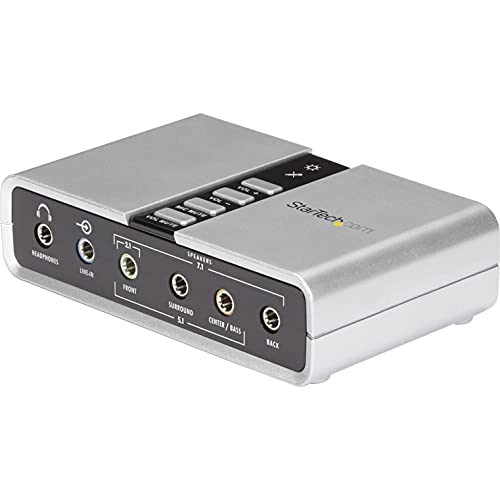
The StarTech ICUSBAUDIO7D is a bus-powered external sound card that delivers up to 7.1 channel output from a single USB connection. It supports 7.1, 5.1, and 2-channel configurations via 3.5mm jacks, plus a dedicated headphone port, line-in, and stereo microphone inputs. Best for desktop or laptop users who want to upgrade existing onboard audio without complex setup. Caution: SPDIF digital output is limited to 48 kHz playback, which may be a constraint for some high-resolution workflows.
Cubilux 7.1 USB Surround Sound Card

The Cubilux 7.1 USB Surround Sound Card is designed for immersive multimedia, offering 7.1/5.1 outputs, stereo headphone output, line-in, and mic input. It supports high-resolution playback up to 384 kHz/24-bit for some modes and uses a full aluminum housing to minimize interference. Best for gamers and music lovers seeking solid aluminum construction and multi-channel flexibility. Limitation: 7.1 support relies on the USB interface and may require compatible software for full use.
SMSL Nano ONE Pro External Sound Card

The SMSL Nano ONE Pro delivers hi-fi DSP-powered, driverless audio with four modes: Music, Game, 7.1 Virtual Cinema, and Voice Enhancement. It includes a 16-bit/48 kHz DSP core and a robust 20 mW @ 600 Ω output for driving high-impedance headphones. Best for streamers and gamers who want configurable surround modes without installing drivers. Caution: May require manual device selection in some software to leverage all four modes.
XTUGA USB Audio Interface Q-12

XTUGA’s Q-12 provides a reliable daily-use interface with 16-Bit/48 kHz resolution and dual inputs, supporting 48V phantom power for condenser mics. It is designed for plug‑and‑play operation on PC via USB, ideal for mobile singers, podcasters, and hobbyists. Best for compact setups and beginners who want a straightforward recording workflow. Limitation: Lacks the higher sampling rates found in premium interfaces, which may matter for advanced studio work.
Focusrite Scarlett Solo 4th Gen

The Focusrite Scarlett Solo 4th Gen pairs a mic preamp and instrument input with Air mode for vocal and guitar clarity. It offers studio-grade converters and up to 24-bit/192 kHz, delivering clean, professional recordings. Best for solo musicians and podcasters who want a compact, high-quality interface. Caution: Fewer inputs than larger 2-channel or 4-channel interfaces may limit multi-mic setups.
Buying Guide
- Channel count: Choose 2-channel, 4-channel, or 7.1 capable models based on your output needs and future upgrades.
- Sound quality: Look for high sample rates (at least 48 kHz) and good dynamic range. Higher-end focuses on 24-bit depth and superior pre-amps.
- Latency and drivers: Driverless or low-latency interfaces suit live monitoring and gaming. Consider whether you need ASIO compatibility for professional DAWs.
- input types: Ensure the required inputs (XLR, line-in, mic) are present and match your gear (guitars, microphones, instruments).
- Portability: For mobile setups, driverless and USB-C powered units reduce clutter and power requirements.
- Build and isolation: Aluminum housings and well-shielded designs minimize interference and noise.
Buying considerations by scenario
- Gamers and movie watchers: Prioritize 7.1 or 5.1 surround support and stable USB connectivity for immersive sound without lag.
- Home studios and podcasters: Emphasize high-quality mic preamps, low latency, and reliable drivers; consider Air mode or similar features for vocal presence.
- Portable creators: Look for compact, bus-powered devices with plug‑and‑play operation and minimal external power needs.
FAQ
- What is the main advantage of a 7.1 USB audio adapter? – It adds multi-channel surround outputs to a computer without a dedicated PCIe sound card, enabling richer spatial sound for games and movies.
- Do I need drivers for these devices? – Some models are driverless, while others may require standard or ASIO drivers to achieve best performance in DAWs.
- Can these interfaces improve mic quality? – Yes, interfaces with high-quality mic preamps can improve gain control, noise performance, and overall vocal clarity.
- Is USB-C required for modern interfaces? – USB-C offers cold-start power and fast data transfer; many current devices support USB-C, but USB-A is still common.
- What should I consider before buying a 7.1 USB card? – Ensure your software supports surround configurations and that the host device can handle multi-channel routing.
- Are aluminum enclosures worth it? – They reduce interference and improve durability, which benefits long-term reliability in busy setups.