
Find a low-profile center channel speaker that fits under slim TVs without blocking the screen while delivering clear dialogue and balanced sound. Below is a quick comparison of featured slim and slim-ish center channel speakers to help you pick the right option for your home theater.
| Product | Brand | Key Feature |
|---|---|---|
| Polk Monitor XT35 | Polk Audio | Slim profile, 1″ tweeter + four 3″ woofers |
| Polk Signature Elite ES35 | Polk Audio | Slim high-performance array with Power Port |
| Polk TL1 | Polk Audio | Curved slim enclosure with Time Lens |
| Saiyin Slim Center | Saiyin | Compact 17″ single-unit design for desktops |
| Yamaha NS-C210 | Yamaha | 2-way bass-reflex with aluminum cone woofers |
Polk Monitor XT35 Slim Center Channel Speaker

Design And Fit: The Monitor XT35 is a low-profile center channel built to sit in front of or under flat-panel TVs without obstructing the screen. Its slim cabinet aims to blend with modern setups.
Drivers And Performance: Features a 1″ Terylene tweeter and four 3″ dynamically balanced woofers to emphasize clear midrange and focused dialogue. The driver array supports an open soundstage for center-channel material.
Compatibility And Connectivity: Designed for 4- and 8-ohm systems and specified as compatible with Dolby Atmos and DTS:X when used within a surround configuration. Hi-Res audio support is listed for higher-fidelity sources.
Polk Signature Elite ES35 Slim Center Channel Speaker

Design And Fit: The ES35 continues Polk’s slim center channel trend with a wider, yet still low-profile enclosure intended for placement below TVs and on narrow shelves.
Drivers And Technology: Utilizes a 1″ Terylene tweeter plus six 3″ woofers in a Dynamically Balanced Acoustic Array with cascading crossovers to deliver clear vocals and wide dispersion.
Bass And Load Handling: Dual Power Port technology aims to enhance bass output and reduce distortion while maintaining the unit’s slim footprint. Listed compatibility includes 4- and 8-ohm systems and modern surround formats.
Polk Audio TL1 Slim Center Channel
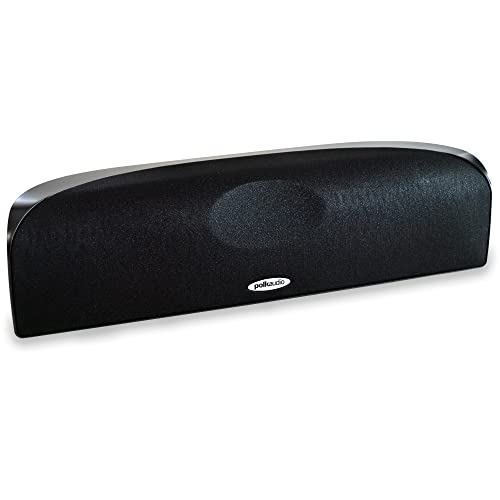
Design And Fit: The TL1 is explicitly made to match flat-panel TVs with a curved, high-gloss enclosure and compact footprint that minimizes interference with screen placement.
Driver Layout And Imaging: Features Polk’s Time Lens technology to align drivers for improved imaging and staging. It includes a 1/2″ silk dome tweeter and dual 2.5″ Dynamic Balance mids/woofers for focused center-channel reproduction.
Use Case: Suited to users who prioritize crisp dialogue and a clean aesthetic for compact living rooms or media consoles with limited depth.
Saiyin Slim Center Channel Speaker 17 Inch

Design And Fit: A compact 17″ single-unit center channel designed for desktops, shelf, or wall mounting. Its slim depth makes it suitable where space is restricted.
Drivers And Features: Dual 3.5″ woofers plus a horn tweeter are specified to enhance vocal clarity and high-frequency detail. Requires a separate amplifier or receiver for operation.
Flexibility: Wall-mountable and portable for flexible placement. The specification emphasizes intelligible dialogue and a compact footprint for small rooms or multimedia desks.
Yamaha NS-C210BL Center Channel Speaker

Design And Fit: The NS-C210 is a classic 2-way bass-reflex center channel with a relatively slim profile suitable for placement under TVs and on AV stands.
Drivers And Response: Uses light aluminum cone woofers for fast transient response and a dedicated tweeter to reproduce dialogue and high frequencies accurately. The design aims to reproduce dynamic HD sources faithfully.
System Integration: Includes speaker cable and is often paired with Yamaha AV receivers for timbre matching and consistent sound across front channels.
Buying Guide: Choosing The Thinnest Center Channel Speaker
Speaker Depth And TV Clearance: Measure the clearance under your TV and shelf depth before buying. Slim center channels vary in depth; choose one that won’t touch the TV bezel or IR sensors.
Dialogue Clarity And Driver Configuration: Center channels prioritize midrange and vocal intelligibility. Look for dedicated tweeters plus mid/woofers arranged to focus on the midband. Technologies like Time Lens or dynamically balanced drivers help imaging.
Bass Output And Porting: Slim cabinets often have limited internal volume for deep bass. Ported designs or Power Port tech can enhance perceived bass, but very low frequencies may still require a subwoofer.
Impedance And Amplifier Matching: Check 4- or 8-ohm compatibility and your receiver’s power ratings. Slim center channels have varying sensitivity; ensure your AVR or amp can drive the speaker cleanly.
Mounting Options And Placement: Low-profile models may offer wall-mount or table-top placement. Confirm mounting hardware compatibility and whether you need a dedicated shelf or isolation pads for optimal performance.
Size Versus Performance Tradeoffs: Thinner models favor fit and aesthetics; wider or deeper units can offer more drivers and higher output. Decide whether space-saving or maximum center-channel headroom is the priority.
Surround Format Compatibility: If you plan to use Atmos or advanced surround formats, ensure the speaker and your AVR support the necessary configurations and timbre matching with left/right fronts.
Construction And Finish: Slim speakers come with different cabinet materials and finishes. Rigid enclosures reduce coloration; finishes should match your room but shouldn’t limit placement due to weight or mounting requirements.
Integration With Existing Speakers: For the most coherent soundstage, match brand/series when possible or choose speakers with similar voicing and dispersion characteristics to your front left/right speakers.
Practical Tips: If deep bass and maximum output are priorities, plan on adding a subwoofer. For constrained depths, test placement in-store or check user images to confirm fit under your specific TV model.