
Best True Wireless in Ear Monitors for Live Performance and Studio Use
Clear, reliable wireless in-ear monitoring is essential for performers and audio engineers. This guide highlights five top options across 2.4 GHz and 5.8 GHz bands, focusing on stability, latency, battery life, and ease of use. Suitable buyers include live performers needing stage freedom, studio musicians seeking precise mixes, and worship teams requiring reliable multi-channel listening. The table below summarizes the featured models to compare at a glance.
| Product | Band | Best For | Key Benefit |
|---|---|---|---|
| Xvive U45 | 5.8 GHz | Band-ready performers | Crystal-clear sound and long-range reliability |
| LEKATO MS-02 | 2.4 GHz | Small to mid-size stages | Upgraded low latency, one TX to many RX |
| LEKATO MS-20 | 2.4 GHz | Pro long rehearsals | Huge battery and OTG flexibility |
| AOKEO AK-680 | 5.8 GHz | Professional stage monitoring | Ultra-low latency with studio-grade sound |
| Xvive U45D | 5.8 GHz | Live and worship teams | True stereo with multiple monitoring modes |
Xvive U45 Wireless in-Ear Monitor System

The Xvive U45 is a 5.8 GHz true diversity wireless IEM system designed for studio work, band rehearsals, and live performances. It offers a solid RF connection over roughly 100 feet and features Channel Scan Mode to help you lock onto the best channel quickly. The system delivers a broad 20 Hz to 20 kHz frequency response and a high-resolution 24-bit/48 kHz audio path with an SNR around 110 dB, ensuring clear, detailed sound at various volume levels.
- Best for bands and stages needing stable 5.8 GHz operation and easy channel selection.
- Clear audio across the full audible range with strong interference resistance.
- Channel Scan Mode helps avoid interference with nearby wireless devices.
Best for: Musicians who want a straightforward, dependable wireless IEM system with simple channel management.
Caution: Channel scanning is receiver-driven; ensure transmitter channel matches after scanning to maintain a solid link.
JOYO Wireless In Ear Monitor System JW-07

The JOYO JW-07 uses a 2.4 GHz wireless link aimed at practice and live performance. It emphasizes low latency for real-time practice and monitoring, with frequency hopping to reduce interference. The setup is designed for beginners and intermediate players who want a cost-effective, immediate wireless solution.
- Best for beginners or practice-focused setups where quick pairing matters.
- Low latency helps with real-time practice and performance feedback.
- High anti-interference technology is useful in busy wireless environments.
Best for: Players starting out with wireless IEMs or those needing a budget-friendly, easy-to-pair option.
Caution: Audio depth and headroom may not match higher-end systems; consider as a practice-first solution or backup pair.
LEKATO MS-02 Wireless In-Ear Monitor System

The upgraded LEKATO MS-02 uses 2.4 GHz with ultra-low latency (<4.5 ms) and a 24-bit/48 kHz signal path for clean monitoring. It supports up to four receivers from one transmitter (One TX to Many RX) and offers long battery life with LED indicators for volume and battery levels. The compact, clip-on receivers make it easy to wear on stage.
- Best for small to mid-sized bands needing one-to-many distribution.
- Ultra-low latency improves timing accuracy for performers.
- Be mindful of environmental interference where 2.4 GHz bands are crowded.
Best for: Bands and rehearsals requiring multiple receivers from a single transmitter with reliable low latency.
Caution: 2.4 GHz can be more susceptible to Wi-Fi and Bluetooth interference in busy venues.
LEKATO MS-20 Wireless In-Ear Monitor System

LEKATO’s MS-20 system emphasizes long battery life and portability. It offers up to 30 hours of use with the charging case and a total capacity of 2000 mAh in the setup. It supports one-to-many connections and OTG audio input, enabling direct smartphone connectivity for playback or practice. The system is designed for performers who stage frequently and need endurance and portability.
- Best for performers who need extended battery life and easy charging on the go.
- OTG input allows direct smartphone connections for practice and playback.
- Consider the larger case needs for transport when traveling light is a priority.
Best for: Long show runs, bands on tour, or worship teams needing up-to-10 receiver support and mobile convenience.
Caution: OTG compatibility depends on device and setup; verify with your primary device before use in a live setting.
AOKEO AK-680 Wireless In-Ear Monitor System
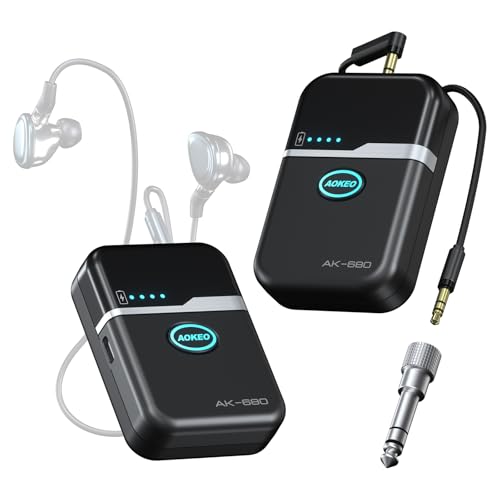
The AOKEO AK-680 uses 5.8 GHz for reduced interference and offers a stereo monitoring experience with auto-sync pairing. It is positioned for live stages, bands, and studio recording, delivering a balance of clean sound and reliable wireless transmission. The package includes versatile connectivity options for professional gear, helping minimize setup time in busy environments.
- Best for professional stage monitoring with clean 5.8 GHz transmission.
- Ultra-low latency and auto-sync pairing streamline setup and performance.
- Long-term reliability in crowded RF environments depends on proper channel management.
Best for: Musicians and engineers seeking professional-grade audio with reliable wireless stability on busy stages.
Caution: Ensure proper channel alignment between transmitter and receivers to avoid dropouts in RF-dense venues.
Buying Guide: How To Choose Your True Wireless IEM System
What frequency band suits your needs?
5.8 GHz systems typically offer strong short-range performance with less congestion than 2.4 GHz in dense venues. 2.4 GHz systems can be more affordable and offer wider compatibility but may encounter more interference in busy spaces. Consider your typical venue size and competing wireless devices when choosing.
How important is latency?
Latency directly affects timing with live performance. Look for systems advertising sub-5 ms latency for best alignment with your live playing and vocals. For practice and rehearsal, very low latency remains beneficial but is less critical than stage timing.
How many receivers or performers need monitoring?
One-to-one systems are straightforward for solo performers, while One TX to Many RX setups are ideal for bands or small ensembles. Verify how many receivers are supported and whether additional receivers can be added later without compromising performance.
Battery life and charging setup
Long battery life reduces mid-show changes and pack management. Systems with a charging case or multiple rechargeable units help maintain uptime during long events. Consider whether you need OTG connectivity for on-the-go device integration.
Compatibility and connectivity
Check if the transmitter and receivers support your preferred input formats (XLR, 1/4″ TRS, or USB-C). OTG support can be a valuable feature for direct phone or laptop use. Ensure the unit can pair quickly and re-pair reliably after power cycles.
Build, comfort, and wearability
Clips, ergonomics, and weight influence on-stage comfort during long performances. Secure, light receivers reduce fatigue and improve reliability in live settings.
FAQ
- Do 5.8 GHz systems work well in crowded venues? Yes, they often experience less interference than 2.4 GHz systems, but proper channel management remains essential to avoid conflicts with other wireless gear.
- What is considered a good latency for IEMs? Sub-5 ms latency is generally ideal for live performance, ensuring tight timing between the performer and the monitored mix.
- Can I use a single transmitter with multiple receivers? Many systems support One TX to Many RX configurations, enabling multi-performer monitoring. Confirm the maximum number of receivers supported.
- Is OTG input useful for IEM systems? OTG input can be handy for direct device playback and practice with smartphones or tablets, reducing extra cables in rehearsal spaces.
- What should I consider for battery life? Longer battery life reduces interruptions during performances. Look for kits with charging options or larger-capacity packs for touring or long gigs.
- Are there interference concerns with 2.4 GHz systems? Yes, 2.4 GHz can face interference from Wi-Fi, Bluetooth, and other devices in busy venues, so plan channel strategy accordingly.