Best TV With Media Player for 4K Streaming and Local Media
When shopping for a television experience that blends streaming, USB playback, and local media, a TV with a capable media player or a robust external media player can simplify your setup. This guide highlights five solid options that support 4K content, varied file formats, and easy connectivity. Each product is evaluated by its playback performance, file support, and ease of use, helping you decide whether to upgrade your TV’s built-in capabilities or pair a compact media player with any display.
Summary of chosen products
| Product | Brand | Key Perks | Media Formats | Connectivity |
|---|---|---|---|---|
| 4K HD Digital Media Player | fnetic | 4K playback, dual USB, optical output | HEVC H.265, MP4, MKV, more | HDMI, Optical |
| Micca 4K Ultra-HD Digital Media Player | Micca | Compact, great for multiple TVs, 4K capable | 4K/60Hz, MP4, MKV, MP3, JPG | HDMI, USB, microSD |
| 4K Ultra HD Media Player & HDD Enclosure 2-in-1 | JLZNLC | Auto playback and looping, sign-age ready | MKV, MP4, AVI, JPEG, music | HDMI, USB, SD |
| Roku Ultra | Roku | Advanced streaming with HDR and Atmos | 4K HDR10+, Dolby Vision, streaming apps | Wi‑Fi 6, Ethernet, Bluetooth |
| NVIDIA SHIELD Android TV Pro | NVIDIA | Top-tier performance, AI upscaling, gaming | 4K HDR, Wide format support | Wi‑Fi, Bluetooth, USB |
Below are five in-depth sections for each product, with direct access to purchase pages and visuals to help you compare at a glance.
fnetic 4K HD Digital Media Player
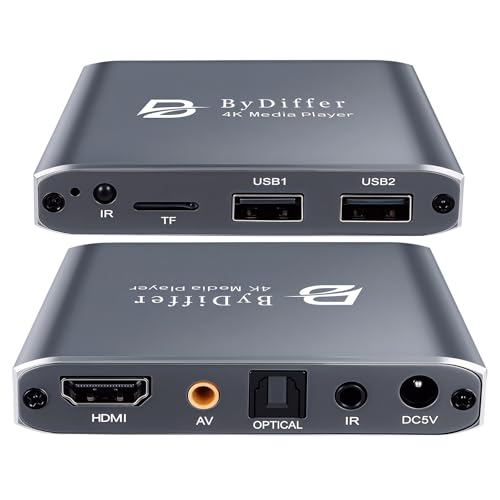
The fnetic media player enables 4K playback from USB drives or microSD cards on any TV, monitor, or projector via HDMI. It also provides Optical output for surround-sound setups up to 7.1 channels. The device supports advanced H.265/HEVC decoding, delivering smooth 4K at 30Hz with data rates up to 200 Mbps. It includes two USB 2.0 ports for connecting multiple devices, though only one drive can be read at a time. Compatible file formats include FAT32, exFAT, and NTFS (MAC-formatted drives are not supported).
Micca 4K Ultra-HD Digital Media Player

The Micca 4K unit enhances any TV by enabling playback of videos, music, and photo slideshows from USB or MicroSD. It supports 4K up to 4096×2304 at 30fps via HDMI, delivering sharp digital audio and video. It also offers a composite AV output for older TVs or stereo systems. The player accepts USB drives and microSD cards up to 8TB and 1TB, respectively, with FAT/FAT32, exFAT, and NTFS file systems. Wireless remotes can provide convenient, non-line-of-sight control.
4K Ultra HD Media Player & HDD Enclosure 2-in-1

This 2-in-1 device combines a 4K media player with a HDD enclosure, ideal for digital signage, lobby displays, and in-store marketing. It features automatic playback with looping and resume capabilities, plus configurable video output rotation (90/180/270 degrees). Supported formats include MKV, MP4/M4V, AVI, MOV, and more, along with SRT and PGS subtitles and multiple audio formats. It supports 2″, 2.5″, and 3″ SATA drives, and includes USB/SD card expansion for flexible storage and playback options.
Roku Ultra

Roku Ultra offers ultra-fast streaming with a user interface that opens apps quickly and supports 4K HDR10+ and Dolby Vision picture quality, along with immersive Dolby Atmos audio. The included Voice Remote Pro features backlit buttons, hands-free voice controls, and a remote finder. The device supports robust wireless connectivity and offers Ethernet options, making it a strong choice for homes seeking a dedicated streaming box with optional local content support via apps and screen mirroring.
NVIDIA SHIELD Android TV Pro

The NVIDIA SHIELD Android TV Pro stands out for high-end performance, AI-powered upscaling, and access to GeForce NOW cloud gaming. It runs Android TV with Google Assistant built-in, supports Dolby Vision and Atmos, and offers 2x USB 3.0 ports for external storage and peripherals. With Plex Server built-in and 16 GB storage plus 3 GB RAM, it handles media playback and streaming demands, while Chromecast 4K is built-in for seamless casting from mobile devices and apps across the home network.
Buying Guide: Key purchase considerations
When choosing a TV with media player capabilities or a standalone media player, consider your viewing habits, existing equipment, and preferred content sources. Here are essential factors:
- Resolution and format support: Look for 4K (or higher) playback, support for H.265/HEVC, and compatibility with common formats like MKV, MP4, AVI, and JPEG. If you plan to use older TVs, ensure analog outputs or AV compatibility.
- File source and storage: Decide between USB, microSD, external hard drives, or network shares. Dual USB ports are convenient, but confirm read/write compatibility and drive size limits (e.g., up to 8TB or 1TB microSD).
- Video and audio outputs: HDMI is standard, but Optical or analog outputs matter for certain sound systems. If you use a soundbar or AVR, ensure channel support (2.0/2.1, 5.1, 7.1).
- Smart features and apps: If you rely on streaming apps, prioritize devices with broad app catalogs, reliable firmware updates, and a responsive user interface. AI upscaling and gaming capabilities add value for some users.
- Ease of setup and control: Consider remotes with voice control, backlighting, or smartphone integration. Compatibility with wireless remotes or air mice can simplify use in shared spaces.
- Future-proofing: A device with broad codec support, USB 3.0, and robust Wi-Fi 6 or Ethernet options provides longer relevance as media formats evolve.
Contextual comparisons: If you primarily stream content from apps, a streaming-focused box like Roku Ultra or NVIDIA SHIELD offers strong app ecosystems. If your goal is local media playback from USB drives or NAS, models with multiple USB ports and wide format support—such as the fnetic, Micca, and JLZNLC options—tend to better handle diverse file types and signage tasks.