
Find the right wall mount to secure and position your speakers for optimal sound. Below is a concise comparison table of the selected mounts to help you scan key features quickly.
| Product | Max Load | Adjustability | Speaker Type |
|---|---|---|---|
| Howonder BS-218pro (2 Pack) | 30 lbs | Tilt 120°, Swivel 180° | Small/Bookshelf |
| Mount-It! MI-SB37 (Pair) | 55 lbs | Full Motion, Side Clamp | Medium/Large Bookshelf |
| Suptek Dual Mounts (2 Pack) | 55 lbs | Tilt 7.5°, Swivel 45° | Bookshelf/Studio |
| FDM Side Clamping Pair | 66 lbs | Swivel 180°, Tilt 10° | Large Bookshelf/Center |
| Aiweiwa Rear Speaker Shelves (Pair) | 33 lbs | Adjustable Depth | Satellite/Small Bookshelf |
Howonder BS-218pro Universal Speaker Wall Mount (2 Pack)

Overview: The Howonder BS-218pro is a compact pair of mounts for small bookshelf and satellite speakers. Construction uses die-cast aluminum and supports up to 30 lbs per mount.
- Key Features: New screw fittings for concrete, brick, drywall and wood; heavy-duty die-cast aluminum; up to 120° tilt and 180° swivel for precise aiming.
- Best For: Small to medium bookshelf speakers from brands like Bose, JBL, KEF and Sony where compact, multi-angle positioning is needed.
- Notes: Two-pack provides left/right placement; verify speaker mounting points and weight before installation.
Mount-It! Bookshelf Speaker Wall Mount Pair (MI-SB37)
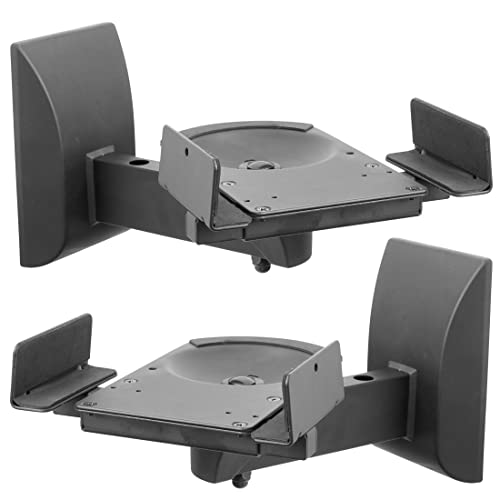
Overview: Mount-It! supplies a pair of side-clamping wall mounts engineered for medium to large bookshelf and studio speakers with a strong 55 lbs capacity each.
- Key Features: Side clamp design with cable management, solid steel construction, and allowance for speaker widths from 5.38″ to 11.13″.
- Best For: Heavier bookshelf or surround speakers from Yamaha, Klipsch, Polk, Sony and others where a stable clamp is preferred.
- Notes: Use stud or suitable anchor hardware for rated load; measure speaker width and depth before purchase.
Suptek Speaker Wall Mounts – Dual Stands (2 Pack)

Overview: Suptek’s dual speaker mounts aim at medium to large bookshelf and studio monitors. The set supports up to 55 lbs per mount and provides swivel and tilt adjustments.
- Key Features: Adjustable tilt (~7.5°), swivel (45°), sleek black finish, and independent clamps with fine-threaded screws to fit various cabinet sizes.
- Best For: Studio monitors or heavier bookshelf speakers that need modest tilt and swivel for surround setups.
- Notes: Confirm clamp compatibility with cabinet shape; hardware for wall types may vary by installation surface.
FDM Universal Side Clamping Bookshelf Speaker Mount Pair

Overview: FDM’s side clamping mounts are built for heavy duty performance with a high max load of 66 lbs and 180° swivel plus 10° tilt for flexible aiming.
- Key Features: Mounts designed for studs, concrete or brick/stone; max capacity 66 lbs; fits speakers with widths approximately 5.5″–11.1″.
- Best For: Large bookshelf or center channel speakers that need robust support and some directional adjustment.
- Notes: Depth and bottom size limits apply; ensure secure anchoring to achieve maximum rated capacity.
Aiweiwa Universal Rear Speaker Shelves (Pair)

Overview: These floating rear speaker shelves combine wood and metal to provide an adjustable depth shelf for many satellite and small bookshelf speakers with a 33 lbs capacity.
- Key Features: Curved-edge wooden shelf design for safety, adjustable depth from 5.3″–6.6″, and compatibility notes for many brand satellite models.
- Best For: Satellite speakers and compact bookshelf units such as small Bose, Vizio, JBL or Roku-compatible models where a discreet shelf is preferred.
- Notes: Shelf style limits tilt/swivel; choose when visual concealment and a stable platform are priorities.
Buying Guide: How To Choose A Universal Speaker Wall Mount
Load Capacity And Safety: Match the mount’s maximum load to your speaker’s weight plus any cables or adapters. For safety, choose a mount rated above the speaker’s weight.
Mount Type: Side-Clamp Shelves: Offer strong lateral support for heavier speakers. Fixed/Plate Mounts: Work well for speakers with keyhole/threaded inserts. Floating Shelves: Best for compact satellites and aesthetic installations.
Adjustability: Decide how much tilt and swivel you need. For precise imaging, mounts with wide tilt (up/down) and swivel (left/right) ranges are ideal. Limited tilt shelves may be sufficient for rear surround speakers.
Wall Material And Hardware: Check included hardware compatibility: some kits include anchors for concrete/brick/stud while others are intended for solid walls only. Use appropriate anchors for drywall or plaster—stud mounting is recommended for heavy loads.
Speaker Dimensions & Mounting Points: Measure speaker width, depth and the location of mounting holes or threaded inserts. Side-clamp mounts require specific width ranges; keyhole mounts require compatible inserts.
Installation And Cable Management: Look for mounts with cable routing options or covers to keep runs tidy. Consider whether you need removable mounts for servicing or tool-free adjustment.
Room Acoustics & Placement: Plan placement relative to listening position and room reflections. Higher tilt helps aim sound down to seated listeners; swivel helps compensate for asymmetric room layouts.
Durability And Finish: Steel or die-cast aluminum frames offer long-term rigidity. Finish options (black, white, wood) can affect visual integration with décor.
Versatility And Future Needs: If you might change speakers, choose a universal mount with broad width and weight ranges or modular clamps that adapt to different cabinets.
Comparison Perspectives: Compare capacity vs. adjustability: heavier-duty mounts often sacrifice maximum tilt; shelf mounts provide a platform but limited angling; clamp mounts offer rigidity and reasonable angle control. Verify manufacturer guidance on wall types and included fasteners to avoid surprises at install time.