
Best USB Audio Input Devices for Easy Digital Capture
Whether you’re digitizing old tapes, streaming live, or recording high-quality audio on a PC or Mac, a USB audio input device can simplify the process. This guide highlights five solid options that cover a range of needs—from simple plug-and-play adapters to multi-input interfaces. Best for casual listeners and hobbyists, better for podcasters and streamers, choose this if you want straightforward setup and accessible software. Below is a quick summary table of the recommended products and their key strengths.
| Product | Best For | Key Feature | Notes |
|---|---|---|---|
| ClearClick Audio to USB 2.0 Second Gen | Casual recording and streaming | 3.5mm and RCA capture; USB-C plug and play | Includes editing software |
| Cubilux CB5 USB Audio Interface | Multi-input setups | 5-in-1 hub with line-in, mic inputs | Supports multi-track recording |
| MOSWAG USB to 3.5mm Jack Adapter | Budget, portable listening | USB sound card with DAC | Supports 16-bit/48kHz audio |
| SABRENT USB-C to 3.5mm Audio Adapter AU-UCMA | USB-C laptops and tablets | 24-bit/96kHz audio; separate mic and headphone jacks | Mono mic input |
| UGREEN USB Sound Card Adapter | Enhancing existing devices | High-resolution DAC; plug-and-play | No drivers required |
ClearClick USB Audio to USB 2.0 Second Gen

Best for: Home studios, hobbyists who need simple capture from 3.5mm or RCA sources. This device supports both a 3.5mm aux input and RCA, making it suitable for converting cassette players, turntables, CD players, or instruments into digital formats. It uses a USB-C plug-and-play interface with a full-size USB-A adapter included for compatibility with older computers. It comes with audio recording and editing software that saves to WAV or MP3 formats. Caution: The device requires USB-C power for some configurations, and software limitations depend on PC or Mac compatibility.
Cubilux CB5 USB Audio Interface

Best for: Small studios or podcasters who need multiple inputs. The CB5 provides 5-in-1 functionality—two mics, one line-in, one line-out, and a headphone jack. It supports multi-track recording by assigning device names to each interface. It offers up to 96 KHz/24-bit quality. Caution: The line-out and output jack cannot be used simultaneously, so plan your monitoring setup accordingly.
MOSWAG USB to 3.5mm Jack Audio Adapter

Best for: Budget-conscious users who need a simple USB sound card with a DAC for 3.5mm audio. It supports 16-bit/48kHz output with noise reduction for clearer sound. Note: The 3.5mm microphone jack does not accommodate TS or TRS connectors, which can limit some microphone setups. Compatible with Windows, Mac, Linux, and some consoles and devices.
SABRENT USB-C to 3.5mm Audio Adapter AU-UCMA

Best for: USB-C laptops and tablets needing a higher-quality USB sound card. It supports two separate jacks—stereo headphone output and a mono microphone input—with 24-bit/96kHz performance. Caution: The microphone input is mono, which may not suit stereo mics or stereo line sources. The adapter is not compatible with USB-A ports without an adapter.
UGREEN USB Sound Card Adapter
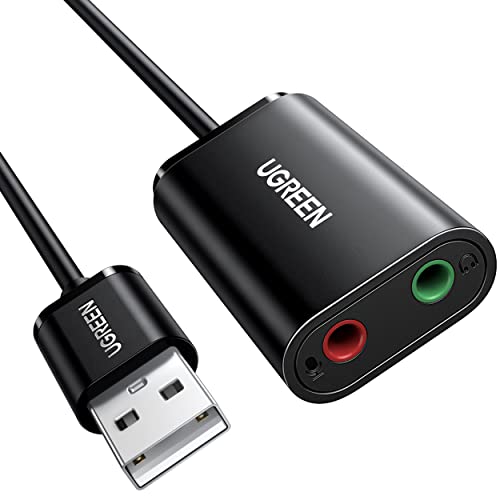
Best for: Users seeking a plug-and-play upgrade to laptop or desktop sound with minimal setup. The device features a high-resolution DAC and noise reduction up to 16-bit/48kHz. Caution: While PC and Mac compatible, some audio software may require driver updates for full functionality on certain operating systems.
Buying Guide
What to consider when choosing a USB audio input device
- Input types: Determine whether you need a single 3.5mm input, RCA, or multiple inputs for microphones and instruments.
- Sampling rate and bit depth: Look for 24-bit/96kHz for higher fidelity; 16-bit/48kHz is adequate for casual use.
- Bus power vs. external power: USB-C plug-and-play devices often draw power from the computer; consider external power if needed for stability.
- Monitoring options: Headphone jacks and line-out help you monitor as you record or stream.
- Software and compatibility: Check whether bundled software suits your workflow and whether it works with your OS.
- Portability and form factor: Smaller adapters are great for travel, while multi-input interfaces suit a fixed setup.
Choosing by use case
- Casual digitization and streaming: Look for 3.5mm/aux plus RCA capture and simple USB-C plug-and-play.
- Multi-source recording: A device with multiple inputs and line-in options is preferable.
- USB-C device compatibility: For newer laptops, prefer USB-C designed interfaces with clear port labeling.
- Budget considerations: Budget models offer basic capture and playback; higher-end models add multi-channel recording and better DACs.
Quick setup tips
- Connect the device to your computer using the recommended USB cable or adapter.
- Plug your microphone, instrument, or audio source into the correct input jack(s).
- Open your recording or streaming software and select the USB device as the input and output source.
- Test levels before recording to avoid clipping or distortion.
FAQ
- What is the main difference between USB audio adapters and dedicated audio interfaces?
USB adapters are typically simpler and focus on basic input/output, while dedicated interfaces offer more inputs, better preamps, and higher fidelity for multi-source setups. - Do I need drivers for these devices?
Most plug-and-play models do not require drivers, but some may benefit from driver updates or companion software for optimal performance on certain systems. - Can these devices improve my computer audio for gaming or video calls?
Yes. They can improve microphone input quality and overall sound clarity, especially when the built-in audio is limited. - Is mono or stereo input better for recording?
Mono input is sufficient for single-channel mics or certain instruments; stereo inputs are preferred for stereo mics and dual-channel sources. - Can I digitize cassette tapes with these devices?
Yes, several devices support analog-to-digital conversion from cassette players via 3.5mm or RCA inputs. - Do these devices work with both Windows and macOS?
Most listed devices are compatible with Windows and macOS, with some features dependent on OS permissions and software ecosystems.