
Best USB Audio Interfaces for Bass: Clear, Studio-Grade Sound on a Budget
Looking for a USB audio interface that delivers crisp bass recordings and reliable performance? This guide highlights five solid options that balance preamp quality, low latency, and ease of use. Each pick is suited to different buyers—from home producers and podcasters to live streamers and mobile musicians. Below, find a quick product summary and then in-depth sections to help you decide which interface best fits your bass-tracking setup.
Summary of chosen products
| Product | Best For | Why It Stands Out |
|---|---|---|
| Focusrite Scarlett Solo 3rd Gen | Home studios and solo musicians | Excellent mic and instrument preamps; Air mode adds brightness without harshness |
| PIYONE Audio Interface 2×2 | Budget-conscious producers | Plug-and-play USB-C, 24-bit/192kHz fidelity, stylish, compact design |
| M-Audio M-Track Duo | Podcasting and singing with gear variety | Two combo inputs, versatile monitoring, easy zero-latency monitoring |
| KYXAIN Guitar Audio Interface Pocket | Mobile recording and live streaming | Type-C and Lightning compatibility, compact, low-latency |
| Focusrite Scarlett Solo 4th Gen | Portable studio on the go | New Air mode, high dynamic range, proven Scarlett workflow |
Focusrite Scarlett Solo 3rd Gen USB-C Audio Interface

Best for solo bassists and vocalists who need clean preamps and reliable conversion. The Scarlett Solo 3rd Gen offers high-headroom instrument inputs and an Air mode to add brightness to acoustic tones, which can help bass tracks sit more clearly in a mix. Its 24-bit/192kHz converters ensure professional-sounding recordings. The two channels are ideal for one instrument plus a vocal or direct bass mic setup. A caution: the A/D/A-D conversion is strong, but you’ll want to pair it with a good DI or cabinet mic if your bass relies on amplifiers for tone.
PIYONE Audio Interface 2×2

Best for Mac/PC users who want plug-and-play simplicity with high fidelity. This 2-channel interface provides 24-bit/192kHz fidelity and USB-C connectivity, making it easy to capture bass tones with clarity. It’s well-suited for home studios and mobile setups where you want low latency and minimal driver concerns. A limitation: the description emphasizes visuals and LED rings, but you should verify whether the physical controls match your preferred workflow for bass DI and amp emulation setups.
M-AUDIO M-Track Duo USB Audio Interface
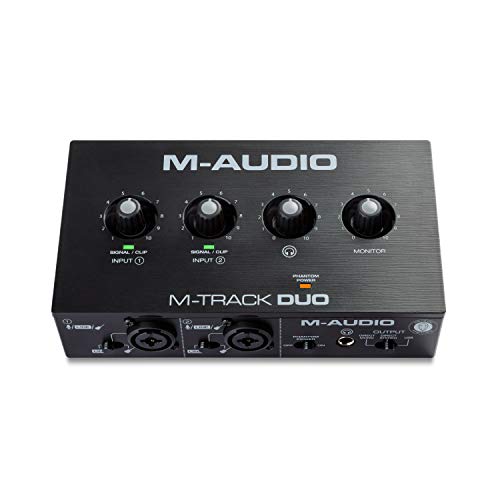
Best for creators who need flexible monitoring and multiple input options. The M-Audio M-Track Duo supports two combo inputs with phantom power, plus complete monitoring controls and a dedicated headphone output. It’s ideal if you plan to record bass alongside vocals or other instruments and want straightforward latency-free monitoring. A caveat: 48kHz is standard here; if you require higher sample rates for critical mastering, check whether your project benefits from higher fidelity interfaces.
KYXAIN Guitar Audio Interface Pocket

Best for mobile creators and live streamers who value portability. The KYXAIN pocket interface supports Type-C and Lightning, allowing quick setup with iPad, iPhone, Android, or laptops. It’s designed for live streaming with low latency and straightforward connections to guitars or basses. A potential limitation: it emphasizes live streaming rather than studio multi-track work, so use it when your setup prioritizes mobility over multi-track depth.
Focusrite Scarlett Solo 4th Gen USB-C Audio Interface

Best for the continuing Focusrite ecosystem with improved Air mode and dynamic range. The Solo 4th Gen maintains the classic solo-input design while upgrading to a larger dynamic range and better Air mode for vocal and guitar tones. It’s a strong choice for bassists who work in a multi-song workflow and need dependable, studio-grade sound when recording at home or on the road. Caution: single-in/one-in solutions can be limiting if you frequently record multiple input sources simultaneously.
Buying Guide
What to consider when choosing a USB audio interface for bass:
- Input/output needs: Do you primarily record bass with a direct instrument input, or will you mic a bass amp or cabinet? Look for at least one instrument input and a way to monitor with low latency.
- Conversion quality and headroom: Higher bit depth and sample rate (24-bit/192kHz) provide more headroom for dynamic bass passages. Consider interfaces with high signal-to-noise ratios and robust preamps.
- Latency and monitoring: Zero-latency monitoring and direct monitoring options save timing when tracking bass lines along with other tracks.
- Mobility and workflow: If you record on the go or with mobile devices, USB-C or Lightning-compatible interfaces simplify setup.
- Driver and compatibility: Class-compliant devices offer plug-and-play operation with fewer driver concerns on various OS versions.
- Brand ecosystem and future expandability: Interfaces from established brands often integrate smoothly with other gear (DAWs, virtual amps, and plug-ins).
Key comparison notes
- Best overall studio-like sound: Focusrite Scarlett Solo 3rd Gen or 4th Gen, thanks to proven preamps and Air mode.
- Best value and portability: PIYONE and KYXAIN offer compact designs with essential features for mobile recording.
- Best for multi-input flexibility: M-Audio M-Track Duo provides two inputs and flexible monitoring for larger mini-studios or podcasts.
FAQ
- Do I need 24-bit/192kHz for bass recording?
Answer: Not always, but higher resolution allows more accurate capture of dynamic bass playing and better headroom during mixing. - Is USB-C essential for modern interfaces?
Answer: USB-C offers faster data transfer and broader compatibility with newer laptops and mobile devices, but USB-A models can still work well with adapters. - Should I pick a two-channel or multi-channel interface for bass?
Answer: For solo bass work, a two-channel interface is usually sufficient; multi-channel is beneficial if you plan multi-track recordings or mic’ing a bass amp. - What is “Air” mode in Focusrite interfaces?
Answer: Air mode enhances the brightness and presence of recorded vocals or guitar/bass to sit better in a mix, emulating brighter vintage preamps. - Is latency a concern for bass players?
Answer: Yes, especially for performance and overdubs. Choose interfaces with good drivers and direct monitoring to minimize latency. - Can I use these interfaces with iPad or Android tablets?
Answer: Many support USB-C or Lightning adapters for iPad; check each model’s compatibility and whether you need a powered hub for bus power.