
Best Budget USB Audio Interfaces for Clear, Studio-Quality Recording
Answering the question for aspiring podcasters, streamers, and home-studio musicians: these budget USB audio interfaces deliver clean sound, reliable drivers, and practical features without breaking the bank. The top picks cater to different needs—from solo vocal recording to instrument tracking and streaming. Each choice is evaluated for who benefits most, including portability, ease of use, and potential limitations.
Summary of chosen products:
| Product | Best For | Why Pick It |
|---|---|---|
| M-Audio M-Track Duo | Podcasters and guitarists | Two inputs, direct monitoring, solid mid-range preamps |
| Focusrite Scarlett Solo 3rd Gen | Vocalists and solo artists | Premium preamps, Air mode, reliable converters |
| MAONO PS22 Lite | Streaming and voice work | 24-bit/192kHz, strong mic options, budget-friendly |
| XTUGA Q-12 | Beginners and mobile setups | Low latency, no external power needed, easy setup |
| PreSonus AudioBox 96 | Home studios and multi-purpose use | Two mics, instrument inputs, MIDI I/O |
M-AUDIO M-Track Duo USB Audio Interface

The M-Track Duo delivers 48kHz recording resolution with two combo XLR/Line/Instrument inputs and phantom power. It supports podcasting, live streaming, and general recording with simple USB connectivity for Mac or PC. Its 1/4″ headphone output and stereo outputs support flexible monitoring. The USB/Direct switch enables zero-latency monitoring, making it a practical choice for multi-gear setups. Best for home studios needing two input channels at a budget-friendly price.
Who it’s best for: solo podcasters or small-duo recording setups that need reliable two-input capability without extra gear. Why chosen: it balances features and price while offering direct monitoring for cleaner takes. Caution: limited if you require more than two inputs or high-end preamps.
Focusrite Scarlett Solo 3rd Gen USB-C Audio Interface

Focusrite’s Scarlett Solo 3rd Gen emphasizes studio-grade preamps and an Air mode that adds brightness to acoustic recordings. It features two high-headroom inputs—one for mic, one for instrument—plus Gain Halos to monitor input levels. With 24-bit/192kHz converters, it delivers clean, professional-sounding tracks for vocals and guitars. Best for solo artists seeking reliable, warm captures with intuitive controls.
Who it’s best for: vocalists and guitar players who want a straightforward, high-quality workflow. Why chosen: excellent preamps and practical features. Caution: higher price relative to some ultra-budget models, and fewer inputs than 2-in models at times.
MAONO PS22 Lite USB Audio Interface

The MAONO PS22 Lite targets recording enthusiasts and streamers with 24-bit/192kHz resolution and a wide dynamic range of 106dB. It supports condenser and dynamic mics with up to 56 dB of preamp gain and 48V phantom power, and offers instrument input for guitar work. Best for creators who need strong, clear sound at a budget-friendly price. Caution: MAONO’s build and driver support may vary by system; verify compatibility for niche setups.
Who it’s best for: podcasters and streamers who want a clear, warm voice with flexible mic support. Why chosen: solid fidelity and features for the price. Caution: some users may want more advanced monitoring options or built-in effects, which this model does not emphasize.
USB C Audio Interface for Recording Music (Synido)

The Synido 2×2 interface supports 24-bit/48kHz, with three monitoring modes to fit different tasks: stereo for accurate recording, mix for live broadcasting, and USB for computer-only monitoring. It emphasizes user-friendly design with independent controls and LED level indicators. Best for on-the-go creators who need flexible monitoring and easy switching. Caution: limited official information on driver support; ensure OS compatibility before purchase.
Who it’s best for: streamers and mobile producers who need quick setup and clear monitoring options. Why chosen: three monitoring modes provide versatile workflows. Caution: some users may outgrow it as their project complexity grows.
PIYONE Audio Interface 2X2 (Q28)

The PIYONE interface provides USB-C connectivity, 24-bit/192kHz fidelity, and a two-channel design with XLR/TRS combo input. It highlights plug-and-play and bus power, making it a practical choice for Mac, PC, or mobile work. Best for users who want a stylish, driver-free setup for immediate recording. Caution: visual design may not reflect the best build quality compared with premium models.
Who it’s best for: portable creators who value a clean, simple, driver-free setup. Why chosen: strong fidelity on a compact form. Caution: not the top choice for projects needing multiple inputs or MIDI I/O.
PreSonus AudioBox 96 25th Anniversary USB Interface
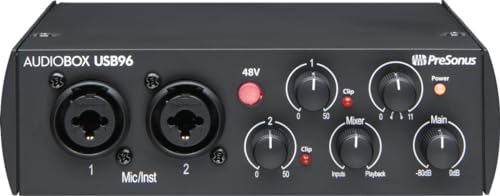
The AudioBox 96 offers a valuable two-channel design with two Class-A mic preamps, instrument inputs, and MIDI I/O. It’s positioned as a portable, value-packed solution for home studios and musicians who need reliable conversion and routing. Best for small projects that require integrated MIDI alongside audio inputs. Caution: features are balanced for budget use; higher-end users might prefer additional inputs or more advanced monitoring features.
Buying Guide
What to consider when choosing a budget USB audio interface
- Inputs and outputs: Do you need 2-in for vocals and guitar, or more? Two-input models are common for beginners, but future needs may require extra channels.
- Latency and monitoring: Direct or zero-latency monitoring helps during recording. Look for USB/Direct or dedicated monitoring controls.
- Preamps and gain: Higher-quality preamps provide cleaner signals at lower gain. Consider headroom for dynamic or loud sources.
- Connectivity: USB-C offers broad compatibility with modern devices. Check compatibility with your computer, tablet, or mobile setup.
- Phantom power: Necessary for many condenser mics. Ensure your chosen model provides 48V if you plan to use condensers.
- Compatibility and drivers: Some budget interfaces are plug-and-play, while others rely on drivers. Verify OS support and update policies.
- Portability: If you record on the go, smaller interfaces with bus power are advantageous.
- Future-proofing: If you expect needing MIDI, instrument inputs, or multi-track recording, choose models offering those features now.
FAQ
- What is a good budget USB audio interface for beginners?
Interfaces like the M-Track Duo or MAONO PS22 Lite provide two inputs, basic monitoring, and solid converters at a budget-friendly price.
- Do I need phantom power for all mics?
No. Only condenser mics typically require 48V phantom power; dynamic mics do not.
- Is latency a concern with budget interfaces?
Yes, but many budget models offer zero-latency monitoring via direct monitoring or USB/Direct switches.
- Can I use these interfaces with both Mac and Windows?
Most listed models are designed for cross-platform compatibility; check the product page for driver requirements and OS compatibility.
- Should I choose a 2-in interface or a multi-in option?
For solo work, 2-in often suffices. If you plan multi-track recording or future expansions, consider models with more inputs or MIDI I/O.